

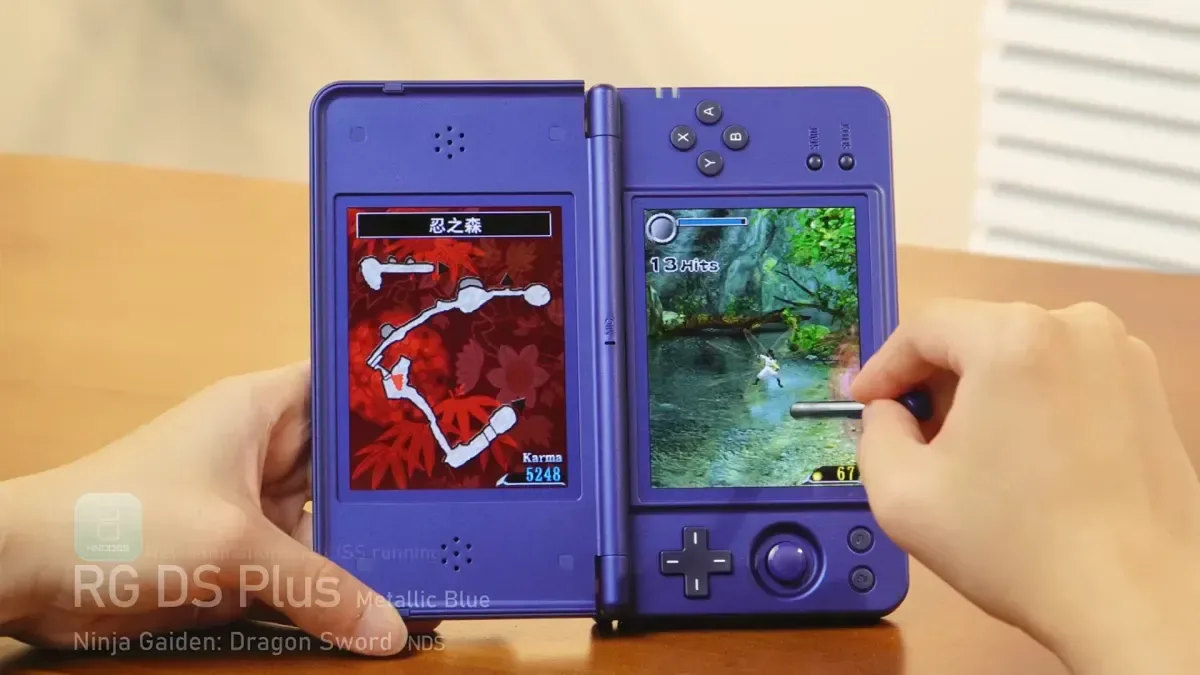
ANBERNIC has offered its clearest look yet at the newly revealed RG DS Plus, publishing a promotional gameplay video that runs for more than six minutes and demonstrates the portable's dual-screen design in action. The footage focuses heavily on Nintendo DS software and stylus interaction, while also showing emulation for other older systems, multiplayer through NetPlay, and streaming of Steam games.
The RG DS Plus is positioned as a Linux-based dual-screen handheld rather than an Android device, and that distinction could be important to what it can do at launch. Its most obvious purpose is recreating the layout needed for Nintendo DS games: two vertically arranged displays, controls around the lower half of the unit, and a stylus for games built around touch input. For players who have spent years adapting DS titles to single-screen handhelds, phones, or desktop display configurations, the prospect of a dedicated clamshell-like dual-display solution is immediately appealing.
There are still major unanswered questions. ANBERNIC has not formally confirmed full technical specifications, a price, or a release date. Rumours have suggested the RG DS Plus could use the same chipset as the original RG DS, include 1GB of RAM, and potentially arrive below $100. Those details remain unverified, so the new video is best viewed as a demonstration of the company's intended experience rather than final proof of retail performance.
A closer look at the RG DS Plus experience
The footage showcases a new Linux-focused emulator referred to as NNDDSS. The software appears designed specifically to make Nintendo DS emulation more practical on modest hardware, including a device with only 1GB of RAM if the reported specification is accurate. That focus makes sense: a dual-screen handheld does not simply need to run games adequately, but also needs to present the two displays in a useful arrangement while supporting touch-oriented interactions.
For useful background on this topic, read Dune: Awakening's Solo Mode Is Built for Survival Fans, Not a Last of Us-Style Campaign.
In the video, Nintendo DS gameplay appears fluid, with the stylus getting considerable attention. That is encouraging for games whose core mechanics rely on drawing, tapping, selecting menus, moving objects, solving puzzles, or managing interface-heavy systems. A physical stylus is not a universal replacement for original Nintendo DS hardware, but it is a much more natural option than relying entirely on analog controls or attempting touch input on a single conventional screen.
However, promotional footage cannot settle every performance question. Emulation results can vary substantially between individual games, emulator versions, settings, and final firmware. It remains unclear how demanding DS software will perform over long play sessions, how accurately touch input will translate across different genres, and whether features such as save states, screen layouts, scaling, fast-forwarding, or per-game settings will be robust in the shipping software.
Those are the areas where hands-on testing will matter most. The footage suggests the RG DS Plus has a promising starting point, but the real measure will come once reviewers and buyers can test a broad library rather than a curated selection chosen for a promotional presentation.
NNDDSS aims for a straightforward Linux interface
The NNDDSS interface seen in the video looks functional rather than elaborate. It appears to organize ROMs in a simple library, allowing users to navigate games without an especially flashy front end. For a budget-oriented handheld, that may be a sensible compromise. A polished interface is valuable, but stable behavior, sensible controls, quick booting, and dependable game compatibility are likely to matter more to the audience considering an inexpensive dual-screen device.
The video also illustrates how the second display may be handled when playing titles designed for just one screen. Rather than leaving an unused panel blank, the RG DS Plus can apparently show an image representing the relevant console. This gives the handheld a more intentional presentation and acknowledges that the device will be used for more than DS software.
That flexibility is significant because the video includes games associated with platforms such as the PSP and SEGA Mega Drive. A vertical dual-screen design is ideal for DS emulation, but it is less conventional for systems that were originally designed around a single landscape display. The ability to choose which screen is active could make the hardware more adaptable, even if some players may prefer a standard single-screen handheld for systems such as PSP.
ANBERNIC has also indicated that the second screen can be switched on or off through settings. Turning it off could help conserve battery life when users are playing software that has no reason to use both displays. Battery capacity, real-world endurance, display brightness, and the exact behavior of this power-saving option have not been detailed, but providing a choice is practical on a device that is likely to spend plenty of time running single-screen consoles.
More than Nintendo DS emulation
Although the dual displays naturally put Nintendo DS games at the center of the conversation, the RG DS Plus video is also intended to show broader ambitions. PSP and Mega Drive footage points to a handheld that could serve as a general retro gaming machine, not solely as a DS-focused device. For buyers with large mixed libraries, that broader support could increase the device's value considerably.
Still, broad support and ideal support are not always the same thing. A system can technically run a game while offering an awkward screen arrangement, imperfect aspect ratio, limited button mapping, or performance compromises. The RG DS Plus will need to prove that it balances its specialized dual-screen identity with the convenience expected from a general-purpose emulation handheld.
The video's Steam streaming demonstration broadens the potential use case further. Streaming a PC game from a Steam setup could let the handheld act as a portable companion for a home gaming computer, rather than requiring the game itself to run natively on the RG DS Plus. This feature is dependent on network conditions and the software setup behind it, so users should not treat it as equivalent to local PC gaming. But it could be useful for slower-paced games, experimentation, or playing away from the main monitor within a reliable local network.
Because the device is expected to use Linux, it should not be assumed that it will offer the general multitasking options associated with an Android handheld. For example, the inactive screen in a single-screen game may be used for a console image rather than a web browser, chat client, or separate app. That may sound restrictive, but it also reflects the likely goal: a focused, affordable retro device rather than a miniature tablet with gaming controls.
NetPlay could make the handheld more social
Another notable moment in the video is the inclusion of multiplayer via NetPlay. Networked retro play can be one of the more appealing modern additions to an emulation device, allowing players to connect for compatible multiplayer experiences without needing original hardware, cables, cartridges, or local setup.
As with the rest of the software presentation, the eventual details will determine how useful this feature becomes. It is not yet known which systems or emulators will support NetPlay on the RG DS Plus, how easy the connection process will be, whether it will be integrated cleanly into the user interface, or how reliably it will work across different networks. Even so, its appearance in the promotional material indicates that ANBERNIC wants the device to be seen as more than an offline ROM player.
For a dual-screen handheld in particular, multiplayer support could be an interesting differentiator. Nintendo DS games have a deep history of local and online multiplayer, and a device that can make some form of connected retro play approachable may find an audience beyond collectors who primarily play alone.
The value question remains unresolved
The central unknown around the RG DS Plus is still its price-to-performance balance. Reports of a possible sub-$100 price have generated attention because dedicated dual-screen emulation hardware has often been either expensive, difficult to obtain, or dependent on compromises. If ANBERNIC can deliver credible DS emulation, usable stylus input, support for other classic systems, streaming options, and respectable battery management at that level, the handheld could occupy a compelling niche.
But that hypothetical price is not official, and 1GB of RAM, if confirmed, would leave little room for error in software optimization. NNDDSS may have been built to address that limitation directly, yet the final quality of the emulator, firmware updates, touchscreen responsiveness, hinge construction, controls, displays, and standby behavior will all influence whether the hardware meets the promise shown in the video.
For now, the new footage makes the RG DS Plus easier to understand. It is a purpose-built Linux handheld that wants to restore the practical two-screen format of Nintendo DS gaming while retaining the wider emulation appeal expected from ANBERNIC hardware. The stylus demonstrations, screen-toggle option, NetPlay footage, and Steam streaming clip all point toward a device with ambitions beyond a novelty form factor.
What remains to be seen is whether those features will translate from controlled video footage into a polished everyday handheld. Until ANBERNIC confirms pricing, specifications, release timing, and the full software feature set, the RG DS Plus remains an intriguing prospect rather than a finished recommendation. Even so, the latest gameplay reveal gives retro handheld fans more reason to watch this dual-screen project closely.
Community
Discussion
Start the conversation.
No comments have been posted yet.