

Portable gaming has made it much easier to take a full library on the road, but battery life is still the limiting factor. A demanding PC game can drain a handheld quickly, and even a long train ride can become inconvenient when a console, phone, earbuds, and laptop all need a turn at the same outlet. Anker's 25,000mAh 165W laptop power bank is designed for exactly that kind of multi-device situation, and it is currently listed for $91, down from $135.
That is a 32% reduction, and the price was described as the lowest seen on Amazon over the previous 90 days at the time it was checked. As with most retailer promotions, availability and pricing can change, so prospective buyers should confirm the current listing before placing an order.
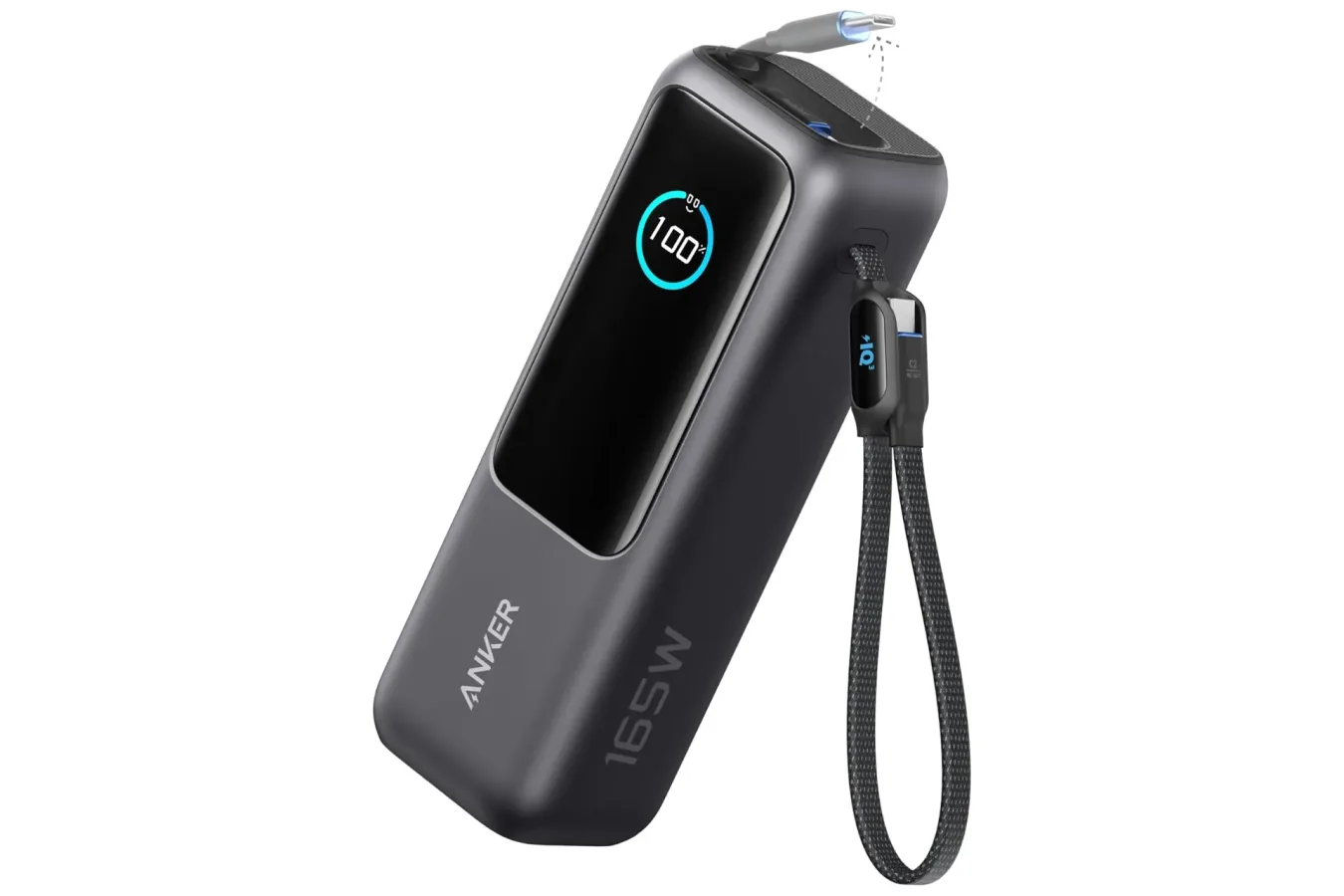
The key appeal is not simply its 25,000mAh capacity. This is a high-output model built to provide considerably more power than the compact phone-focused batteries commonly carried in a pocket. It combines up to 165W of shared output, two built-in USB-C cables, a dedicated USB-C port, and a USB-A port. In practical terms, that means a player can potentially keep a handheld charging during a session while also topping up a phone and other accessories.
Built for handhelds that need more than a basic phone charger
Many smaller power banks are intended primarily for phones and may offer around 20W to 30W of output. Those capacities can be helpful between gaming sessions, but they are not always enough to make a meaningful difference while a high-performance handheld is actively running a demanding game. In some cases, a low-output battery may only slow the rate at which the handheld loses charge under a heavy load.
For useful background on this topic, read Meta Quest 3S 128GB Bundle Drops to $297 With Golf+ Included.
Anker's 25,000mAh model is positioned as a more substantial option. Each USB-C output can deliver up to 100W, while the unit supports up to 165W shared output across connected devices. The exact charging behavior will naturally depend on the device, cable, battery level, power profile, and how many products are connected at once. Still, the higher ceiling makes this a more appropriate travel companion for power-hungry handheld PCs and compatible laptops than a standard phone battery.
For players using a handheld gaming PC, that extra output can matter on a commute, in an airport, or during a long stay away from a wall socket. It may also be useful for Nintendo Switch 2 owners, particularly when a console and phone both need attention during travel. A power bank cannot eliminate the internal battery limitations of the hardware itself, but a capable external battery can extend the amount of time spent playing before an outlet becomes necessary.
The 25,000mAh rating also suggests that this is intended for longer trips rather than emergency phone charging. Capacity in real-world use varies because of conversion losses and because every device charges differently, so it is not possible to promise a specific number of full recharges for every handheld. Nevertheless, it is a much larger reserve than the 10,000mAh or 15,000mAh packs that are common for everyday mobile use.
Two integrated USB-C cables reduce backpack clutter
One of the more useful features for gaming travel is the inclusion of two attached USB-C cables. Power banks are only helpful if the right cable is available, and cables are often the first accessory left behind when packing in a hurry. Anker's design attempts to address that problem without requiring users to dedicate another pouch or pocket to charging leads.
The first integrated cable retracts into the battery body and can extend to roughly 2.3 feet. That gives it enough reach for a setup where the power bank is sitting in a bag, on an armrest, or beside a seat while the handheld remains in a player's hands or lap. It is rated for 20,000 pulls, a figure intended to speak to the durability of a mechanism likely to see repeated use on commutes and trips.
The second built-in USB-C cable is shorter, measuring about a foot, and serves a dual purpose as a carrying strap. Anker rates that cable for more than 20,000 bends. A short strap cable will not suit every setup, but it could be convenient for charging a phone held alongside the bank or for keeping a smaller device connected while moving between terminals, hotel rooms, or convention halls.
For gamers, the integrated-cable approach is especially convenient because portable setups already involve plenty of equipment. A typical travel bag may include a handheld, case, controller, headphones, a mouse, storage accessories, and a laptop. Removing even one or two loose cables makes it easier to stay organized, while also providing a fallback if a separate USB-C cable fails or is forgotten at home.
Four-device charging for travel groups and game nights
Beyond the two attached leads, the power bank includes one additional USB-C port and one USB-A port. The four available connections mean it can charge up to four devices at the same time. That is more flexibility than most individual players will need during a short commute, but it becomes more meaningful on a road trip, at a tournament, during a convention weekend, or at a local multiplayer gathering.
A possible gaming loadout could include a handheld connected through the retractable cable, a phone using the strap cable, wireless earbuds on the USB-A port, and a laptop or another handheld connected through the remaining USB-C port. The 165W total is shared among those devices, so users should not assume that every port will always receive its maximum rated output simultaneously. But the available connections make the bank a useful charging hub when several products need power at once.
That can also be helpful when outlets are limited. Hotel rooms, airport gates, and event venues often have fewer convenient sockets than the number of devices a group has brought along. Rather than rotating every device through one wall charger, players can use a fully charged power bank as a temporary central reserve. It will not replace a full desktop power setup, but it can make a long day away from the mains much less stressful.
Air-travel considerations and recharging
Anker designed the unit to meet the 100Wh threshold commonly used by airlines for lithium battery packs in carry-on luggage. That is important for people flying to gaming events or taking handhelds on a vacation, as portable batteries generally need to remain in carry-on baggage rather than checked luggage. Airline rules can differ, and travelers should always review the policy of their specific carrier before departure, especially when flying internationally.
The carry-on-friendly sizing is a notable advantage for a battery with this capacity. Long-haul flights are one of the clearest cases for a high-output power bank: seat power can be unavailable, damaged, weak, or unable to keep pace with a handheld running a more demanding title. Having an external power source can give players more options than relying on whatever charging hardware happens to be installed in a seat.
When it is time to refill the battery itself, Anker says the unit can recharge quickly when paired with a charger rated at 100W or more. Buyers should keep in mind that a 100W wall charger may not be included with every power bank purchase unless explicitly stated on the retail listing. The package does include a protective pouch, which should be welcome for anyone placing the unit alongside controllers, adapters, and other gear that can scuff a device during travel.
The product also carries an 18-month warranty. For an accessory with retractable components and an unusually high number of charging connections, warranty coverage is a relevant consideration, though buyers should check the applicable terms for their region and retailer.
A practical upgrade for frequent portable players
At $91, the Anker 25,000mAh 165W power bank is not an impulse-priced accessory, but it offers features that cheaper, low-wattage batteries generally do not. The large capacity, high USB-C output, four-device capability, carry-on-oriented 100Wh design, and two built-in cables all target the common frustrations of gaming away from home.
It makes the most sense for players who regularly use a handheld PC, travel with a laptop, attend gaming events, or simply want one battery capable of handling several devices at once. For someone who only needs to recharge a phone once during the day, a smaller bank will likely remain the better fit. For a player who has watched a handheld battery warning appear in the middle of a boss encounter with no outlet nearby, however, this higher-capacity option could be a much more useful addition to a travel kit.
Community
Discussion
Start the conversation.
No comments have been posted yet.