

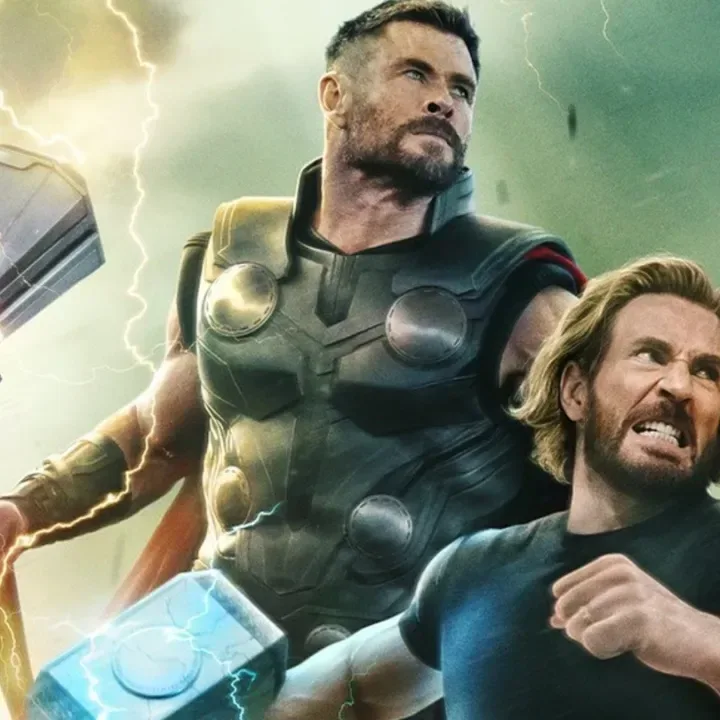
Marvel's latest Avengers: Doomsday poster reveal is more than a simple collection of character portraits. The 11 connected images form a large battlefield montage, bringing together the Avengers, the X-Men, and the Fantastic Four as they face Robert Downey Jr.'s Doctor Doom and an army that includes Sentinels and Doombots. Alongside the obvious spectacle of so many heroes occupying one piece of promotional art, the posters offer a handful of visual details that could point toward major alliances, conflicts, and one particularly significant new development for Thor.
The most talked-about element is the pairing of Chris Hemsworth's Thor with Chris Evans' Steve Rogers. Both characters are shown wielding familiar weapons tied to their shared history: Steve carries Mjolnir, while Thor holds Stormbreaker. Yet the lightning surrounding them is not the same. Mjolnir is associated with its usual blue electrical energy, but Stormbreaker appears to call down yellow lightning. That difference has immediately raised the possibility that Thor has gained access to the Odinforce, an immense source of power traditionally associated with Odin in Marvel stories.
It is a striking possibility because Thor is already one of the Marvel Cinematic Universe's strongest heroes. A move toward the Odinforce would not just be a cosmetic alteration to his effects; it could represent a substantial escalation in his abilities at a time when the franchise is assembling its broadest coalition of heroes yet. And if the trailers for Avengers: Doomsday are any indication, even an upgraded Thor may have a difficult time standing against Doom.
A connected battlefield for Marvel's biggest crossover
The full poster lineup is designed as a single montage rather than 11 entirely separate scenes. That presentation emphasizes the core promise of Doomsday: characters from previously distinct corners of Marvel's film universe are being drawn into one immense conflict. The Avengers, Fantastic Four, and X-Men occupy the same visual space, while Doctor Doom's forces loom as the unifying threat.
For useful background on this topic, read Blade Runner 2099 Producers Discuss Potential AAA Game Set in the Cyberpunk Universe.
Doctor Doom's army includes Sentinels, the towering mutant-hunting machines long associated with the X-Men, as well as Doombots. The posters offer the first look at the Doombots for this film. In Marvel lore, these robotic servants and bodyguards are among Doom's most recognizable tools. Their presence suggests that Doom will not simply be a powerful individual antagonist. He will also command a highly organized mechanical force capable of creating danger on a massive scale.
The Sentinels add another intriguing dimension. Their involvement naturally connects the threat to the X-Men, but their appearance beside Doom's own creations makes the film's battlefield feel less like a conventional superhero clash and more like a war involving multiple factions, histories, and technologies. The image of iconic Marvel teams fighting under one banner is exciting on its own. The question is how stable that banner will be once old rivalries, complicated loyalties, and radically different approaches to heroism enter the story.
Alan Cumming's Nightcrawler is among the characters receiving a closer showcase in the artwork. The posters provide a better look at his costume, giving audiences another glimpse of how the returning mutant will fit into the new crossover. Nightcrawler's arrival matters beyond nostalgia: his teleportation abilities and long-standing association with the X-Men could make him especially valuable in a conflict against enemies as numerous and imposing as Sentinels and Doombots.
Thor's yellow lightning and the Odinforce theory
Thor's apparent change in power is the reveal generating the most immediate speculation. In the posters, Steve Rogers channels the classic blue lightning of Mjolnir. That image recalls his memorable use of the hammer and underscores that he remains connected to one of the defining moments in his history with Thor. Stormbreaker, however, is surrounded by yellow lightning instead of the more familiar visual treatment fans expect from Thor's weapons.
That yellow energy has led many viewers to consider the Odinforce explanation. In the comics, the Odinforce is a vast mystical power connected to Odin and the rulers of Asgard. It has been depicted in varying ways over the years, but it is generally understood as a tremendous enhancement that can grant its wielder far greater cosmic and magical capabilities. Marvel Studios has not confirmed that the film's yellow lightning is the Odinforce, and a poster alone cannot settle the question. Still, the specific contrast with Steve's blue lightning seems deliberate enough to invite the theory.
If it does prove to be an Odinforce-style upgrade, it would fit the stakes suggested by the rest of the campaign. Doom has the resources, intellect, and apparent military strength to threaten multiple superhero teams at once. Thor stepping into a new level of power could be one way for the film to establish that Earth's defenders have an answer to the scale of the danger--though not necessarily an answer strong enough to win.
There is also an emotional layer to the Thor and Steve pairing. Their relationship has been forged through several defining battles, and Steve's ability to wield Mjolnir has always marked the depth of mutual respect between the two heroes. Seeing them placed together again, now with Thor potentially changed by a new source of power, makes the image feel like more than an action pose. It may signal a reunion shaped by both familiarity and the immense pressure of the threat ahead.
Could the pairings reveal the film's alliances?
The posters also place characters in pairs, prompting questions about whether those combinations are meant to preview actual teams within the movie. Thor and Steve are the clearest fit due to their established history. Other matches are less obvious, which may be exactly why they are worth watching.
Vanessa Kirby's Sue Storm, also known as the Invisible Woman, appears alongside Tenoch Huerta's Namor. The choice is notable because the two characters have a complicated comic-book connection, including Namor's largely one-sided romantic attachment to Sue. Bringing them together in the promotional material could simply create a striking pairing of powerful figures, but it could also suggest that Doomsday will draw on the tension and unusual chemistry of their comic history.
Another poster combination places Channing Tatum's Gambit with Florence Pugh's Yelena Belova. Gambit's charismatic, roguish style and Yelena's sharp, pragmatic personality make the potential dynamic easy to imagine, even though the poster does not confirm an on-screen partnership. A pairing of Tom Hiddleston's Loki and Rebecca Romijn's Mystique is similarly fascinating. Both are associated with deception, shifting loyalties, and the ability to operate outside straightforward heroic or villainous categories. Whether they become allies, rivals, or simply two characters forced into the same dangerous situation remains unknown.
These pairings may be clues, misdirection, or a mixture of both. Ensemble marketing often uses visual symmetry to create memorable images without directly mapping every relationship in the finished story. But with a cast this large, posters can be an efficient way to seed expectations. Marvel may be telling audiences which personalities will collide, which histories will matter, and which combinations could become the film's surprises.
Doctor Doom remains the central obstacle
Even with the attention on Thor's lightning and the returning heroes, the posters make clear that Doom is the figure around whom the conflict revolves. Robert Downey Jr.'s presence gives the character immediate weight, while the Sentinels and Doombots reinforce the impression of an antagonist who can attack on several fronts. The heroes may have impressive numbers, but the montage does not present their victory as assured.
That uncertainty is important. Avengers: Doomsday is positioned as a major event film, and its imagery is built around the idea that familiar champions are confronting a challenge beyond anything one team could reasonably solve alone. The convergence of teams is therefore both the movie's biggest attraction and evidence of how severe the situation has become.
There are already signs that the story will extend beyond this installment. Marvel has begun setting expectations for Avengers: Secret Wars, scheduled for 2027, and has indicated that the follow-up will differ substantially in tone and genre. Ryan Reynolds and Hugh Jackman have also received writing credits on Doomsday, a detail that suggests Deadpool and Wolverine may appear in the film. Neither the new posters nor the credits explain how those characters might enter the conflict, but their potential involvement would add still more unpredictable energy to an already enormous roster.
When Avengers: Doomsday arrives
Avengers: Doomsday reaches theaters on December 18. Until then, the connected posters leave audiences with plenty to examine: the first movie look at the Doombots, Nightcrawler's costume, the looming Sentinels, possible character partnerships, and the tantalizing suggestion that Thor could be wielding power tied to Asgard's former king.
The Odinforce theory remains unconfirmed, but the yellow lightning has done its job. It has turned a single visual flourish into one of the campaign's biggest questions, and it has given fans a reason to look at Thor's role in the looming battle very differently. With Doom positioned against heroes from three of Marvel's most important teams, a major power-up may be necessary. Whether it will be enough is another matter entirely.
Community
Discussion
Start the conversation.
No comments have been posted yet.