

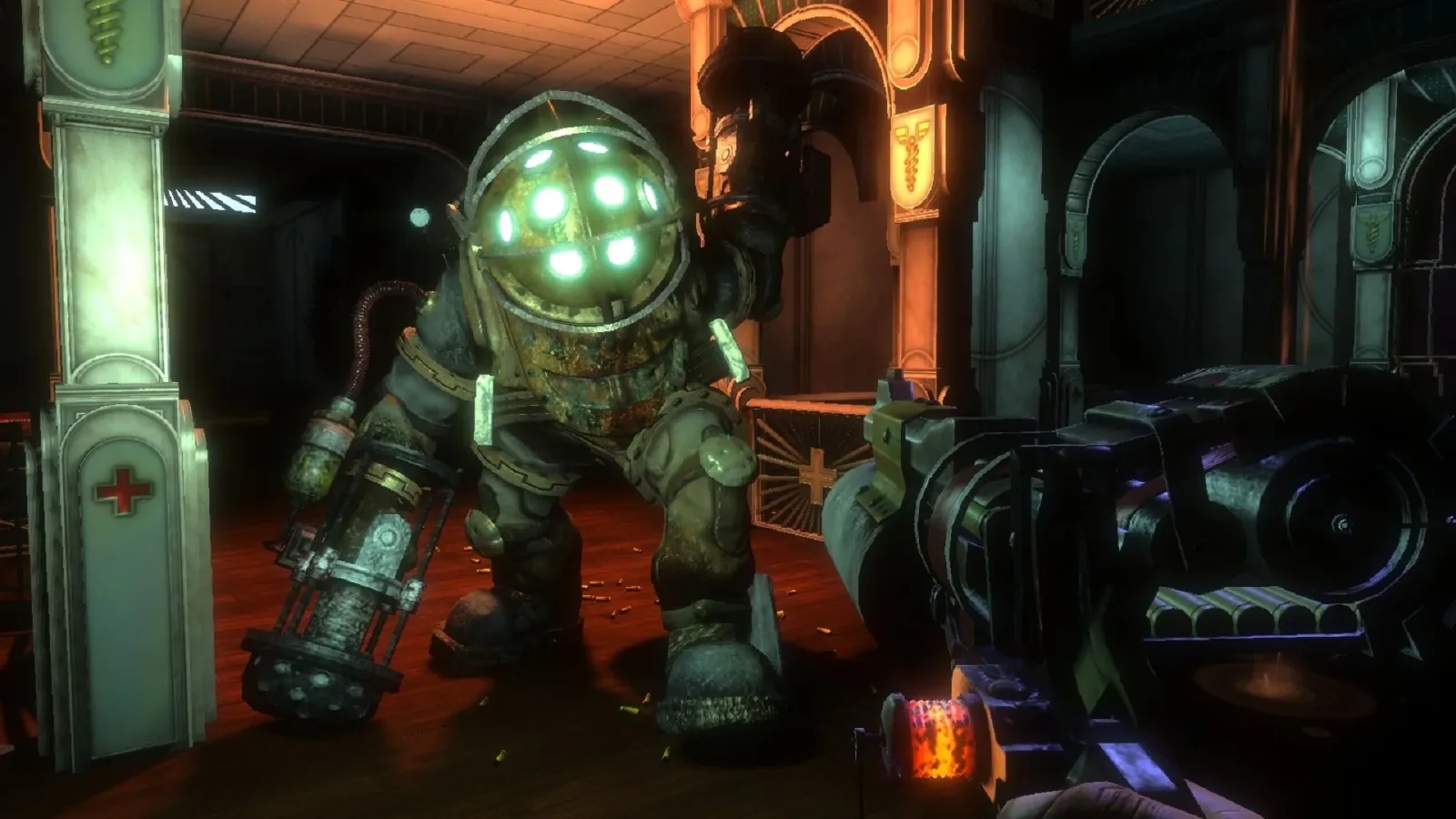
Netflix's long-gestating BioShock movie remains in development, and director Francis Lawrence has offered a clearer explanation of why he is still so invested in the project. For the filmmaker, the appeal begins with Rapture itself: the fallen underwater city at the heart of the celebrated game series. Lawrence views it as an extraordinary piece of world-building, rich enough to support a major film while also presenting unusual adaptation problems that cannot simply be solved by recreating familiar game moments.
Lawrence, who is also directing The Hunger Games: Sunrise on the Reaping, described BioShock's setting as one of the greatest worlds created across games, film, or other storytelling media. He said that building worlds is among the parts of filmmaking he enjoys most, making the opportunity to explore the franchise especially compelling. At the same time, he stressed that the team is still carefully working through the story rather than rushing toward a finished version.
Rapture remains the movie's central attraction
Since the first BioShock arrived, Rapture has been the series' most immediately recognizable achievement. Conceived as an isolated city beneath the Atlantic Ocean, it promised a society free from external control and built around radical individualism. By the time players enter its halls, however, that experiment has collapsed into violence, decay, genetic instability, and ideological ruin.
That contrast is a major reason the game has endured. Rapture is not simply a dangerous location filled with enemies. Its Art Deco architecture, propaganda, damaged luxury, flooded corridors, and failed utopian ambitions all communicate the history of a place that believed it could escape the world above. The city gives BioShock a distinctive visual identity, but it also supports the series' larger questions about power, freedom, class, science, commerce, and the consequences of pursuing an ideal without restraint.
For useful background on this topic, read Treyarch Veteran Craig Houston Says He Was Affected by Activision Layoffs.
Lawrence highlighted both sides of that appeal. He sees an enormous amount of creative possibility in the setting, as well as compelling themes and philosophies beneath its surface. For a film adaptation, that is important. A successful BioShock movie will need more than recognizable environments, Big Daddies, Little Sisters, plasmids, and a trip through a ruined underwater metropolis. Those elements are essential pieces of the franchise, but they matter because of the ideas and human failures they represent.
The director's comments suggest that the adaptation is being approached as a dramatic interpretation of BioShock's universe rather than a straightforward attempt to reproduce the experience of moving through the original game level by level. That distinction could be crucial. Games and movies create immersion differently, and BioShock's identity has always come from the relationship between exploration, combat, atmosphere, story revelations, and player involvement.
The challenge of adapting a player-led story
Lawrence identified the most difficult issue facing the film: in the game, the player occupies the central role. The original BioShock places its audience in control of its protagonist, Jack, asking players to move through Rapture, choose whom to trust, decide how to treat the Little Sisters, and gradually question the nature of their own agency.
That structure is powerful in an interactive medium because the player is not only observing events. They are participating in them. The game's most famous narrative turn gains force specifically because it confronts a person holding the controller and invites them to reconsider what they believed they were choosing to do.
A movie cannot rely on that same relationship. A film audience follows a character rather than controlling one, so the adaptation must create a lead who makes sense emotionally and thematically within Rapture. Lawrence said fitting that character into the setting is a puzzle, one the team continues to work through. The challenge is not merely finding a protagonist with a familiar backstory. It is determining whose perspective can guide viewers into the city while preserving the tension between personal choice, manipulation, and ideology that defines BioShock.
That is a significant task because an overly passive hero could weaken the drama, while a protagonist with too much certainty or independence could alter the franchise's central tension. The screen story will also need to establish Rapture's history and factions without allowing exposition to overwhelm the suspense of entering a city that has already fallen apart.
There are many possible routes through that problem. A BioShock film could focus closely on an outsider discovering Rapture for the first time, use a new character created for the movie, or place greater emphasis on the people who shaped the city before its collapse. No story approach, cast, release window, or final script details have been announced. Lawrence's remarks make clear only that the question of the lead character remains one of the key creative issues being refined.
Years of development, with a script said to be close
Netflix first announced its BioShock film project in 2022. Its extended development has naturally made fans eager for a more concrete update, particularly because the series has such a devoted audience and an unusually cinematic reputation. Yet Lawrence's latest comments frame the slow process as a matter of creative care rather than a lack of interest.
Earlier in 2026, Lawrence said the project was pretty close to having a script. His new comments reinforce the idea that the adaptation is actively being shaped, even if it has not reached the stage where Netflix can reveal production dates, casting, or a release plan. There is currently no confirmed premiere date for the movie.
For fans, the lack of a firm timetable may be frustrating, but BioShock is the kind of property where foundational choices carry unusual weight. Rapture must feel physically convincing while retaining its heightened, stylized atmosphere. Its political and philosophical conflicts have to be understandable to newcomers without becoming a lecture. The story must also serve longtime players who will immediately notice whether its imagery and ideas feel authentic to the franchise.
Lawrence's background makes his emphasis on structure and world-building especially notable. His work on the Hunger Games films has involved translating popular speculative fiction into large-scale screen stories with social systems, visual identities, and political conflict at their core. BioShock presents a different kind of fictional society, one that is more claustrophobic, grotesque, and haunted by the remnants of its own promises, but it similarly demands a careful balance between spectacle and character.
Why BioShock still has film potential
Video game adaptations have entered a more ambitious period, with studios increasingly treating game worlds as foundations for distinct screen stories rather than assuming that name recognition alone is enough. BioShock has long seemed suited to that shift. Its setting is visually bold, its central mystery is rooted in character and ideology, and its broader world provides material for horror, thriller, science fiction, and psychological drama.
Still, its strengths are inseparable from the risks. A film that treats Rapture only as a backdrop for monsters and action would miss what made the original so memorable. Conversely, a movie overly concerned with explaining every aspect of its philosophy could lose the dread and momentum of a journey through a dying city beneath the sea.
The adaptation will need to make its setting feel seductive before--or while--it reveals the horror of what Rapture became. The city was born from a dream of boundless possibility, and its tragedy is that the dream was never separate from the cruelty that destroyed it. That tension is where BioShock's greatest cinematic opportunity may lie.
Lawrence appears to understand that the project's value is not limited to its imagery. His focus on themes, philosophies, and the emotional logic of a protagonist indicates that the movie is trying to find a form that works as a film in its own right. Whether it ultimately adapts the original game closely or uses its world as a springboard, the filmmakers will be judged on how well they translate that balance.
What is confirmed--and what remains unknown
The confirmed picture is still relatively simple. Netflix is developing a BioShock film, Francis Lawrence remains attached as director, and he believes the franchise contains exceptional material for cinematic world-building. The screenplay has been described as close, but the team is still working through the difficulty of constructing a film lead for a story originally designed around player control.
Beyond that, major details remain unannounced. There is no confirmed cast, no announced start of filming, no stated release date, and no official indication of exactly which BioShock story the film will tell. Fans should therefore be cautious about treating speculation around characters, plot points, or game-specific events as settled fact.
For now, the most meaningful update is one of creative intent. The BioShock movie is still moving through development, and its director remains enthusiastic about the strange, beautiful, unsettling world at its center. Rapture has survived in players' imaginations for years because it is more than a location. If the Netflix adaptation can solve its protagonist problem and preserve that deeper identity, it may have the potential to become a game adaptation with a world truly worth diving into.
Community
Discussion
Start the conversation.
No comments have been posted yet.