

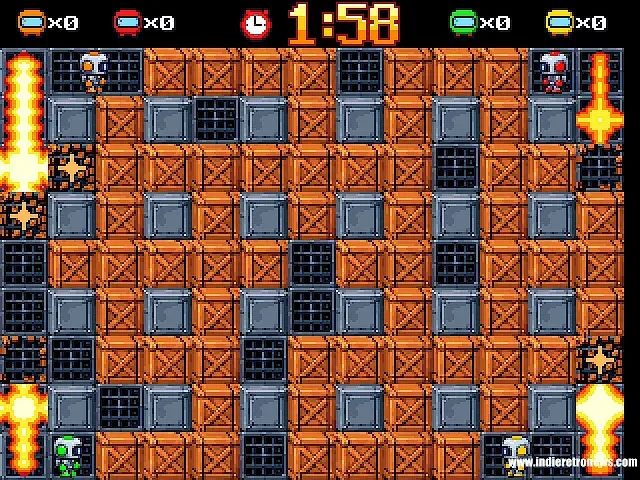
Blast Grid is bringing a fresh dose of maze-based explosive action to Amiga systems. Developed by sandlbn, the new game takes clear inspiration from the classic Bomberman formula: players navigate compact grid arenas, lay bombs to destroy obstacles and opponents, collect helpful upgrades, and try not to get caught in their own expanding blast paths.
Rather than limiting itself to a quick succession of multiplayer rounds, Blast Grid has been built with both a sizeable single-player component and a competitive party mode in mind. Its Story mode contains 30 stages spread over five industrial-themed worlds, while Battle mode allows up to four total combatants in matches that can mix human players with computer-controlled rivals. The game is designed for AGA-equipped Amigas now, with a version for OCS/ECS machines planned later in the year.
For Amiga owners looking for a new game that embraces the machine's local multiplayer possibilities as well as its campaign-friendly strengths, Blast Grid is shaping up to be a notably feature-rich addition to the library.
A 30-Stage Industrial Campaign
Blast Grid's Story mode is divided into five distinct locations: Factory, Reactor, Data Lab, Waste Processing, and Deep Core. Each world contributes six stages to the full 30-level campaign, giving the game a structure beyond a simple set of disconnected bomb arenas.
For useful background on this topic, read How GTA 5 Made Its Fast Character Switches Work on PS3 and Xbox 360.
The industrial settings also suggest a gradual descent through increasingly hostile facilities. Players begin among the machinery of the Factory before progressing through more dangerous and specialised zones, culminating in Deep Core. While all five environments are tied together by that mechanical, high-tech theme, they are not merely palette swaps. Every world introduces its own enemies, power-ups and hidden secrets for players to uncover.
That variety matters in a game built around familiar rules. Bomb-laying maze action is immediately understandable, but the strongest games in the genre sustain the premise by continually changing the player's decisions. New enemies can alter how safely players can move through a map. Different power-up combinations can affect whether it is wiser to clear blocks, build a longer blast range, or focus on mobility and survival. Secrets provide another reason to look closely at each level rather than treating it as a route directly to the exit.
Each of Blast Grid's five worlds ends with a boss encounter. These bosses have their own attack patterns, meaning the end-of-world challenges are intended to demand a different approach from ordinary maze clearing. The promise of a tough boss at the conclusion of every region gives Story mode a clear rhythm: learn the world's hazards, get through its stages, then face a larger test before moving forward.
Bombs, Blocks and Careful Positioning
At its core, Blast Grid follows a proven arcade design. A bomb is both a weapon and a potential trap. It can eliminate enemies, break destructible blocks and open routes through a stage, but its blast travels along the grid and can just as easily catch the person who placed it. Success comes from reading the arena, judging distances and always preserving a possible escape route.
The game's power-ups bring added momentum to that basic loop. Collectibles are present throughout the campaign and multiplayer battles, with the worlds specifically said to feature their own selections. In this kind of grid-based action game, pickups are central to the shifting balance of a round: an early advantage can turn a slow, cautious player into a major threat, while a poorly timed bomb can throw that advantage away in an instant.
Blast Grid also includes hidden secrets across its Story levels. That should give solo players an incentive to experiment with destructible terrain and inspect each stage more thoroughly. The difference between simply surviving a level and fully exploring it can be an important one in a game whose surface-level objective is so direct.
Four-Player Battle Mode Takes Advantage of the Amiga
For many fans of this style of game, the arena mode is where the real chaos begins. Blast Grid's Battle mode supports up to four participants, and those four slots can be filled by any mixture of human players and CPU-controlled bots. This is especially useful for a local multiplayer game: a player does not need to assemble a full group before playing, and a pair of friends can still create a packed arena by adding computer opponents.
The CPU competitors are available across three difficulty tiers. That leaves room for less experienced players to learn the game's timing before escalating the challenge, while stronger players can use tougher bots to make smaller gatherings more competitive. The ability to combine people and CPUs also gives the game flexibility that suits the Amiga's social, same-room multiplayer tradition.
Battle mode includes five arenas and supports Sudden Death matches. Sudden Death is a natural fit for bomb-based arena play, where a round can otherwise reach a tense stalemate as surviving competitors circle around newly opened spaces. A late-round escalation creates pressure, reduces safe territory, and forces players to act rather than wait for an opponent to make the first mistake.
With five dedicated multiplayer maps, varied player-and-bot combinations, and Sudden Death available, Blast Grid appears designed to remain useful after its campaign has been completed. It can serve as a solo game one day and a competitive local fixture the next, depending on who is in the room.
Built for AGA Amigas, With Wider Compatibility Planned
The currently available edition of Blast Grid is made for AGA Amiga hardware, including the Amiga 1200. Its stated requirements are a 68020 processor, Kickstart 3.1, and 2 MB of chip RAM. Those details are important for prospective players, since Amiga software compatibility is often defined by the exact hardware configuration in use.
An OCS/ECS version is planned for later in the year. That edition is intended for machines including the Amiga 500, Amiga 600, and Amiga 2000. The planned expansion is particularly welcome for users of earlier Amiga hardware, although players should keep in mind that it remains a later release rather than part of the current AGA version.
Blast Grid runs at 50 Hz on both PAL and NTSC displays. That is a useful practical touch for a game where responsive movement, bomb timing and split-second escapes all matter. The game can be launched from either floppy disk or hard drive, accommodating the different ways Amiga owners organise and use their software.
It also exits cleanly back to Workbench. This may sound like a small convenience, but it reflects attention to the full experience of using software on original hardware. A polished return to the operating environment saves players from awkward resets and makes it easier to switch between games, tools and desktop tasks.
Controller Options Designed for Real Hardware Setups
Blast Grid supports an unusually broad selection of input options. Players can use standard joysticks, two-button joysticks, CD32 pads, keyboards and classic four-player parallel-port adapters. The range is especially valuable given the variety of peripherals still used across the Amiga community.
For a single-player Story run, keyboard or joystick support means players can choose the control arrangement that feels most natural on their setup. For Battle mode, support for the old parallel-port multiplayer adapters is a significant inclusion. Local four-player competition is much easier to realise when a game recognises the accessories that helped make multi-controller Amiga sessions possible in the first place.
That hardware awareness carries into performance considerations as well. Owners with 8 MB of Fast RAM can expect near-instant screen transitions with no disk-loading pauses between them. The game remains playable without that stated Fast RAM benefit, but the enhancement offers a welcome quality-of-life improvement for suitably equipped systems.
A Modern Release With Classic Amiga Priorities
Blast Grid's feature set is notable because it respects several different ways people continue to play Amiga games. There is a long-form single-player campaign for players who want progression, bosses and exploration. There is a fast local multiplayer option for groups. There is broad input compatibility for owners of vintage controllers and adapters. And there are practical touches such as disk saving, hard-drive booting, clean Workbench exits and Fast RAM-enhanced transitions.
The disk-saving feature is particularly helpful for the 30-stage Story mode. A campaign of that size is more inviting when progress can be retained and resumed later, rather than demanding that players tackle a lengthy sequence in one sitting. It lets Blast Grid work as a sustained adventure instead of only an arcade challenge.
In a retro scene where new software often has to account for very different models, memory expansions, displays and controller collections, that attention to the details of ownership can be as meaningful as the game's headline modes. Blast Grid is not just using the Amiga as a nostalgic target; it is being shaped around the ways Amiga systems are actually used.
For now, AGA owners with an Amiga 1200-class setup can look to the game's Factory, Reactor, Data Lab, Waste Processing and Deep Core worlds, while the promised OCS/ECS edition gives earlier-machine users something to watch for later in the year. Whether approached as a 30-stage solo run or a four-player bomb battle, Blast Grid offers a new reason to connect an Amiga to a display, pick a controller, and make every escape route count.
Community
Discussion
Start the conversation.
No comments have been posted yet.