

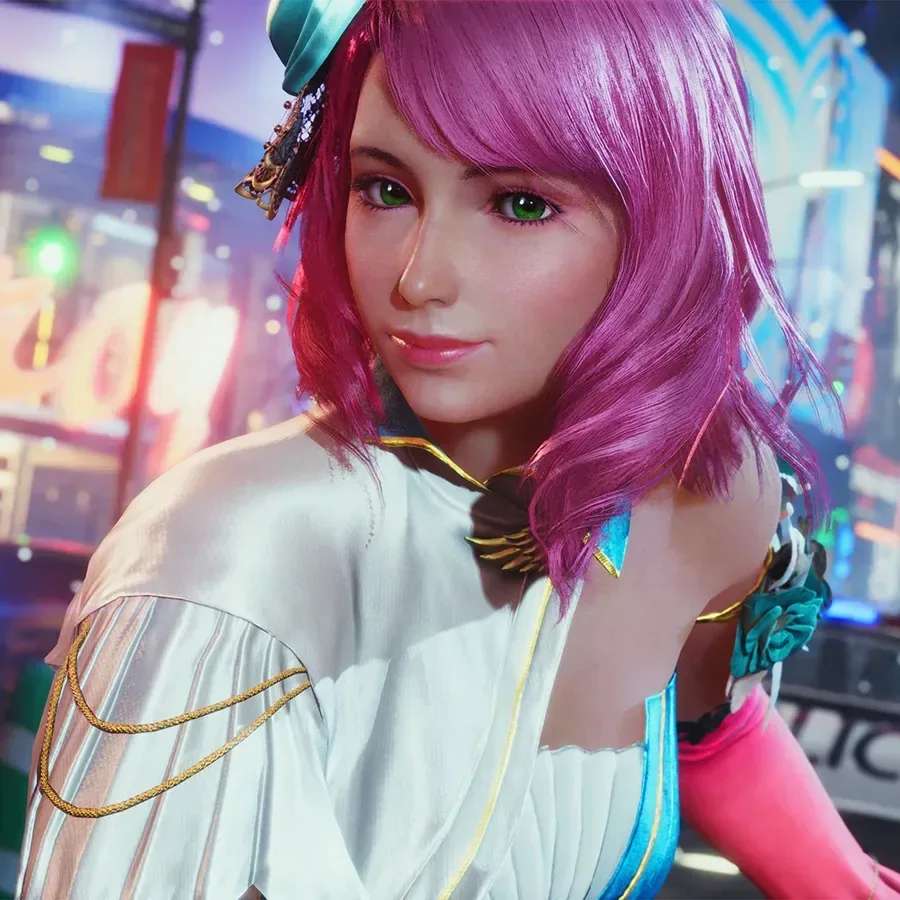
Tekken 8's ranked ladder is built around fast reactions, awareness of spacing, matchup knowledge, and the ability to recognize an opponent's habits in seconds. SuperBrine took one of those pillars away entirely. The professional Tekken 8 player has reached the God of Destruction rank while wearing a sleep mask, completing a challenge that began at Beginner and unfolded across seven Twitch broadcasts.
The final broadcast, held in early October after the project started in June 2026, has drawn widespread attention across the fighting-game community. SuperBrine played Alisa throughout the run and kept his vision obscured, meaning every decision had to be made through sound, memory, timing, and a deep understanding of the ranked environment. God of Destruction is among Tekken 8's highest ranks, making the result striking even before the blindfolded condition is considered.
The accomplishment has naturally prompted arguments about what it says about Tekken 8, Alisa, and the demands of the game's online ranking system. SuperBrine, however, has stressed that the challenge was a personal test rather than an attempt to condemn the game or declare it fundamentally broken.
Embedded X/Twitter post
A challenge built around removing sight
SuperBrine said the central motivation was to accomplish something most people would view as impossible. The run also fits into a wider plan to build visibility as a competitive player, with unusual high-skill challenges serving as a way to show both knowledge and determination beyond ordinary tournament play.
For useful background on this topic, read indie.io Schedules October 2026 Next Fest Demo Showcase.
"My primary goal was simply to take on a challenge that most people will consider impossible and prove that I can do it," SuperBrine said.
He also made clear that the stunt was rooted in affection for Tekken 8. Rather than framing the game as poorly made, he described the project as an extreme way to push his own limits in a title he genuinely enjoys. For a player looking toward a long-term competitive career, the appeal was not simply novelty. It was an opportunity to demonstrate persistence and game knowledge under an intentionally severe limitation.
The sleep mask itself was not a symbolic blindfold that left room to peek at the screen. SuperBrine confirmed that he could not see through it, describing the thick material and padded eye area typical of a sleep mask. Because the entire progression was streamed live over multiple broadcasts, viewers could follow the attempt as it developed rather than only seeing a final claim or a carefully selected highlight.
That extended format matters. A ranked challenge can turn on consistency as much as a single excellent match. Moving from Beginner to a top rank requires repeated wins against players of changing strengths, styles, and familiarity with the game. Removing vision does not just complicate offense and defense during an exchange; it affects menu navigation, match-to-match adaptation, positioning, and the ability to visually verify nearly every part of a fight.
Listening for the state of a match
SuperBrine's explanation of the run centers on two interconnected strengths: foundational fighting-game experience and Tekken 8's audio feedback. In a conventional match, players often confirm whether an attack connected, was blocked, produced a counter hit, or sent an opponent toward the wall by looking at animations and visual effects. SuperBrine instead had to process the game's sounds as actionable information.
The distinction is more detailed than simply listening for a hit. Different outcomes create different situations, and each situation changes which follow-up options make sense. A wall splat can create a major opportunity. A blocked attack can mean it is time to stop pressing buttons or prepare for retaliation. A counter hit may allow an extension that would not be available after an ordinary strike. Recognizing those states from audio alone requires both careful hearing and enough experience to immediately turn that cue into a decision.
"You would be able to instantly differentiate specific sounds knowing whether a move resulted in a wall splat or not, if it was a hit or a block, and if you landed a counter hit versus a normal hit," SuperBrine explained.
That reliance on sound also highlights an aspect of fighting games that can be easy to overlook when watching at full speed. Audio is not merely presentation. It communicates impact, movement, successful defense, and changing momentum. Tekken 8's sound design provided enough distinction for an exceptionally experienced competitor to read situations without visual confirmation, though that should not be mistaken for a claim that the game can be mastered without sight by default.
SuperBrine's ability to use those cues depended on knowing what he was looking for before a sound even occurred. He said he had accumulated a precise sense of the game knowledge common at different portions of the ranked ladder. Experience playing on multiple smurf accounts gave him a picture of which strings, pressure sequences, and flowcharts were likely to work against certain opponents, as well as when those approaches would be less reliable.
Rank knowledge was as important as execution
That point may be the most important part of understanding the achievement. SuperBrine was not blindly repeating attacks and hoping Tekken 8's systems would carry him upward. He was making predictions about the player on the other side, their likely defensive choices, and the gaps in their knowledge. The blindfold made those reads harder to execute, but his familiarity with ranked behavior gave him a framework for deciding what to attempt.
In fighting games, a flowchart is often used as a dismissive word, but its real meaning depends on context. A repeatable sequence can be a powerful tool when an opponent does not know the answer, while the same sequence can become dangerous against a player prepared to interrupt, sidestep, punish, or otherwise counter it. Knowing when to use a simple plan--and when it has stopped working--is a skill in itself.
SuperBrine argued that thousands of hours of accumulated knowledge were behind the climb. That includes character familiarity, knowledge of likely responses at specific ranks, and the ability to make audio-only judgments quickly. Alisa was his chosen character, but he rejected the idea that character selection alone could make the feat reproducible for anyone willing to put on a blindfold.
"You can't reach God of Destruction blindfolded just by picking a specific character and hoping for the best," SuperBrine said. "It takes thousands of hours of game knowledge, knowing what kind of players you will face and what level of game knowledge they have, and relying entirely on audio cues."
That has not stopped the result from feeding into familiar debates around character strength and accessibility in competitive games. Some viewers have treated the challenge as evidence that Tekken 8 is too easy or that Alisa's tools are too forgiving. Those arguments are likely to continue, especially in a community where balance discussions can be intense. But the premise of SuperBrine's response is straightforward: if the feat were merely the product of an easy character or a major flaw, it would be far less unusual.
The physical and mental cost of the run
The difficulty was not limited to the matches themselves. SuperBrine said keeping his eyes closed beneath the mask for long stretches caused them to burn. The mental effort of listening closely, tracking the flow of each round, and staying patient also created substantial fatigue. As a result, he needed to take frequent breaks throughout the undertaking.
That detail makes the run more than an exercise in unusual controls or a clever use of game audio. Fighting-game concentration can be exhausting even with full visual access. Players must manage execution, timing, adaptation, emotional momentum, and the pressure of ranked points. Taking vision away adds another layer of strain, because information that would normally be absorbed almost instantly has to be inferred.
Patience became essential. An impulsive response can be risky in any fighting game, but a player who cannot see must be especially disciplined about when to commit, when to wait, and when to trust a familiar pattern. SuperBrine described that mental endurance as necessary to seeing the challenge through.
A reminder of fighting games beyond conventional play
The blindfolded climb is a self-imposed challenge from a sighted competitor, but it also arrives in a genre with a meaningful history of players succeeding through disabilities and alternative ways of interacting with games. SuperBrine's experiment should not be conflated with those experiences, yet it can draw attention to how much design, accessibility, and player ingenuity can matter.
The late BrolyLegs, for example, became a respected Street Fighter competitor while using his mouth to operate a controller. BlindWarriorSven, a blind Street Fighter 6 player who lost his sight at age six because of cancer, won a livestreamed Evo set 2-1 using E. Honda. Street Fighter 6's accessibility features enabled him to use audio to understand his opponent's on-screen location.
Those examples speak to the importance of accessibility options designed for players with real disabilities, while SuperBrine's climb demonstrates how formidable a sightless challenge remains even for an experienced professional. In both cases, the common thread is that games communicate more than their visuals alone, and players can develop extraordinary ways to process that information.
For SuperBrine, the God of Destruction result stands as the conclusion of months of streamed effort, physical discomfort, repeated breaks, and immense confidence in his own competitive foundation. It may keep generating debate about Tekken 8 and Alisa, but it is also a rare demonstration of how far knowledge, audio recognition, and patience can take a player when the screen is no longer available to them.
Community
Discussion
Start the conversation.
No comments have been posted yet.