

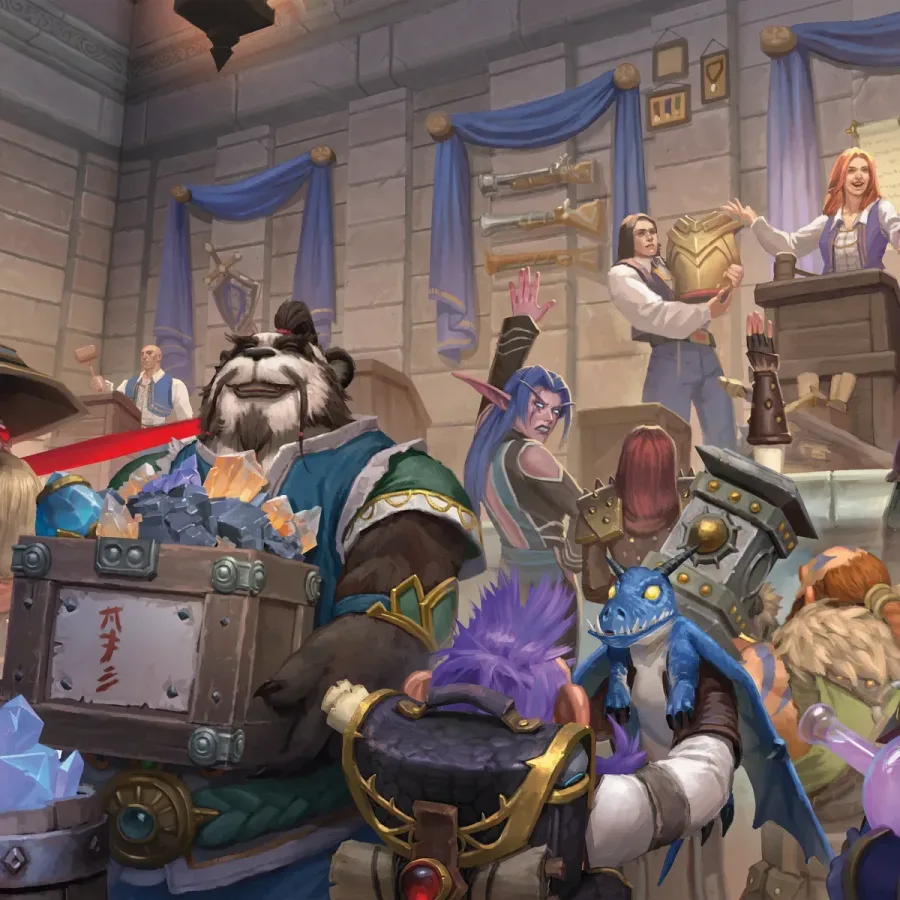
Dungeons & Dragons: World of Warcraft is shaping up to be far more than a short crossover adventure. Due to launch on November 17, the tabletop release adapts much of Azeroth into a campaign setting for D&D groups, letting Dungeon Masters build stories across familiar regions, pull from Warcraft's major wars, and turn iconic dungeons and raid encounters into slower, choice-driven tabletop adventures.
The project is notably the first Universes Beyond release for Dungeons & Dragons. Wizards of the Coast has used that banner extensively with Magic: The Gathering, but this release takes a broad approach closer to a complete game setting than a single quest. It is designed to support years of campaigns, with geographical material, monsters, crafting systems, faction progression, and a roster of recognizable lore figures all included.
For players who know Azeroth through the long-running MMO, the major appeal is freedom. A party can follow familiar landmarks and conflicts, but it is not required to repeat the path laid down by quests, expansions, and raid progression. D&D's structure means the group can decide what matters, which problems to solve, and what history to change.
Azeroth Is the Focus
The setting book covers the world of Azeroth through the era of The War Within. Its regions are presented with suggested character-level ranges, echoing the way players have traditionally progressed through zones in World of Warcraft. Game Designer Joey Haeck pointed to Durotar, the Orc starting area, as an example of a region that naturally suits characters around levels 1 through 4. Older endgame areas, including parts of Northrend, are intended for considerably stronger parties.
For useful background on this topic, read NBA 2K25 Will Be Delisted in October as Server Shutdown Ends MyCareer Access.
Those ranges are guidance rather than hard boundaries. A Dungeon Master can shift threats, rewrite the world, or send low-level adventurers somewhere they clearly should not be. That flexibility is central to the adaptation: familiar Warcraft geography creates a useful framework, while the table retains authority over what happens next.
The scope is limited to Azeroth itself. Argus, the Shadowlands, and Draenor are not part of the core setting material. That means campaigns focused directly on Outland or the events of The Burning Crusade will need additional work from the DM, particularly because Outland is the shattered remnant of Draenor. Players can certainly use their own Warcraft knowledge to extend the setting, but the official material keeps its attention on Azeroth.
Its campaign framework also reaches beyond a single point in Warcraft's timeline. Dungeon Masters will be encouraged to choose three major conflicts to shape a campaign, using them to inform its encounters, locations, enemies, and adventure prompts. Potential touchstones include the Alliance-Horde war, the Burning Legion's invasions, and the Scourge.
There is a practical answer for groups that want to mix eras freely: Chromie Time. Borrowing an established Warcraft concept, Chromie can provide a bespoke timeline for the party. That opens the door to stories that begin after an event associated with Xal'atath, then jump backward to the Classic era, potentially allowing characters to interfere with history in ways the MMO could never permit.
Classic Dungeons Reworked for Tabletop Play
World of Warcraft dungeons are usually built around brisk combat runs: groups clear packs of enemies, defeat bosses, gather loot, and queue up again. A tabletop role-playing game needs a different rhythm. In Dungeons & Dragons: World of Warcraft, dungeons are intended as more open-ended environments, where investigation, stealth, negotiation, and creative problem solving can matter as much as combat.
That shift should be especially apparent in places fans already know well. A party venturing into the Deadmines might sneak past pirates instead of fighting every enemy. Scarlet Monastery could become a covert mission in which the leadership simply disappears, leaving behind stories about mysterious intruders rather than a trail of defeated crusaders. The setting is not asking players to recreate an MMO pull route at a dining table.
Dire Maul illustrates the broader approach. The ancient night elf complex carries its history into the tabletop setting: it was overtaken by Satyrs and Ogres following the Well of Eternity's destruction and the corruption of its mages by fel magic. Adventurers might enter to confront Tendris Warpwood, following an objective recognizable to MMO veterans. Alternatively, they could become involved in an Ogre political struggle and help place a new ruler on the throne.
The revealed dungeon list currently includes:
- Deadmines
- Blackfathom Deeps
- Dire Maul
- Scarlet Monastery
- Azjol-Nerub
- Shadowfang Keep
- Onyxia's Lair
Raids work differently from their MMO equivalents for equally obvious reasons: the game is not asking a regular D&D campaign to assemble 20 or 40 participants. Instead, raid locations are essentially high-level dungeons with appropriately spectacular boss battles. Onyxia's Lair is the key example. Its direct route toward an encounter with Onyxia makes it a natural foundation for a concentrated, high-stakes tabletop confrontation.
Dragons and Major Warcraft Characters
Dragons are a major meeting point between Dungeons & Dragons and Warcraft, but the two properties do not use them in the same way. The tabletop adaptation is therefore treating Azeroth's dragonflights as their own creatures rather than simply assigning D&D's familiar colored-dragon rules to Warcraft names.
Game Designer and Writer Carl Sibley used the Blue Dragonflight to explain the philosophy. While blue dragons in Warcraft share a connection to cold with D&D's white dragons, Warcraft's blue dragons are also deeply tied to arcane magic. A blue dragon's breath can consequently deal cold damage while also creating an aura that disrupts spellcasting. The goal is to make an encounter feel rooted in Azeroth's lore and combat identity.
The same principle extends to demons, the Scourge, and the rest of the setting's creatures. The bestiary ranges from low-threat Murlocs and Imps to major figures such as Arthas, the Lich King. Murlocs sit at challenge rating 1, while Arthas is rated CR 25, making him one of the most imposing threats in the release.
Several pivotal characters will receive complete histories and game statistics, including Sylvanas Windrunner, Alleria Windrunner, Anduin Wrynn, and Thrall. Their former raid mechanics are being translated into tabletop-friendly abilities rather than copied literally. Jaina Proudmoore provides one example: a stacking freeze effect from her MMO raid encounter becomes a more immediate freeze ability in D&D, which she can follow with an Ice Lance attack capable of producing a damaging area effect. A frozen character is not necessarily doomed, however, as inventive options such as taking fire damage may help break the effect.
Professions Bring MMO-Style Crafting to D&D
Crafting exists in Dungeons & Dragons already, but World of Warcraft expands it through a profession system inspired by the MMO. Gathering professions provide materials, while crafting professions convert those resources into useful goods. Fishing and Herbalism, for example, can supply ingredients for Cooking or Alchemy.
The system avoids demanding exact MMO-style ingredient checklists by default. Instead, materials are generally measured by their gold-piece value, so characters gather enough value to create a desired item. A DM who wants more detailed recipe tracking can require particular materials, such as a set quantity of Stranglekelp, though those recipes will need to be managed at the table.
Each profession has a defined crafting list, and access to items depends on a character's level of proficiency with that trade. Importantly, magical crafting is not solely for spellcasters or characters with Arcana proficiency. A skilled blacksmith can make exceptional enchanted gear through mastery of the profession.
The included professions are divided into gathering and crafting categories:
- Gathering: Archaeology, Fishing, Herbalism, Mining, Skinning
- Crafting: Alchemy, Blacksmithing, Cooking, Enchanting, Engineering, Inscription, Jewelcrafting, Leatherworking
Faction Renown Without the Endless Grind
World of Warcraft players will recognize the idea behind the setting's faction-renown rules, but the tabletop version removes the repetitive grind. Characters improve their standing organically by pursuing adventures that help a faction meet its goals, especially assignments provided by that faction. There is no expectation that a group will farm the same activity or complete a long series of daily chores just to unlock the next reward.
Most factions begin with a Renown score of 3. Characters become Honored at 10, Revered at 25, and Exalted at 50. The speed of advancement remains in the hands of the DM, but the lower numbers fit D&D's smaller scale and campaign pacing.
Rewards can be substantial. At the Exalted tier with the Horde, characters may be able to call upon figures such as Sylvanas or Thrall for aid during an adventure. The exact use of such support will naturally depend on the campaign, its chosen era, and the Dungeon Master's interpretation of its timeline.
With its broad map, flexible eras, dungeon material, iconic villains, professions, and renown structure, Dungeons & Dragons: World of Warcraft looks positioned to offer more than a brief nostalgia trip. It gives groups a way to visit Azeroth while doing something the MMO cannot always accommodate: making the world's biggest events, alliances, and disasters genuinely their own.
The release arrives on November 17, shortly before World of Warcraft's 22nd anniversary.
Community
Discussion
Start the conversation.
No comments have been posted yet.