

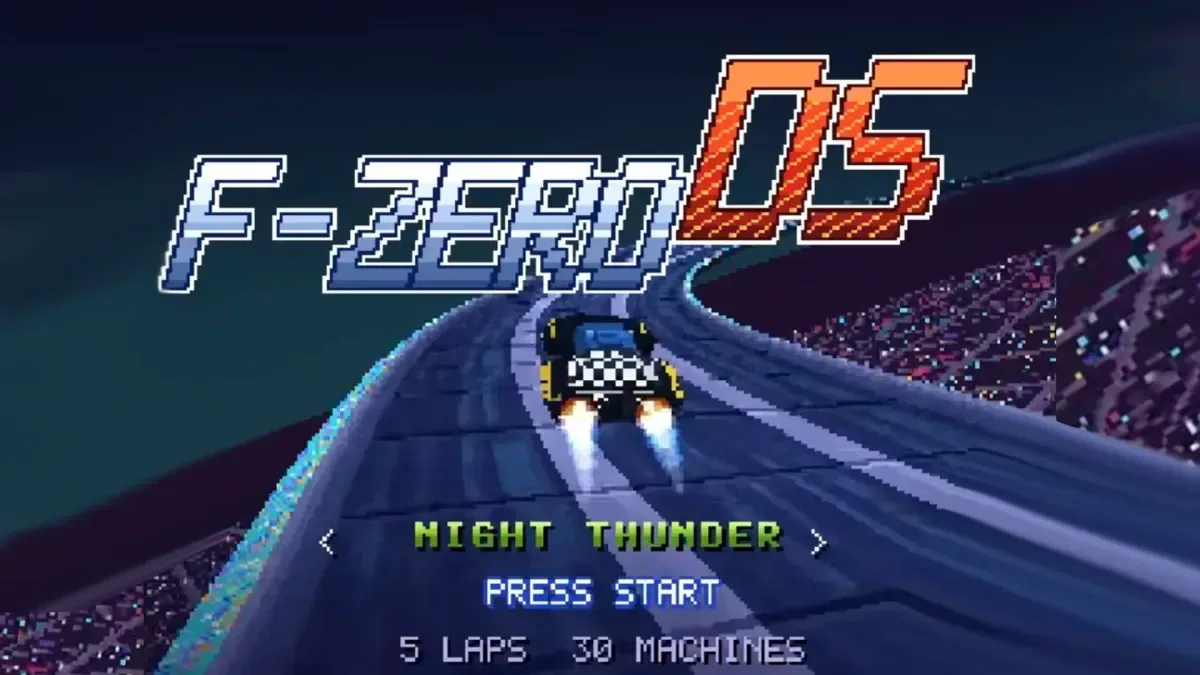
A new fan project is imagining an alternate history for Nintendo's futuristic racing series: one where F-Zero arrived on the Nintendo DS with a game built specifically around the handheld's distinctive two-screen setup. Developed by Justin Prine, the currently in-development project is called F-Zero DS, and an early prototype video offers a promising glimpse at its high-speed tracks, interface ideas, and planned tools.
It is important to set expectations: this is a fan-made project rather than an official Nintendo release, and Prine describes it as little more than a prototype at this stage. Even so, the footage already presents a convincing answer to a question many racing fans may have asked during the DS era: what could an arcade-focused, anti-gravity F-Zero have looked like if it had been designed to use the system's dual displays and touch controls?
A "What If" F-Zero Built for DS Hardware
Prine has described F-Zero DS as a one-person fan project centered on the idea of "what if Nintendo had made F-Zero DS." The prototype is intended to run on real Nintendo DS hardware, rather than existing solely as a modern PC reinterpretation. That is a meaningful detail for a project based on a handheld whose identity was defined by its unusual format: two stacked screens, a touch-sensitive lower display, and a stylus.
The project arrives after a long period in which fans have had relatively few major new entries to point to in the series' traditional high-speed racing lineage. F-Zero GX, released for GameCube in 2003, remains the last major console installment referenced in discussions around the franchise's earlier peak. A DS game could have occupied an intriguing space in that history, especially on a platform that supported both fast-paced action games and inventive touch-screen interfaces.
For useful background on this topic, read Anker Prime Qi2 25W Car Charger Mount Drops to $67 for Mobile Gaming Road Trips.
Rather than merely putting a race on one screen and duplicating information on the other, the prototype appears to consider how a second display can make racing data immediately useful. The result is an interface concept that feels suited to the DS while retaining the speed-first priorities associated with F-Zero.
Racing Information Split Across Two Screens
One of the most notable elements shown in the prototype is the lower-screen display. Alongside race information such as a map, player position, elapsed time, and ranking, it includes a rear-facing view that functions much like a reverse mirror. In a game where competitors can rapidly close in from behind and positioning can change in seconds, that extra perspective could be more than a decorative feature.
On a single-screen system, a rear-view mirror or rear camera would need to take up valuable space in the main play area, or require the player to activate it manually. The DS format provides a natural place to keep that information visible without crowding the primary race view. The top display can remain focused on the track and vehicle action, while the bottom display carries the additional awareness tools.
That division is particularly fitting for an ultra-fast racing game. A track map and race standings are essential, but repeatedly opening menus or obscuring the action would undermine the flow of a tense race. Keeping those details on the touch screen makes the interface feel like a companion dashboard, offering information at a glance while leaving the central action unobstructed.
The course-selection presentation also uses both screens. The top screen displays a featured video for the selected course, while the lower screen works as the selection menu. It is a straightforward idea, but it reflects a thoughtful approach to the DS's strengths. Course previews can play without replacing the menu itself, giving players a clearer sense of a track before committing to it.
A Course Maker Could Be the Big Feature
Prine's plans extend beyond the prototype's currently demonstrated racing concepts. Among the features in development are additional course themes, stock courses, peer-to-peer multiplayer for a web version, and a course maker inspired by the Nintendo 64DD.
The course-creation tool may be the most exciting of those ambitions. The Nintendo DS stylus was particularly well suited to direct manipulation, whether players were drawing, arranging, selecting, or editing objects. In the context of a futuristic racer, a lower-screen editor could make it possible to build routes with an immediacy that a traditional directional-control interface might lack.
The 64DD inspiration is an interesting touch because it points toward player creativity and editable game spaces rather than simply a list of predetermined tracks. There are no full details yet on exactly how construction, sharing, limitations, or track testing will work, so fans should avoid assuming the final shape of the tool. Still, even the prospect of a DS-focused F-Zero course maker gives the project an identity beyond being a technical recreation of an imagined lost release.
If it comes together, custom tracks could also be a strong reason to return after mastering the included courses. High-speed racing games thrive on memorable layouts, shortcuts, difficult turns, and the balance between risk and control. A creator tool puts those design decisions in players' hands, potentially allowing the community to explore what kinds of circuits work best under the project's handling model.
Web Multiplayer Is Also Planned
Prine has also mentioned peer-to-peer multiplayer for the web version. That wording matters because it indicates a separate web-focused multiplayer plan rather than a confirmed online mode for original Nintendo DS hardware. At present, it is a feature in the works, not a completed component shown as a finished release.
Multiplayer has always been a natural fit for competitive racing, particularly in a series built around aggressive overtakes, precision cornering, and constant pressure from nearby rivals. A web version with peer-to-peer play could make it easier for players to race one another, while the real-hardware goal preserves the project's connection to the DS itself.
For now, the prototype's greatest value is in demonstrating direction. It establishes that the developer is not treating the dual-screen system as a novelty attached to a conventional racer. The rear view, live race data, course previews, and prospective stylus-driven editor all aim to make the DS hardware part of the game's core design.
Why the Project's Format Matters
Fan games often attract attention through a familiar name or a nostalgic premise, but the best concepts also make a case for why they should exist in a particular form. F-Zero DS has that advantage. The Nintendo DS was not simply another portable screen; its clamshell design invited developers to separate action from information, menus from presentation, and direct input from standard controls.
That makes this project appealing even as an imagined piece of handheld history. It does not have to argue that every franchise needed a DS entry. Instead, it suggests that F-Zero had a specific opportunity on the system: fast arcade racing on the upper display, supported by a persistent tactical dashboard underneath.
The idea also has relevance for players who enjoy using dual-screen retro handheld devices. The DS remains the most authentic target for the project, given its stated real-hardware compatibility, but the interface design naturally benefits from devices that can reproduce the stacked-screen experience. That is especially true for a game whose HUD and navigation concepts are intentionally distributed across two displays.
Early Days, but a Strong Concept
There is no release date announced for F-Zero DS, and the project should be viewed as an ongoing prototype rather than a finished game. Plans for additional themes, stock tracks, web multiplayer, and the 64DD-inspired course maker remain development goals. As with any independently made fan project, the eventual feature set and timing can change.
Nevertheless, the available footage has already made a strong case for the central idea. The project captures the appeal of imagining a missing handheld chapter without reducing that idea to a simple visual demake or a one-screen racing experiment. Its most interesting elements come from embracing what the DS could contribute: continuous supporting data, rear visibility, a preview-friendly menu layout, and stylus-oriented creation.
For fans who have wanted to see more of F-Zero in a portable, dual-screen context, Justin Prine's prototype is one to watch. It may only be an early glimpse, but it is a thoughtful glimpse--one that makes the hypothetical question behind it feel surprisingly convincing.
Community
Discussion
Start the conversation.
No comments have been posted yet.