

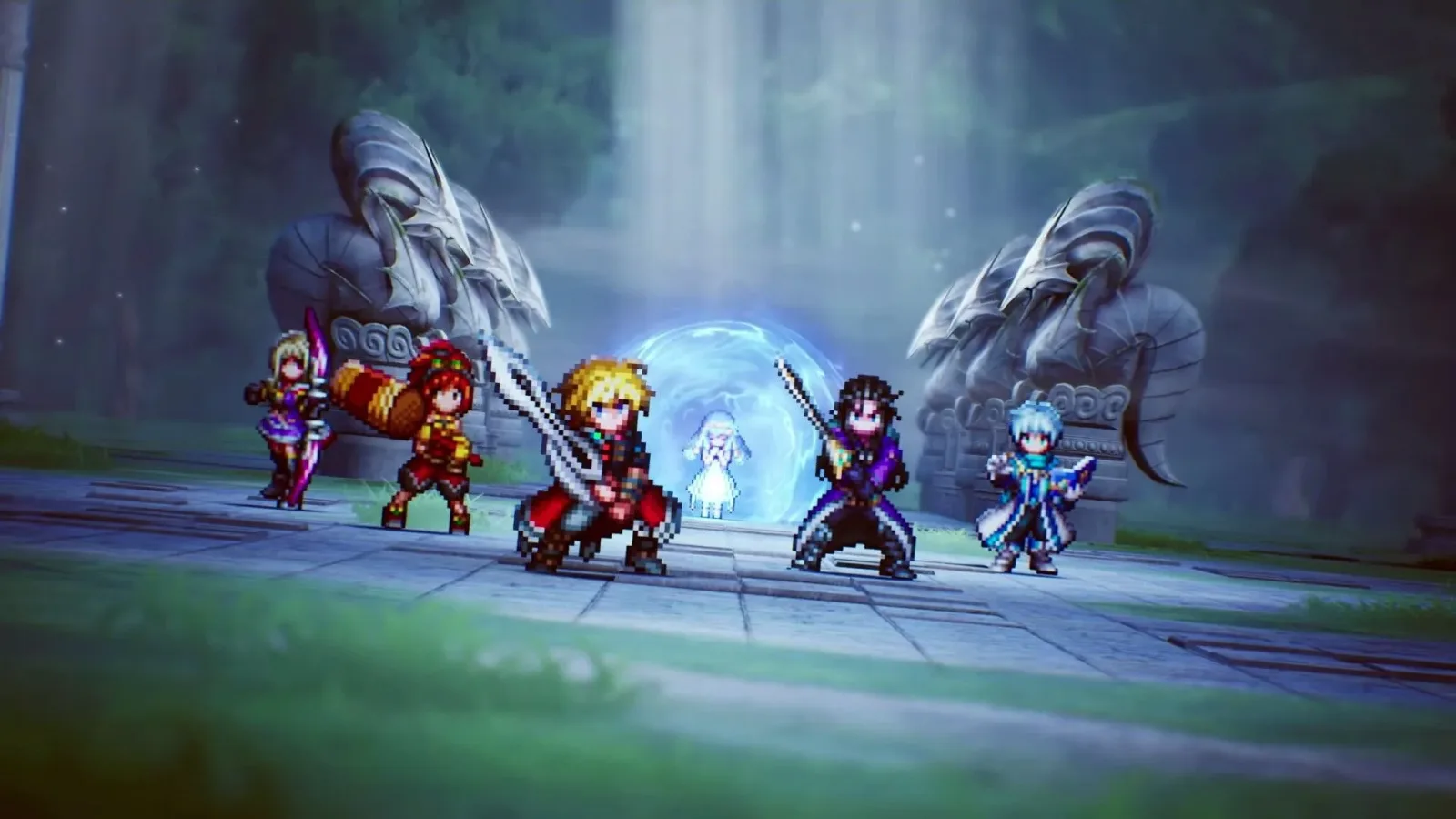
Final Fantasy Resonance has apparently exceeded even its creators' expectations. The retro-styled role-playing game, which revisits material connected to the 2015 mobile title Final Fantasy Brave Exvius, has been welcomed enthusiastically by players looking for a more traditional flavor of the long-running series.
Producer Keisuke Nakashima and director Hiroto Furuya discussed the response in a recent translated interview. Both developers indicated that they believed there would be an audience for Resonance's particular approach, but neither expected the appeal to be so broad, including among players outside Japan.
The reception is notable because Resonance occupies a deliberately different space from the franchise's most prominent modern releases. It leans into a top-down presentation, pixel-art styling, and an older-school sensibility while applying contemporary polish. Its battle approach has also been framed around classic Final Fantasy traditions, standing apart from the heavily action-focused direction associated with some recent major entries.
A Familiar Style With a Modern Audience
Nakashima said that he enjoys the action-oriented, fully 3D Final Fantasy games as well, but was struck by the number of people eager for a return to elements they associate with earlier installments. In particular, he highlighted the appetite for turn-based combat and pixel visuals, two features closely linked in the minds of many fans with the series' 16-bit era.
For useful background on this topic, read GameSir Pocket Taco Hits Its Lowest Price Yet in Black Friday Retro Deal.
That does not necessarily mean players want the franchise to abandon its modern experiments. Final Fantasy has long changed shape from one entry to the next, shifting among fantasy worlds, combat systems, art styles, party structures, and narrative tones. The recent blockbuster-scale games have demonstrated the series' continuing ability to pursue cinematic presentation and real-time action. Resonance's response instead suggests that there is still meaningful room for a parallel style of Final Fantasy: one built around the visual language and game-feel that longtime players remember.
For a series with such a vast history, that is an important distinction. "Classic" Final Fantasy means different things to different audiences. Some players think immediately of the original crystal-centered adventures. Others point to the Super Nintendo-era games, with their expressive sprites, world maps, menu-driven battles, and melodramatic stories. Still others have stronger attachments to PlayStation-era 3D titles or the MMO entries. Resonance appears to have connected most strongly with players who miss the earlier 2D and top-down traditions without necessarily wanting a simple museum-piece recreation.
Nakashima explained that the team made something it believed its own members would enjoy and hoped other players would share that enthusiasm. That instinct proved sound. The strong response in Japan and overseas has given the developers a clearer indication that nostalgic design is not merely a narrowly regional interest or a preference held only by longtime fans.
Furuya Expected a More Divided Response
Furuya was more direct about the uncertainty surrounding the project. He said he expected opinions might be split, an understandable concern for a Final Fantasy release with an unusual background and a visual identity that differs sharply from the series' biggest contemporary productions.
Resonance is not simply an all-new chapter arriving without context. It is a top-down remake drawing from aspects of Final Fantasy Brave Exvius, the mobile game first released in 2015. That heritage makes the project unusual within the broader Final Fantasy catalog. Mobile games can develop devoted communities and extensive stories, but a large portion of the wider console and PC-focused audience may not have followed every chapter, character, or storyline associated with them.
The fact that Resonance has been embraced so widely is therefore especially encouraging for its team. Furuya described the result as positive for the industry, expressing personal happiness that so many people accepted a game with that unconventional origin. His view points to a broader lesson beyond one franchise: familiar brands do not always need to follow a single production model to find an audience.
There can be value in letting large series support different kinds of projects at once. A lavish, cinematic action RPG and a pixel-art, top-down adventure need not be competing answers to the same question. They can serve different moods, different player histories, and different definitions of what makes a series special. Resonance's performance suggests that players may be more receptive to those varied approaches than development teams sometimes anticipate.
The Appeal of the Retro-Inspired Middle Ground
One reason Resonance's approach may have landed so well is that it occupies a middle ground between imitation and reinvention. The game evokes older Final Fantasy installments through its 2.5D look and retro-minded structure, but it is not presented as though game design stopped decades ago. The goal appears to be a contemporary RPG that carries the texture of the past rather than a strict reproduction of an older technical era.
That balance has become increasingly attractive across Japanese role-playing games. Players who grew up with sprite-based adventures often want the readability, charm, and focused pacing of those games, but they also appreciate improved interfaces, smoother presentation, and modern conveniences. Newer players, meanwhile, can discover the appeal of a style that may have been unfamiliar to them without needing to approach an archival release with all of its original limitations.
Final Fantasy is particularly suited to this kind of experiment because it has never been one fixed thing. Its numbered installments are united by recurring ideas, imagery, creatures, and musical traditions more than by a single permanent combat system or visual format. Chocobos, crystals, summons, airships, jobs, and familiar names can move easily between dramatically different worlds. That flexibility gives Square Enix opportunities to revisit past aesthetics without making the franchise feel as though it is simply repeating itself.
Resonance also arrives at a time when fans have had several distinct Final Fantasy experiences to discuss. Final Fantasy VII Rebirth continued the high-profile reimagining of the original Final Fantasy VII, while Final Fantasy Tactics: The Ivalice Chronicles brought a much-loved tactical RPG back for modern systems. Alongside those projects, Resonance represents another strand of the brand's history: a smaller-scale, pixel-forward RPG perspective connected to mobile-era storytelling but styled to recall the genre's earlier roots.
What the Reception Could Mean
Neither Nakashima nor Furuya announced a sequel or outlined future plans for Resonance. Still, the developers' comments naturally invite questions about whether additional material from Brave Exvius could eventually be revisited in a similar format. The original mobile game contains a much larger narrative pool than any single reinterpretation could cover, leaving potential room for further projects if Square Enix chooses to pursue them.
For now, the more immediate takeaway is that Resonance has validated a creative bet. The team knew there were players who might want a game rooted in the older Final Fantasy feeling, but the size and enthusiasm of the response came as a surprise. That response has shown that retro-inspired presentation can still feel fresh when it is paired with a strong identity and treated as a meaningful direction rather than a novelty.
It is also a reminder that fan communities are rarely as uniform as broad market assumptions suggest. Some Final Fantasy players want massive 3D worlds and real-time spectacle. Others remain attached to command menus, pixel landscapes, and the intimate rhythm of a top-down journey. Many likely enjoy both. Resonance's warm reception indicates that the audience for classic-minded Final Fantasy is not a relic of the past; it remains active, international, and ready to support new games that understand why those older styles mattered in the first place.
For Nakashima, Furuya, and the Resonance team, that is a gratifying outcome. A project that may have seemed likely to divide opinion instead found a broad audience, giving one of gaming's most adaptable RPG series another compelling route forward.
Community
Discussion
Start the conversation.
No comments have been posted yet.