

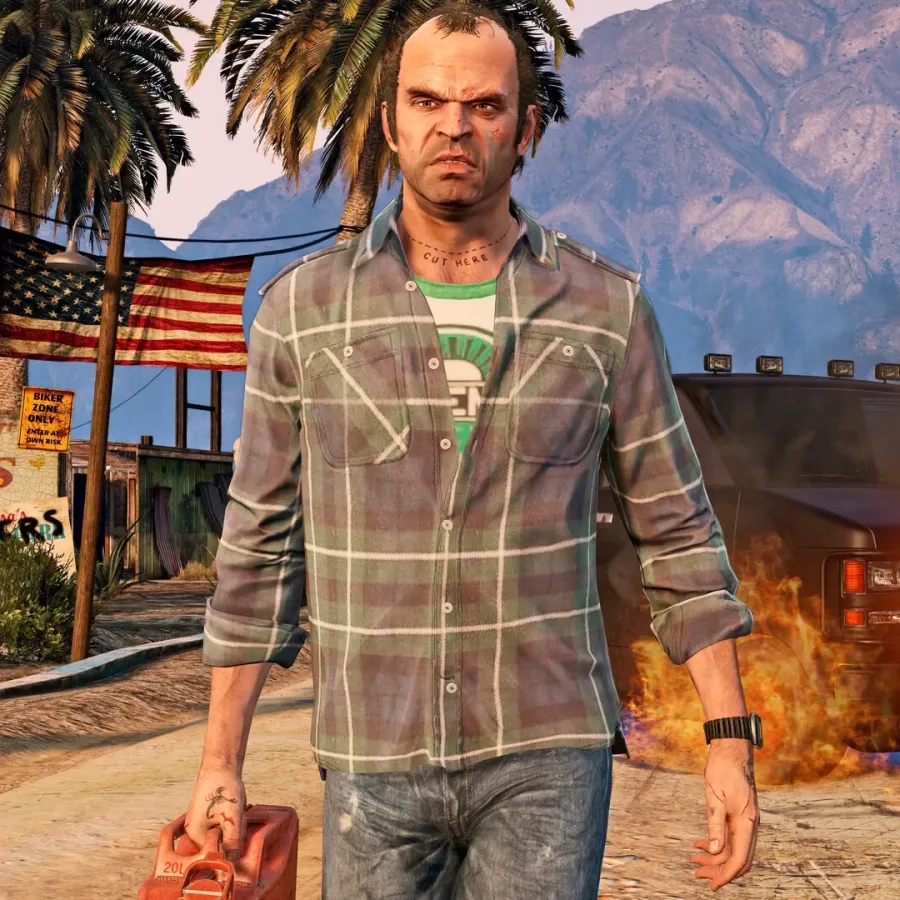
Grand Theft Auto V has spent more than a decade rewarding players who look closely at its world, its missions, and its characters. Los Santos is packed with radio jokes, incidental conversations, reactive police behavior, background animations, changing weather, and countless visual touches that can be easy to overlook during the chaos of a typical play session. A newly discussed example is especially easy to miss: a small blood effect on Trevor Phillips' jeans that persists after a pivotal mission, then gradually fades away as the player continues through the game.
The detail was created by former Rockstar Games designer Matt Freedman, who worked at the studio for almost nine years after beginning as a level designer on Max Payne 3. Freedman's most prominent contribution to Grand Theft Auto V involved the game's in-mission character-switching camera system. But the blood on Trevor's clothing reflects another side of large-scale game development: the substantial technical work that can be invested in a visual flourish many players may never consciously see.
A brutal introduction to Trevor
The story context for the effect arrives when players are properly introduced to Trevor, one of Grand Theft Auto V's three playable protagonists. His entrance is intentionally shocking. Trevor encounters Johnny Klebitz, the former lead character of The Lost and Damned, the expansion connected to Grand Theft Auto IV. The confrontation ends with Trevor violently killing Johnny, establishing both Trevor's instability and the harsh tonal shift that comes with his section of the campaign.
Freedman wanted the visual aftermath of that scene to carry into gameplay. Rather than treating the mission as a self-contained cinematic moment whose consequences disappear once player control resumes, he added blood spatter to Trevor's jeans. The stain begins around the boot cuff and extends upward on the leg, reflecting the violence of the encounter.
For useful background on this topic, read Schools Brace for GTA 6 Absences With Warnings, Homework Breaks and Gift Card Draws.
That alone would be a recognizable bit of environmental storytelling, but the feature went further. The blood was not intended to remain frozen in place forever. Freedman created a system that would slowly clean the jeans as the game progressed. In other words, the stain had a lifecycle: it appeared after the event, persisted as a reminder of what had happened, and gradually diminished over the course of a playthrough.
Persistence is harder than it sounds
Video game character models often reset in ways that are invisible to players. Death, respawning, mission failures, checkpoints, wardrobe changes, and transitions between gameplay states can all create complications for any visual state that is meant to remain consistent. Injuries such as cuts and bruises frequently vanish when a character dies and returns, because the game treats the respawned character as a fresh version of the model.
Trevor's jeans could not work that way if the intended effect was to feel believable. The blood needed to remain at precisely the same stage of its gradual cleanup process after a respawn. If it suddenly returned fully stained, or disappeared immediately because the character model had reset, it would undermine the point of the system. Freedman therefore had to ensure that the game tracked the state of the stain and restored it correctly whenever Trevor reappeared.
It is the kind of challenge that illustrates why small visual details are rarely as simple as adding a texture to an outfit. A detail must also survive the many systems surrounding it. It needs rules for when it begins, how it changes, what interrupts it, whether it can be overwritten, and how it behaves after the player fails a mission or dies in the open world.
For most players, the feature was likely hidden by another major strength of Grand Theft Auto V: player expression. Trevor can visit shops and change clothes, and many people will customize each protagonist's appearance shortly after gaining access to them. A new pair of trousers naturally removes the opportunity to watch the original jeans gradually clean themselves. Freedman himself suggested that he was certain almost nobody noticed the work.
Designing for the player, not the checklist
Freedman's explanation was not simply about technical pride. It was rooted in a broader philosophy about respecting the person holding the controller. He described players as the ultimate audience for a developer's work, emphasizing the desire for someone to come home after a difficult day, start a game, and have an enjoyable experience.
That perspective helps explain why an almost invisible clothing system mattered. The goal was not necessarily to make players stop and admire a bloody trouser cuff. Instead, it was to make the game world respond in a way that feels internally consistent. Even when players do not identify every individual system, they can still sense when a world seems attentive to cause and effect.
Freedman said he spent significant time considering whether a player might reasonably want to attempt a particular interaction, then asking whether the game respected that decision. He had previously applied the same thinking to Max Payne 3, where he worked to make sure gameplay interactions performed at one point in a level remained consistently acknowledged across the rest of that level.
That principle is particularly relevant in games built around player freedom. Open-world titles invite unexpected behavior: players wander away from objectives, revisit areas, test mechanics, change outfits, fail missions, and approach scenes in sequences the designers may not have anticipated. Every persistent detail is an opportunity to acknowledge that the player has a memory of what happened and that the game does too.
The appeal of details players discover years later
Rockstar's games have long generated discussions around systems that are amusing, elaborate, or both. One famous example from Red Dead Redemption 2 is the way horses visibly react to cold weather, a detail that became a frequent shorthand for the studio's willingness to spend time on minute simulation elements. It is easy to laugh at an unusually specific feature, but the Trevor jeans effect shows that the same development mindset can also serve character, continuity, and atmosphere.
Not every detailed system needs to be mechanically important. Some are there to create texture. A stain that fades naturally does not unlock a mission, change a weapon's damage, or alter the story. Yet it makes the transition from one scene to the next feel slightly less artificial. The player is not simply moved from cutscene to gameplay with no trace of the prior event; a physical reminder remains on Trevor's clothes.
These touches also give communities something to uncover long after release. Players return to older games with new questions, examine assets more closely, compare outcomes, and share discoveries that may have gone unnoticed at launch. In a medium where familiar genres and systems can make many experiences feel immediately recognizable, surprising interactions retain a special value. They suggest that there may still be another hidden layer waiting for someone curious enough to look.
What it says about Rockstar's approach
The blood-stained jeans are a tiny part of a massive game, and they should not be mistaken for a promise that every action in Grand Theft Auto V receives the same bespoke treatment. Still, the story demonstrates how individual developers can use small opportunities to reinforce the larger identity of a project. Trevor's stained cuff was not a headline feature, but it was deliberate, authored, technically supported, and tied to an important narrative moment.
As attention turns toward Grand Theft Auto VI, which is set to launch on November 19, stories such as this offer a reminder of what players often seek from a new Rockstar release. The expectation is not only a larger map, a new cast, or a more advanced presentation. It is also the prospect of hundreds of small decisions that make the world feel reactive, surprising, and worth revisiting.
Whether players noticed Trevor's fading blood stain or replaced his clothing immediately, Freedman's work still reflects a valuable design principle. The smallest details can communicate that player actions, story events, and time itself have consequences. In a game as chaotic as Grand Theft Auto V, a slowly cleaning pair of jeans may be one of the quietest examples of that idea.
Community
Discussion
Start the conversation.
No comments have been posted yet.