

Gaming culture has supplied the internet with another word that is now official enough to sit in a dictionary: friendslop. Collins has added the term to its dictionary, defining it as "a type of low-budget, independently produced video game, designed to be played casually with a group of friends."
It is a deliberately scruffy-sounding name for a corner of gaming that has become increasingly visible on PC storefronts and social platforms. These are games built around a simple but powerful proposition: get a few friends together, jump into a strange shared activity, make a mess, laugh at failures, and create stories that will be much funnier in retrospect than they sound in a game description.
The term arrived in a new group of slang and contemporary expressions recognized by Collins, although it did not claim the publication's top annual linguistic honor. That went to mogging, which was selected as Collins' Word of the Year for 2026.
What does friendslop mean?
Collins' definition is broad, but the word has a very specific cultural flavor. A friendslop game is generally not judged by the scale of its budget, its visual fidelity, or a meticulously authored campaign. Its appeal is social. It gives players a framework--whether that is climbing a mountain, collecting junk, surviving monsters, gambling on ridiculous outcomes, or simply trying to reach somewhere together--and lets the group generate the memorable moments.
For useful background on this topic, read Itch.io Removes Terabytes of AI Spam and Expands Its No-AI Search Filters.
The "slop" part is not necessarily an accusation that a game is badly made. More often, it is an affectionate and slightly mocking acknowledgement of the genre's rough edges, disposable-looking premises, bizarre physics, noisy voice chat energy, and immediate appeal. The games can be low-budget and independent, but that does not mean they are short on invention. In fact, their smaller scope can encourage designers to focus on one compelling co-op idea rather than attempting to compete with blockbuster productions.
Friendslop also describes how these games are consumed. They are often picked up because someone in a group has seen a clip, heard a recommendation, or wants an excuse to organize an evening online. A game may be entertaining alone, but the intended experience comes from the unpredictable interaction between players. Someone gets lost. Someone makes a terrible call. A plan collapses. A teammate accidentally becomes the problem. The game's systems create the setup; friends supply the comedy.
Big Walk stands out in the new label's growing category
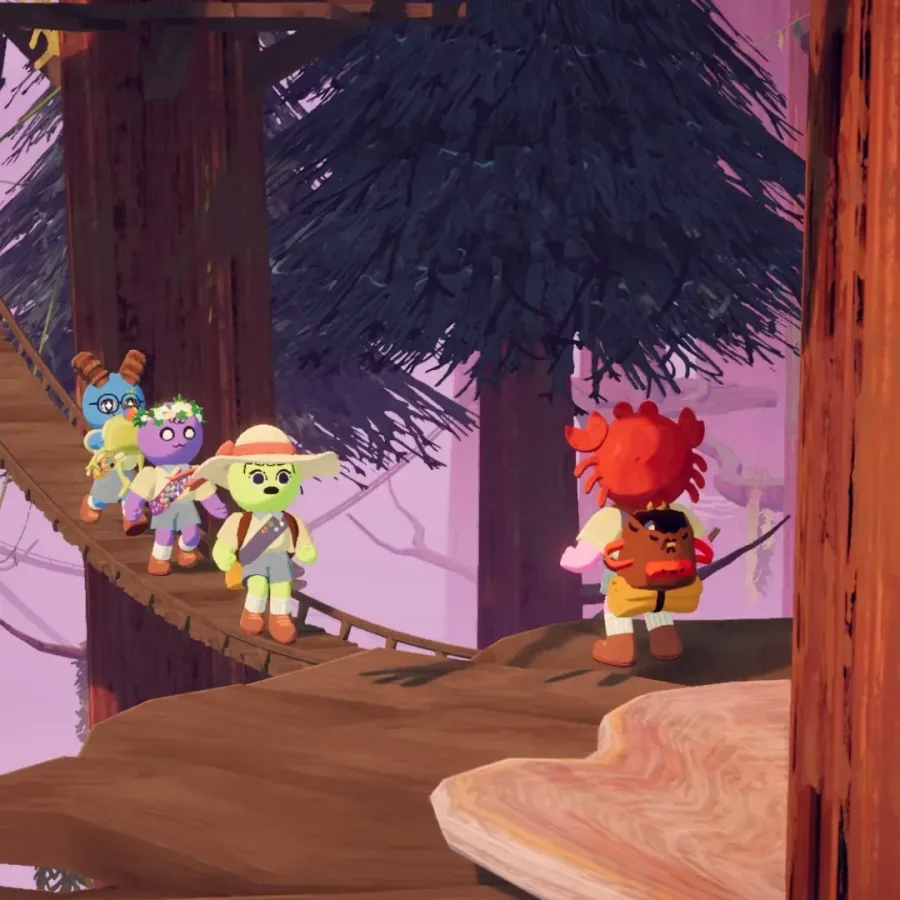
Big Walk is among the strongest recent examples associated with friendslop. Rather than treating co-op as a secondary feature attached to a more conventional adventure, the game makes communication, exploration, and collective problem-solving central to its identity.
Its open world allows groups to travel, get separated, recover from mishaps, and interpret the environment together. That can result in moments that would be difficult to script: falling down a mountain after dark and attempting to retrieve lost equipment, spotting a distant flare and using it to regroup, or slowly establishing shared language and routines for more complicated puzzles.
Those details show why the friendslop label should not be mistaken for a dismissal. A game can look modest, be made outside the traditional blockbuster system, and still be carefully designed around player behavior. Big Walk's greatest strength is not simply that it supports multiplayer. It understands that friends need room to improvise, make discoveries, and develop their own ways of communicating.
That distinction matters. Plenty of games let several people occupy the same digital space. The standout co-op games make the group itself part of the design. They turn coordination into a challenge, confusion into a source of humor, and accidental setbacks into stories players share afterward.
The games commonly called friendslop
Big Walk is not alone. The label has also been applied to games including Peak, Gamble With Your Friends, Lethal Company, and R.E.P.O.. Each takes a different route to the same social destination.
- Peak turns cooperative climbing and survival into a test of teamwork, with players helping one another through dangerous terrain.
- Gamble With Your Friends leans into a social-game atmosphere, where the enjoyment is inseparable from the people around the table--or, in this case, the digital table.
- Lethal Company uses tension, scavenging, and horror to create frantic group situations where communication can be as valuable as courage.
- R.E.P.O. similarly builds memorable multiplayer chaos from cooperative objectives, danger, and the ways players react when plans stop going smoothly.
These games have enjoyed millions of sales on Steam, demonstrating that the appetite for smaller, social-first experiences is not a marginal trend. Their success also reflects the importance of streaming clips, group chats, and word-of-mouth recommendations in modern game discovery. A single funny moment can explain the appeal more effectively than a trailer full of feature lists.
The idea has spread beyond Steam as well. Countless games on Roblox echo the same formula: accessible multiplayer structures, immediately readable objectives, and systems that encourage groups to return because the players make each session different. That does not mean every Roblox game belongs under the friendslop umbrella, but the platform's enormous social ecosystem has helped normalize the kind of casual, friend-driven play the term describes.
Why a dictionary entry matters
Dictionary recognition does not create a gaming trend, but it does signal that the language around that trend has traveled beyond a small online community. "Friendslop" is now a word with a documented meaning that can be used by developers, players, critics, and anyone trying to identify this style of co-op game.
That could be useful because the games grouped under the label do not always fit neatly into older genre categories. "Multiplayer" is far too broad. "Co-op" is accurate, but it includes everything from sprawling action campaigns to highly competitive tactical experiences. "Party game" gets closer in some cases, yet it may suggest local play or a very different kind of structured minigame collection.
Friendslop instead identifies a mood and a relationship between players. It suggests a game that is approachable, somewhat chaotic, and best experienced with a regular group. It also captures the contrast between polished presentation and social value: a title does not need to be visually lavish or mechanically enormous if it can reliably produce an evening of shared disaster and laughter.
Of course, labels can become limiting if they are applied too casually. Not every inexpensive indie co-op game is friendslop, and not every game people jokingly call slop lacks ambition. The new dictionary definition is a useful starting point, but the term will likely continue evolving as players use it across social media, storefront reviews, videos, and group chats.
Mogging wins the wider language battle
While friendslop secured its dictionary place, mogging was Collins' Word of the Year. The slang term means outshining someone else in a particular area. It can refer to appearance, height, status, wealth, skill, or nearly any quality people decide to compare.
In gaming terms, the usage is easy to understand. A player might say they are mogging an opponent after a dominant performance, though the word's wider online life is not limited to games. Like much contemporary slang, it shifts between irony, exaggeration, genuine admiration, and mockery depending on the context.
Alex Beecroft, managing director of Collins, said the organization's lexicographers examine both how frequently words appear and the patterns in which they are used. Beecroft described mogging as an example of Gen Z and Gen Alpha reshaping an existing word into humorous slang and making it their own.
Friendslop's addition belongs to that same broader story. Gaming communities do more than adopt new technology and new games; they produce language for experiences that older vocabulary does not quite capture. Sometimes those terms disappear as quickly as a viral clip. Sometimes, as friendslop now has, they earn a durable place in the dictionary.
For players, the practical takeaway is simpler than the linguistic debate. If a game gives a group of friends a strange problem, a little freedom, and enough room for everything to go wrong in memorable ways, it may be friendslop--and that is increasingly a compliment.
Community
Discussion
Start the conversation.
No comments have been posted yet.