

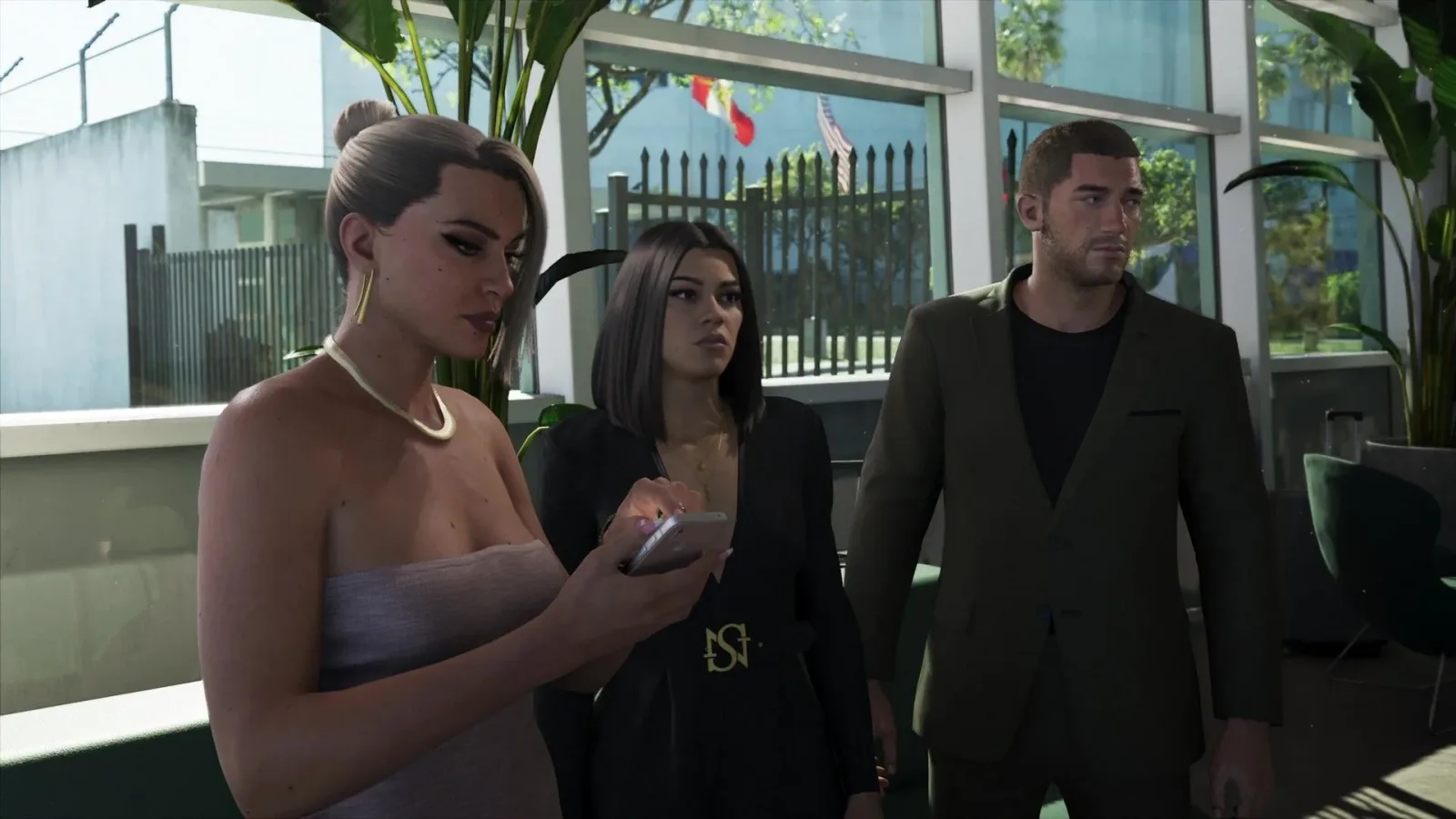
Grand Theft Auto 6 has brought a long-requested change to the series' celebrated radio formula: players can keep listening while away from a vehicle. The headphone feature gives Jason and Lucia a portable way to hear the game's stations while moving through Leonida on foot, whether they are exploring urban streets, traveling through wetlands, or heading into a mission.
It is an addition that can seem like a natural evolution for a huge open-world game in 2026. Yet former Rockstar Games technical lead Obbe Vermeij has revealed that the basic idea reaches much further back. Rockstar had considered headphones for Grand Theft Auto: Vice City, the 2002 entry that first took the series to Vice City.
Vermeij shared the detail after discussion around GTA 6's headphones and the way they affect immersion. He said the team had planned a headphone feature for Vice City, although it ultimately did not make it into the finished game. He attributed its absence to a technical issue, but said he could no longer remember precisely what prevented the feature from being completed.
Embedded X/Twitter post
The revelation creates an interesting connection between two games separated by 24 years, both associated with Rockstar's version of Vice City. A feature that now helps GTA 6 make its world feel more continuous was apparently already being explored when the franchise was still defining its identity as a 3D open-world series.
For useful background on this topic, read GTA 6 fastest cars: Where to Find the Thrax Truffade and Every Emerus Variant.
A small feature with a major effect on exploration
Music has always been central to the personality of Grand Theft Auto. Radio stations do more than provide a soundtrack. Their hosts, advertisements, genres, news segments, and song selections have helped establish the tone of each city and time period. Traditionally, however, that experience has been tied closely to cars, motorcycles, boats, and other vehicles with radios.
Headphones alter that relationship. Rather than treating travel on foot as a break from the radio, GTA 6 allows the music to follow the player beyond the driver's seat. The result is a more personal version of the usual Grand Theft Auto soundtrack: a player can walk through Leonida while listening to a favorite station rather than rushing to find another vehicle simply to resume the music.
That change also affects the rhythm of play. Open-world games often encourage players to move as efficiently as possible between map markers, missions, shops, and collectibles. Portable radio can make slower travel feel worthwhile. Walking through an area, observing the scenery, or taking a less direct route can become part of the experience instead of empty time between major activities.
It can also create unusual tonal contrasts during action. A radio track continuing through a tense encounter, for example, can make a shootout feel either more dramatic or strangely comic depending on the song and situation. The player retains the familiar Grand Theft Auto combination of danger, satire, and music, but no longer needs to remain inside a vehicle to experience it.
Vice City had the idea first
Vermeij worked at Rockstar Games from 1995 to 2009, a period that covered the studio's transformation from the era of the original Grand Theft Auto games through several of its most influential 3D releases. His recollection places the abandoned portable-radio idea during development of Grand Theft Auto: Vice City.
Released in 2002, Vice City was a technically ambitious game for its time. It built on the foundation of Grand Theft Auto III while presenting a larger sense of style, a distinctive 1980s setting, a major licensed soundtrack, and a city whose neon nightlife and coastal atmosphere became inseparable from its musical identity.
A portable radio system would have fit that setting especially well. Vice City's stations were among the game's defining features, and headphones could have extended their reach into the game's beaches, interiors, alleys, and on-foot missions. But early 2000s console development involved much tighter limitations than modern open-world production. Memory budgets, streaming demands, audio systems, user-interface constraints, and the challenge of keeping numerous systems working together could all complicate features that might seem straightforward today.
Vermeij did not identify the specific technical cause, so any attempt to pin the decision on one limitation would be speculation. What is clear is that the feature was considered and then cut before release. He also included an image of the intended pickup icon, offering a rare glimpse at an idea that did not survive the development process.
Portable radio, not a personal music player
The distinction Vermeij made about the original concept is important. The planned Vice City headphones were meant to provide a portable radio system, rather than functioning as a Walkman-style device that would let players select individual songs whenever they wanted.
That approach is consistent with how Grand Theft Auto has traditionally handled music. Players choose a station, not a specific track, and the station programming provides a curated flow of songs, presenter dialogue, and commercials. It is a format that supports the illusion of living radio rather than an on-demand playlist.
GTA 6 follows that same general principle. The headphones extend radio access, but they do not turn the game into a music library where individual tracks can be freely chosen at will. That limitation may disappoint players who imagine building a custom soundtrack for every mission, but it preserves a long-running part of the series' design. The randomness and station identity matter: a memorable song arriving unexpectedly can become connected to a chase, a mission failure, or a quiet walk through the world.
In that sense, the feature is not simply about giving players more control. It is about making the existing radio ecosystem available in more moments. The player remains inside Rockstar's programmed audio world, just with fewer restrictions on where it can be heard.
Why the timing makes sense now
The eventual arrival of headphones in GTA 6 illustrates how game features can wait years--or decades--until the surrounding technology and design priorities support them. The original idea emerged during an era when Rockstar was still learning what a 3D Grand Theft Auto could be. Modern hardware and production tools allow a vastly more detailed world, while player expectations have shifted toward seamless systems that continue across different activities.
For GTA 6, a portable radio makes particular sense because Leonida is designed to encourage attention beyond the road network. A soundtrack that continues during on-foot exploration helps connect the game's different spaces and reinforces the feeling that the world does not pause when the player leaves a car.
It also reflects the real-world habits that have changed since 2002. Personal audio is now a routine part of walking, exercising, commuting, and exploring public spaces. While Grand Theft Auto has always reflected and exaggerated contemporary culture, headphones give GTA 6 a small but recognizable everyday behavior that earlier entries could only gesture toward.
None of that means the feature was impossible in 2002 in a purely theoretical sense. Rather, development decisions are shaped by trade-offs. A team may have an appealing concept but choose to prioritize stability, performance, missions, vehicles, environments, or other systems needed to finish a game. Vermeij's comment is a reminder that cut features are not always bad ideas; sometimes they are simply ideas that arrive before the right moment.
An old concept finally finds its place
Grand Theft Auto is full of mechanics that have been refined across multiple generations: driving, shooting, mission design, radio, pedestrian behavior, police responses, and city simulation. The headphone feature now joins that history as an example of a concept that began as an unrealized possibility in Vice City and eventually returned in a much more technologically capable era.
For players, it may be one of GTA 6's quieter additions compared with its larger technical achievements and expansive open world. But its impact can be felt throughout ordinary play. It makes walks more atmospheric, gives exploration its own musical backdrop, and lets the series' famously curated radio stations remain part of the action outside a vehicle.
For Vermeij, it also closes a remarkably long loop. The portable-radio idea that did not happen in 2002 has finally become part of a Grand Theft Auto game set around Vice City. That makes GTA 6's headphones more than a convenience feature: they are the eventual realization of a Rockstar experiment that was left behind more than two decades ago.

Community
Discussion
Start the conversation.
No comments have been posted yet.