

Grand Theft Auto 6 remains one of the largest releases in modern games, yet its current availability leaves a major part of the audience waiting on the sidelines. The game can be played on PlayStation 5 and Xbox Series X/S, while Rockstar has not publicly detailed plans for a PC edition. That absence has helped fuel a fast-moving, legally fraught community push to make the console version run on computers through unofficial recompilation projects.
That push is already meeting resistance. Rockstar Games parent company Take-Two has sought the removal of public infrastructure connected to one of the most visible GTA 6 PC recompilation communities, Project Leonida. Its Discord server was removed following a request tied to Rockstar and Take-Two, while GitHub took down the project's central repository along with thousands of related forks after receiving a DMCA notice.
The situation has rapidly become a high-profile example of how accessible AI coding tools, leaked game material, public development platforms, and the enormous demand surrounding GTA 6 can collide. It is also a reminder that a project's technical ambition does not settle the legal and ethical questions around it--particularly when the work is connected to allegedly leaked proprietary code.
A PC audience is still waiting for official news
GTA 6 has the kind of cultural visibility few games achieve. For players who have a current PlayStation or Xbox console, that excitement can be experienced directly. For those limited to PC--or unwilling to buy a console at today's prices--the lack of a confirmed PC release window has been a conspicuous gap.
For useful background on this topic, read GTA 6 Leaves Mission Replay Behind to Protect Its Story Choices.
Rockstar's history makes the desire understandable. Grand Theft Auto V and Red Dead Redemption 2 eventually arrived on PC, but not at the same time as their original console launches. That track record has led many players to expect a PC version of GTA 6 eventually, though expectation is not confirmation. Rockstar has not publicly outlined a release schedule, technical specifications, or even an announcement plan for a PC port.
Into that uncertainty stepped several community projects pursuing "recompilation." In broad terms, recompilation efforts aim to adapt software built for one hardware environment so it can run on another. In prior game preservation and homebrew contexts, developers have sometimes attempted clean-room-style approaches that require users to provide their own legally obtained game files rather than redistributing protected assets such as art, audio, dialogue, or other game content.
Even in the most favorable interpretation, that route can occupy a complicated legal landscape. The controversy becomes substantially more serious when the work is built around an allegedly leaked executable from a commercial game, rather than a player's own legitimate copy and a strictly separated technical compatibility layer.
For another perspective on this story, read GTA 6 PC Recompilation Projects Face Takedowns After Xbox Executable Leak.
The alleged Xbox executable changed the pace of public efforts
The current wave of activity intensified after Cyberleek, described as a rogue individual or group connected to numerous GTA 6 leaks dating back to August, released what was said to be an Xbox Series X executable online. That alleged release removed one of the barriers that had existed for people attempting to inspect or adapt the console game's software.
It also gave highly motivated hobbyists a focal point at a moment when AI-assisted coding services are widely available. Tools such as Anthropic's Claude have been used by participants to generate code, troubleshoot errors, and attempt technical tasks through natural-language prompts. The result has been a burst of public "vibe coding" streams and posts in which people try to direct an AI system through porting-related work with limited conventional programming involvement.
Some of those streams have been hosted on platforms with comparatively light moderation. Public broadcasts create obvious risks for the creators, however. They can reveal activity in real time, associate usernames with a potentially infringing project, preserve evidence of how a project is being built, and make it easier for rights holders to identify the most active groups.
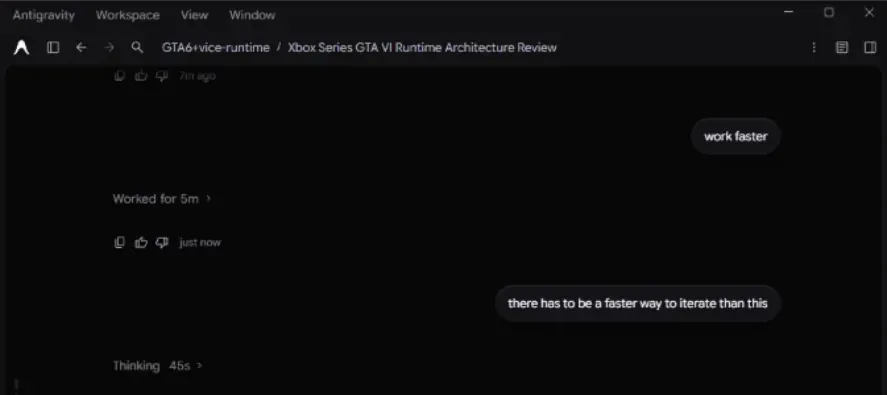
One account on Bluesky documented a stream in which the person operating the project was largely giving AI tools basic directives involving the game's title screen and urging them to progress more quickly. The episode illustrates the mismatch between the simplicity of some user prompts and the immense complexity of the job. Moving a modern open-world game from closed console hardware to the varied ecosystem of Windows PCs is not a matter of issuing a few commands to an assistant.
At least one public progress tracker, PortWatch VI, had presented a running timer starting from the executable's alleged release and tracked multiple community recompilation efforts with status indicators. A listed build was characterized as technically playable, but at below five frames per second. That is far from a viable consumer release, and it underscores how early these experiments appear to be from a functional standpoint.
Project Leonida faces Discord and GitHub action
Project Leonida emerged as one of the most visible communities dedicated to a GTA 6 PC recompilation. Its public profile also made it a natural target for enforcement. The group's Discord server was removed after a request connected to Rockstar and Take-Two.
The project's 15-year-old creator said on X that they would step away to concentrate on schoolwork. Many posts were subsequently deleted, while replies indicated that Discord had issued a two-year ban against the account. A later surviving post told followers to disregard other posts and watch for something significant in the future, leaving the project's actual status uncertain.
GitHub also received a request from Take-Two targeting Project Leonida's primary repository and its forks. The DMCA notice published by GitHub stated that the affected network was extensive enough that the removal action covered all 3,007 repositories associated with it. That scale demonstrates one of the practical realities of open development platforms: once a repository is forked repeatedly, its technical material can spread rapidly, while a takedown can also reach a large number of copies in a single action.
Neither the Discord removal nor the GitHub takedown necessarily resolves the broader issue. Public repositories and large chat servers are relatively easy to locate, document, and target. Smaller groups working privately, projects distributed through less visible channels, and individuals experimenting alone are much harder to monitor. The visibility that helped Project Leonida attract attention also made it easier to identify.
Why an unofficial port is not a simple shortcut
For the average player, an unofficial recompilation should not be viewed as a dependable alternative to an official PC release. Setting aside the legal concerns, a technically incomplete PC build of a game as large and demanding as GTA 6 could bring severe stability, performance, compatibility, and security problems.
PC releases require more than getting an application to reach a menu or render a few scenes. They need to account for countless combinations of processors, graphics cards, drivers, storage setups, operating-system versions, display configurations, input devices, and accessibility needs. They require optimization, crash testing, user interface changes, file integrity protections, networking considerations where relevant, and support for a broad range of real-world systems.
A build reported to operate at fewer than five frames per second is a technical proof of concept at most, not an experience remotely comparable to a finished product. AI tools can potentially accelerate individual programming tasks, explain errors, generate boilerplate, and help experienced developers test ideas. They do not erase the need for expertise, review, debugging, hardware knowledge, or extensive quality assurance. They also cannot make the underlying rights issues disappear.
There is an additional personal risk for anyone looking for these projects. Software obtained through unauthorized distribution channels can be malicious, mislabeled, incomplete, or bundled with malware. A game's extraordinary popularity makes it particularly attractive to scammers who can exploit players' eagerness for a PC version. Players should be cautious about files and claims that promise access to GTA 6 outside officially supported channels.
An enforcement challenge that may continue
Take-Two's actions show that the company is prepared to pursue prominent projects and widely shared code repositories. The company has previously taken a firm stance against unauthorized use of its games and intellectual property, and GTA 6 is one of the most commercially important releases it could possibly protect.
Still, online enforcement is often a continuing process rather than a final solution. A visible project can be removed, its discussion spaces can disappear, and a repository network can be taken down, only for similar work to reappear under different names or in different places. Public trackers that rank progress can become a useful guide for enthusiasts, but they can also serve as a map for legal teams seeking the most active targets.
That does not mean an unofficial community port is inevitable, functional, or likely to meaningfully displace the eventual official version. The number of people prepared to seek out obscure repositories or risky file-sharing locations, navigate difficult installation steps, and accept unreliable performance may be relatively limited compared with the huge audience likely to buy a supported PC release when one is announced.
But the episode is significant beyond GTA 6. It highlights a growing tension for the industry: AI coding tools lower the barrier for people to experiment with software projects, while leaked binaries and proprietary material can give those experiments a far more troubling starting point. Rights holders now face an environment where public technical efforts can form rapidly, fragment across many platforms, and attract participants before conventional enforcement can catch up.
For now, Rockstar has not announced a PC version of GTA 6, and Project Leonida's most public infrastructure has been removed. Other recompilation attempts may continue to surface, especially away from open repositories and highly visible streaming channels. Yet the only version of GTA 6 that can offer players clear legitimacy, support, security, and a finished level of performance on PC will be one released through official channels.

Community
Discussion
Start the conversation.
No comments have been posted yet.