

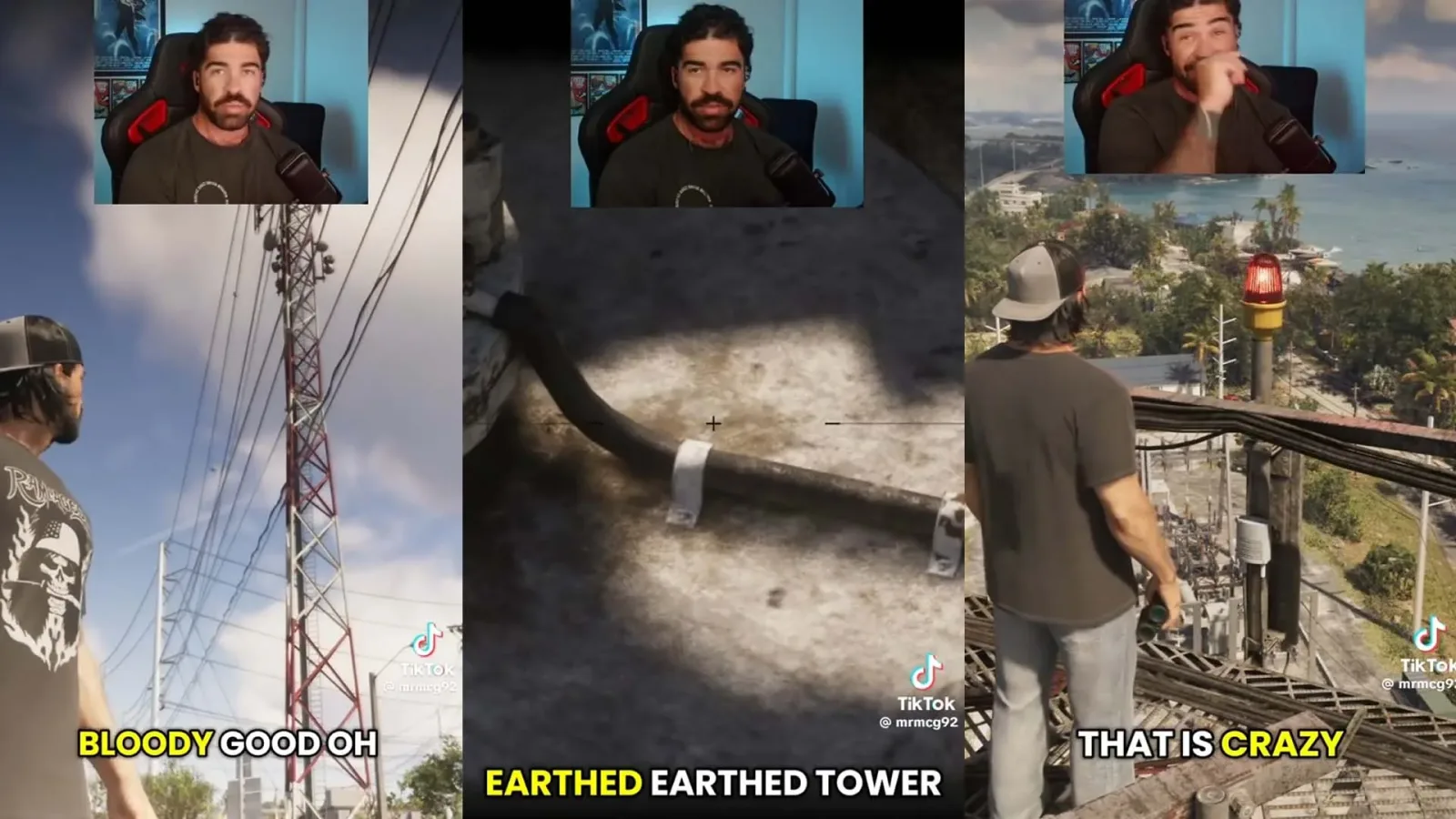
Grand Theft Auto 6 has attracted plenty of attention for its huge setting, crowded streets and broader ambitions, but one of its most enthusiastic recent examinations concerns something many players will probably drive past without a second glance: a radio tower.
Content creator MrMcg92, who has real-world experience working on and climbing large communication towers, took a close look at one of the structures in GTA 6 as part of his ongoing "Tower Inspection" videos. His verdict was emphatic. Rather than finding a simplified landmark made to look convincing from a distance, he spotted construction and equipment details that he says closely resemble the practical components expected on an actual communications installation.
The inspection turned a seemingly ordinary piece of open-world scenery into a showcase for environmental art. Grounded tower legs, specific mounting hardware, cable routing, panel connections and an aircraft warning light all stood out during the climb. For players who do not know the terminology, much of the discussion may sound highly technical. The central takeaway, however, is simple: someone familiar with these structures found an unusual amount of care in a part of the world that is easy to overlook.
A specialist perspective on a small piece of a massive world
MrMcg92 is known primarily for content around first-person shooters and military simulations, but his professional background gives him a distinctive way of assessing virtual environments. When a game includes a climbable or visible radio tower, he examines it with an eye for the real equipment, structural choices and safety-related features that developers often omit or approximate.
For useful background on this topic, read White PS5 DualSense Falls to $54 as GTA VI Arrives.
That perspective has previously been applied to towers in games including Battlefield, Days Gone and Far Cry. Those games can include attractive, recognizable towers, yet the inspections have identified places where designs are incomplete, impractical or lacking components that would commonly be present on an operating communications site.
GTA 6 appears to have made a markedly different impression. Approaching the tower, MrMcg92 immediately noticed that the legs had been earthed, or grounded, and that saddles were present. He also pointed out double locknuts on hardware he identified as HDs. These are not the kind of additions needed to tell a player, at a glance, "this is a radio tower." They are the sort of specifics that help an environment hold up when viewed by somebody who knows what they are looking at.
The creator's excitement was not limited to a single object. As he climbed, he continued to call out details in the tower's setup, including AA clamps at mount points, cable tails running from panels, and connections leading to an RRU. He also noticed a red power cable running up the middle of the structure. The tower ultimately included another feature he had hoped to see: a red aviation warning light at the top.
For another perspective on this story, read A Tower Worker's GTA 6 Inspection Finds Earthed Legs, Double Locknuts and a Warning Light.
Put together, those observations suggest that the asset was designed with more than silhouette and atmosphere in mind. The visible components appear to have been considered as parts of a functioning installation, even if players are unlikely to interact with them in any meaningful gameplay sense.
Why grounding, hardware and cabling matter
In a game, a tall steel tower can be represented with a handful of beams, ladders and antenna panels. That is often enough for navigation, mission design or visual storytelling. Yet a real tower has to address a much wider range of concerns. Its structure needs to be installed securely, equipment must be mounted and connected properly, electrical systems require suitable routing and protection, and tall structures can need lighting to remain visible to aircraft.
Grounding is one of the details that helped GTA 6's tower stand out to MrMcg92. Communication towers are exposed structures, and earthing is an important part of managing electrical risk, including lightning-related concerns. It may be an obscure detail for most players, but it is immediately meaningful to someone who has worked around this kind of equipment.
Likewise, double locknuts and correctly represented clamps may seem minor in isolation. Their inclusion helps give a structure a sense of physical logic. In the best environmental art, small components support the illusion that a place existed before the player arrived and would continue to operate if the player left. The scene no longer feels like a collection of props arranged solely around a mission marker.
The red cable and equipment connections caught attention for the same reason. A virtual tower can look impressive while still leaving viewers to wonder how its antennas receive power or communicate with other infrastructure. Visible cabling does not make a game simulation-grade engineering software, of course, but it can make the setting feel substantially more credible.
Then there is the warning light. Red obstruction lights are a familiar feature of tall real-world structures, especially those near flight paths or extending above surrounding terrain. Including one at the peak provides a useful visual touch at night, but it also completes the picture from an occupational perspective. For MrMcg92, finding that light capped an inspection already full of unexpectedly accurate elements.
Environmental storytelling beyond landmarks
Open-world games are frequently judged by the scale of their headline locations: skylines, beaches, airports, highways, stadiums, downtown districts and rural backroads. GTA 6 has naturally been discussed in those terms. However, the reaction to this tower demonstrates how much worldbuilding depends on objects far away from the main attractions.
Utility infrastructure is especially important in creating a believable contemporary setting. Power lines, cell towers, substations, roadside cabinets, drainage systems, traffic equipment and industrial facilities are usually background scenery. They also make up much of the visual language of everyday life. If these systems are too generic or repetitive, a large world can feel artificial despite having impressive architecture and dense crowds.
Conversely, infrastructure that has been researched and built with care can make a fictional region feel inhabited and functional. The player may not consciously catalog every bracket, cable or warning light, but those elements contribute to the impression that the map has rules. A tower does not merely exist because the game needed something tall for the horizon; it appears to serve a purpose within the landscape.
This is particularly valuable in a series built around observation as much as action. Grand Theft Auto worlds encourage players to wander, take detours and investigate spaces not directly tied to objectives. Details tucked into industrial yards, highway corridors and remote countryside can become memorable because they reward curiosity. A highly specific tower model may never be the center of a major story beat, but it can help make the journey between those moments more convincing.
The value of expert reactions
Specialist breakdowns have become a useful way to appreciate game development from angles that ordinary previews rarely cover. Firefighters can assess emergency vehicles and station layouts. Pilots may comment on aircraft procedures. Historians can identify period inaccuracies. Mechanics, architects, military personnel and road-design specialists often see details that are invisible to a general audience.
These reactions should not be treated as a demand that every game reproduce every profession with total precision. Video games are designed experiences, and visual readability, performance, gameplay and artistic direction all matter. Still, when experts recognize familiar, functional touches, it can reveal the depth of research behind a world.
MrMcg92's response to GTA 6's tower is notable precisely because he has criticized or questioned virtual tower designs before. His enthusiasm did not come simply from seeing a recognizable mast in a high-profile game. It came from recognizing multiple interconnected details that he believes are commonly missing in other depictions.
That distinction matters. A single accurate component can be accidental or decorative. Several correct-looking components, arranged in a way that supports the broader structure, imply a more deliberate reference process. It is impossible to know from one inspection exactly how Rockstar's team researched or assembled the asset, but the result was convincing enough to impress a person accustomed to these installations.
One tower, and potentially many more details to find
GTA 6's scale means the radio tower will almost certainly be one tiny part of a much larger environmental package. The enthusiastic inspection also raises an entertaining possibility: other professionals may begin scrutinizing the game's less glamorous systems once they can explore the world more broadly.
Electrical workers could examine poles, transformers and substations. Highway specialists may focus on lane layouts, guardrails, signage and interchanges. Construction workers might investigate job sites and building methods. Maritime experts could look at docks and boats, while aviation observers may study airport operations and lighting. Not every element will necessarily withstand that level of review, nor should any single feature define the full game. But these detailed checks can provide a different measure of how successfully a fictional place sells its reality.
For now, the tower inspection is a reminder that technical authenticity can be found in unexpected corners. Most players may only notice the structure as part of the skyline. Others may climb it for the view, a collectible or the novelty of reaching the top. A tower worker, meanwhile, can see earthed legs, locking hardware, proper clamps, cable runs and a warning beacon--and find a surprising amount to celebrate.
That kind of response is a strong compliment for the artists responsible. In an open-world game filled with large-scale spectacle, it is often the unglamorous details that make a setting feel like a place rather than a backdrop. GTA 6's radio tower may be a small part of the map, but it has already become an example of how closely observed infrastructure can turn routine scenery into something worth inspecting.
Community
Discussion
Start the conversation.
No comments have been posted yet.