

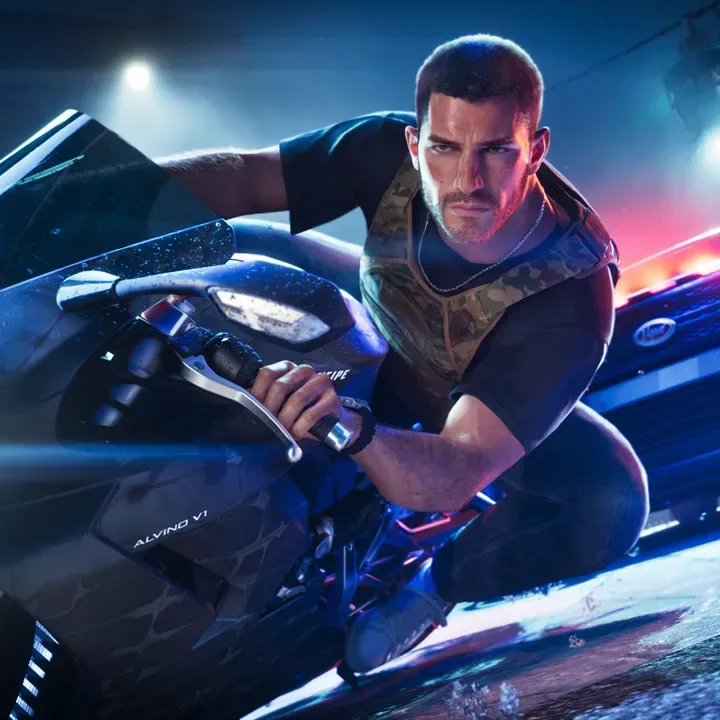
Grand Theft Auto 6 is prompting a fresh debate among players over its Criminal Profile mechanic, a system designed to track how Jason and Lucia conduct themselves across Leonida. The discussion is not simply about whether the game has a morality meter. Instead, it centers on what the game appears to value: calculated, discreet criminal behavior versus reckless violence that leaves chaos in its wake.
That distinction sounds straightforward, but the system has become contentious because some players feel they are being punished for reasonable actions, including responding with lethal force when threatened. Others argue that this reaction misses the point entirely. In their view, Criminal Profile is not judging whether a character is morally good or bad. It is judging whether they are a controlled, capable criminal or an escalating danger to everyone around them.
The divide matters because GTA has always encouraged players to experiment. For many, spontaneous car thefts, explosive firefights, and indiscriminate destruction are inseparable from the series' appeal. GTA 6 does not appear to remove that freedom, but it attaches longer-term character and gameplay consequences to how far players take it.
A five-tier scale for Jason and Lucia
Criminal Profile tracks each protagonist separately, meaning Jason and Lucia can develop very different reputations depending on how each is played. The scale has five labels: Professional, Hardened, Violent, Psycho, and Irredeemable.
For useful background on this topic, read GTA 6 Update 01.002.002 Fixes Crashes, Stuck Weather, and Story Phone Calls.
The lowest tier, Professional, does not mean avoiding all violence. A player can still kill enemies and complete dangerous jobs while retaining that classification. The central idea appears to be discipline. Stealth takedowns, non-lethal incapacitations, and acts of kindness toward non-player characters contribute to a more professional profile and can provide a focus boost. During bullet-time-style moments, shots aimed at limbs are highlighted in yellow, encouraging players to disable threats rather than immediately go for lethal headshots.
That is a significant change in emphasis for a series often built around excess. The system seems less interested in counting bodies than in recording the circumstances around them. Clearing a hostile hideout while using stealth, avoiding civilian casualties, and incapacitating enemies where possible is treated very differently from turning a public confrontation into a massacre.
Hardened occupies the next position on the scale. This represents a character who is more willing to kill in a firefight, such as regularly choosing headshots against hostile opponents, without necessarily turning on police officers or uninvolved bystanders. It is still a criminal profile, but not one defined by uncontrolled destruction.
The shift to Violent is more severe. At that stage, police and random civilians are increasingly being swept into the player's actions. The focus bonus changes too, favoring headshots and reflecting the more lethal approach. It is a clever way of connecting the mechanical reward to the personality being formed: the game does not merely tell players their character has become more violent; it alters the combat tools that reinforce that behavior.
Where the consequences become permanent
Psycho is where Criminal Profile becomes especially punishing. Reaching this rank means the player has left behind a trail of defenseless victims, animals, or excessive collateral damage. Law enforcement responses become harsher, and the option to surrender is removed. The game's logic is clear: a character who has repeatedly shown they cannot be trusted to de-escalate is no longer offered an easy route out of a confrontation.
The final tier, Irredeemable, raises the stakes further. Players who remain at Psycho for too long, after receiving multiple in-game warnings, can permanently enter Irredeemable status for the rest of the playthrough. Once there, Criminal Profile can no longer be changed. The player also loses the ability to boost focus, making combat more difficult, and there are narrative consequences tied to the state of the character.
The permanent nature of that outcome is likely a major reason the system is attracting so much attention. GTA has historically allowed players to cause catastrophic mayhem and then return to the main story with few lasting consequences beyond a wanted level. GTA 6 seemingly offers that same chaotic possibility, but asks players to accept that their protagonists may be defined by it.
Why self-defense has become the flashpoint
The most common criticism is not that GTA 6 tracks violence at all. Many players like the idea of differentiating between a careful criminal and an indiscriminate killer. The concern is that some situations appear difficult to read, particularly street encounters where an NPC attacks first and the player responds with a headshot.
Critics argue that lethal self-defense should not necessarily push a character away from Professional status, especially when the player is reacting to an immediate threat. There is also frustration around carjacking. Some players believe removing someone from a vehicle without injuring them should fit the game's criminal fantasy without being treated as an especially negative act.
That perspective is understandable. The GTA series has trained its audience to see vehicle theft as a basic interaction rather than an ethical choice. The name itself foregrounds grand theft auto, after all. If a player simply needs a fast escape from danger, forcing a driver out of a car may feel practical rather than psychotic.
But defenders of the mechanic see those examples differently. Their interpretation is that the profile is about planning and operational control. A Professional does not need to hijack a stranger's vehicle in the middle of traffic because they prepared an escape vehicle before the job began. They do not shoot a clerk during a robbery when intimidation would have been enough. And they do not turn every hostile encounter into a headshot contest if a less conspicuous option exists.
Under that reading, "professional" is not a synonym for "heroic." It means efficient, prepared, and restrained when restraint serves the job. The character is still committing crimes. They are simply avoiding the kind of behavior that creates witnesses, casualties, panic, and an overwhelming police response.
Context appears to be the key
Much of the uncertainty may come down to how GTA 6 evaluates context. The available details suggest that the system does not automatically condemn every kill. For example, killing a gang member inside a hostile location after mostly using limb shots may not significantly damage a Professional profile. The same action in a public setting, or firing at a bank employee rather than threatening them, can be treated much more seriously.
That nuance is ambitious, but it also creates a communication challenge. Players need to understand why a particular action changed their profile. If the game does not make the contextual rules legible, a player may conclude they are being penalized for defending themselves when the actual issue was location, target type, level of force, witness exposure, or a preceding decision such as failing to plan an escape.
For a system with permanent consequences at its extreme end, clarity is essential. It is one thing to discover that random collateral damage moves a character toward Violent. It is another to unknowingly cross a threshold that ultimately locks a protagonist into Irredeemable status. The in-game warnings before that final transition provide some protection, though players will still want a clear sense of how to reverse course before it is too late.
A role-playing layer for a series built on freedom
At its best, Criminal Profile could give GTA 6 a more meaningful role-playing dimension without taking away the series' sandbox identity. A player who wants Jason to be a composed operator can park around the corner, bring changes of clothes, disable alarms, remove evidence, use lockpicks, and arrange a route to a body shop. Another player can let Lucia become an increasingly volatile force whose missions erupt into chases and shootouts.
That contrast may be especially effective because the system is tracked separately for both leads. Rather than delivering one fixed interpretation of the duo, GTA 6 can reflect the player's habits. One protagonist may remain focused and methodical while the other becomes feared by police and civilians alike. The mechanic turns routine gameplay decisions into a form of character writing.
There is a simple comparison players have used to explain the scale: it resembles a movement from Michael to Trevor. That shorthand captures the broad idea, even if GTA 6's system appears more detailed than a personality comparison. The question is not just whether the player is violent. It is whether that violence is purposeful, contained, and compatible with getting away cleanly.
The argument is likely to continue
The disagreement over Criminal Profile ultimately reflects two different expectations for GTA. One side wants the franchise to preserve its traditional consequence-light chaos, where blowing up a city block can be followed by a relaxed drive to the next mission. The other welcomes a world that reacts more persistently, particularly in a story aiming for greater weight in its relationships and criminal escalation.
Both approaches remain possible in GTA 6. Players can still embrace mayhem, but the game appears willing to label that choice and make it matter. For those who want to maintain a Professional profile, the lesson is not to become harmless. It is to be deliberate: plan ahead, keep violence proportionate, avoid civilian harm, and leave as little evidence as possible.
Whether that balance feels immersive or restrictive will depend on how consistently the system recognizes player intent. For now, the strongest takeaway is that GTA 6's Criminal Profile is not a conventional good-versus-evil meter. It is a measure of the kind of criminal each player chooses to become--and whether Leonida sees them as skilled, dangerous, or beyond redemption.
Community
Discussion
Start the conversation.
No comments have been posted yet.