

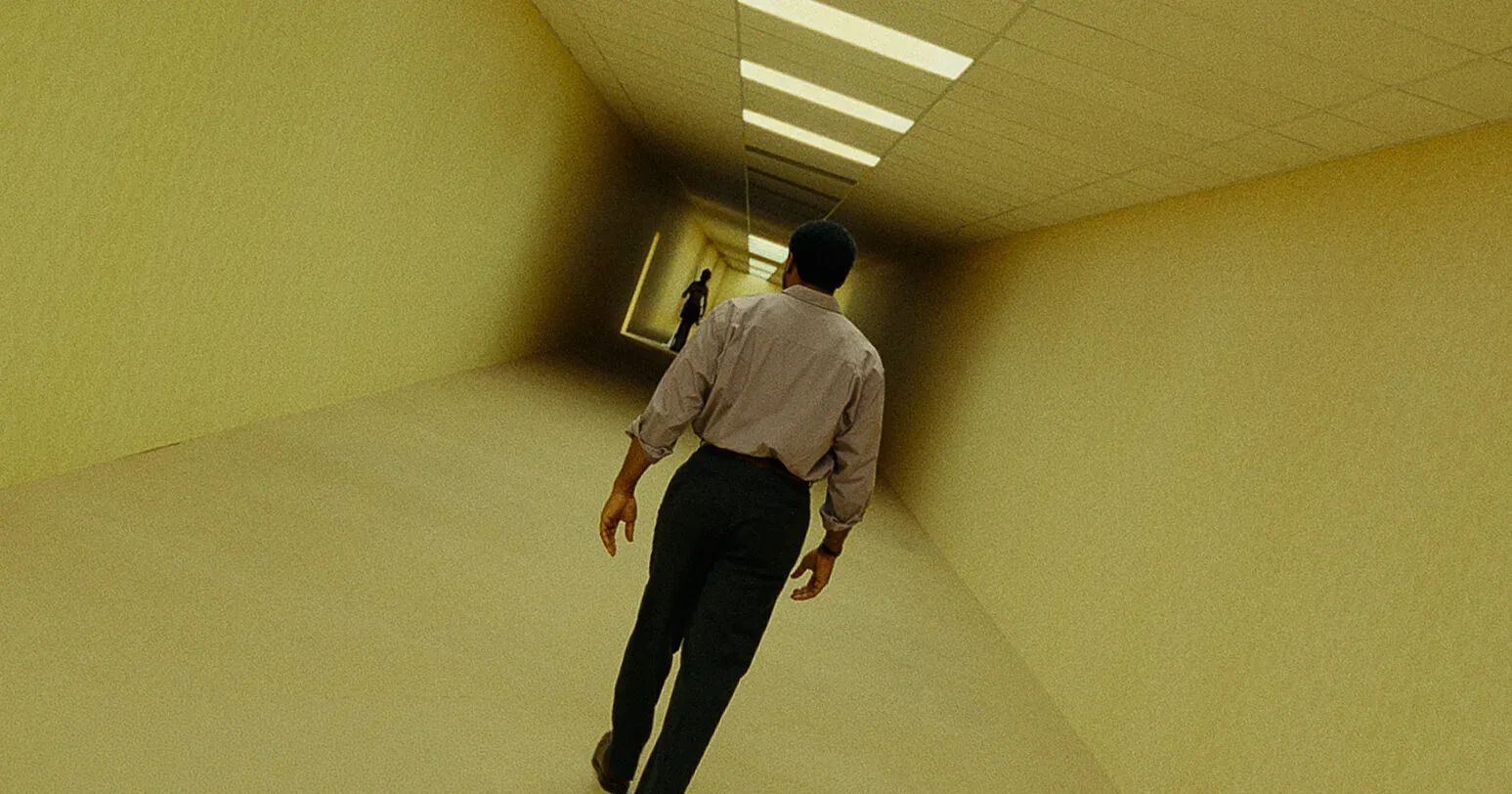
Hideo Kojima's enthusiasm for Backrooms has become one of the most intriguing intersections between games, online horror, and contemporary filmmaking. During the Japanese rollout of the film, the Kojima Productions founder appeared alongside director Kane Parsons for a post-screening Q&A in Roppongi, Tokyo. Kojima used the discussion to share his admiration for Parsons' approach to mystery, atmosphere, sound, and visual design--and admitted that the younger filmmaker's work made him feel "a little jealous."
The event also produced a tantalizing, if still entirely unconfirmed, hint of a future creative partnership. Parsons said he would like to collaborate with "a certain someone" in the near future after visiting Japan and spending time at Kojima Productions. No project was announced, and neither creator provided details about what a collaboration could be. Still, the combination has naturally captured the imagination of fans who recognize how closely their artistic interests appear to align.
Kojima is a game creator whose work has long blurred the boundary between interactive entertainment and cinema, while Parsons emerged from internet horror with a highly influential interpretation of the liminal-space concept known as the Backrooms. Their meeting is not confirmation that a game, film, or other project is in development. It is, however, a notable moment for two creators who each have built reputations around unsettling spaces, ambiguous storytelling, and atmosphere that lingers long after a scene ends.
Embedded X/Twitter post
Embedded X/Twitter post
Kojima Celebrates the Craft Behind Backrooms
Kojima had already seen Parsons' original Backrooms short film before the feature-length version reached Japanese cinemas. He explained during the September 4 screening discussion that he had been curious about how the premise would be expanded into a full movie. His reaction focused not merely on the concept itself, but on the execution behind it.
For useful background on this topic, read Physical Media's Music Revival Offers a Warning--and an Opportunity--for Games.
He praised the film's tricks, art direction, sound work, and story construction. Kojima was particularly taken with the way the visuals and audio support the larger structure of the narrative, rather than simply serving as surface-level horror decoration. In his remarks, he emphasized that he wanted to avoid revealing details that could spoil the experience for new viewers, but his overall message was clear: Parsons' film impressed him on a technical and artistic level.
That response carries extra weight because Kojima has spent decades making games where environment and sound are storytelling tools in their own right. From the militarized surveillance spaces of Metal Gear Solid to the desolate landscapes and strange thresholds of Death Stranding, his games frequently ask players to absorb mood before they fully understand context. The Backrooms concept similarly derives much of its power from disorientation. Familiar-looking interiors become unnerving because of their scale, repetition, emptiness, and the nagging sense that they do not obey ordinary rules.
Parsons' work helped transform that online fascination into a widely discussed horror property. The director's early Backrooms films gained attention through their convincing found-footage presentation, immense vacant spaces, and an ability to make mundane architecture feel hostile. A feature film has different demands than a short-form viral work, so Kojima's praise for the structure and integrated design suggests he believes the project successfully made that leap.
A Japanese Release with a Very Different Age Rating
The Japanese debut created an unusual contrast with the movie's ratings elsewhere. Backrooms received an R rating in the United States and comparatively restrictive classifications in many other territories. In Japan, however, the film was assigned a G rating, making it open to audiences of all ages.
That difference was especially visible at the screening Kojima attended. The audience included parents and young children, and Kojima later recalled hearing children say they might struggle to sleep after watching the film. The reaction reflects a curious strength of Backrooms-style horror: it can disturb viewers without relying solely on conventional monsters, gore, or explicit violence. A humming light, a long hallway, an empty room, or the suggestion that something is waiting just beyond sight can be enough to create powerful unease.
Kojima also described overhearing a young boy repeatedly asking his father how the enormous Backrooms environments had been made, wondering whether they were computer-generated. Kojima said he was tempted to tell the child that the locations were sets, but held back. It is a small anecdote, but it underlines one of the film's most effective qualities: the spaces are persuasive enough to inspire questions about how they could possibly exist.
For game audiences, that reaction may sound familiar. Environmental illusion is central to game design, especially in horror. Players often examine distant corridors, ceilings, prop placement, lighting, and architecture for evidence that a location has been built with a purpose. When a fictional environment feels too large, too quiet, or too artificial, it can produce tension even before a direct threat appears. Backrooms horror turns that sensation into its central language.
Why a Parsons-Kojima Pairing Makes Sense
Speculation around a potential collaboration is understandable, though it remains speculation. Parsons visited Kojima Productions during his trip, joining a long list of actors, directors, musicians, and other artists who have passed through the studio. Kojima's creative network is famously broad, and he has consistently incorporated performers and collaborators from film, television, music, fashion, and art into his projects.
His current work already reflects those connections. Kojima Productions is developing multiple projects across games and screen entertainment, while Kojima is also working with A24 on a live-action adaptation of Death Stranding. A24 also produced Backrooms, giving the encounter an additional industry connection, even though the film's Japanese distribution is being handled by a separate company.
It would be premature to assume that Parsons has joined a Kojima Productions game, that Kojima will become involved with a future Backrooms installment, or that the two are preparing a movie. None of that has been announced. Yet their public comments leave the door open. Parsons' suggestion that he hopes to work with "a certain someone" was delivered after discussing his appreciation for elements of Japan, including its architecture, and it was difficult to miss the context of his appearance with Kojima.
Architectural fascination could be a particularly meaningful shared interest. Much of Kojima's design sensibility is rooted in spaces that communicate history, systems, and emotional distance. Parsons' Backrooms imagery treats architecture as an unknowable force: rooms repeat, proportions become strange, and an office-like interior can feel as alien as another planet. Whether in a game or a film, a collaboration between the two could potentially explore environments as characters rather than backgrounds.
From Online Horror to Mainstream Conversation
The broader significance of the meeting is that it demonstrates how internet-born storytelling has entered conversations once dominated by established studios and traditional film pipelines. The Backrooms began as a viral concept built around liminal imagery and collective imagination. Its appeal grew through memes, fan fiction, games, videos, and countless interpretations of what might exist beyond those yellow walls and endless corridors.
Parsons' films stood out because they gave that abstract idea momentum and cinematic credibility. Rather than simply explaining the mythology, the work emphasized uncertainty and scale. Viewers were placed in spaces where answers remained incomplete, and the lack of certainty became part of the horror. That approach resonates with many modern games, particularly those that let players piece together meaning from place, sound, fragmented documents, and half-seen details.
Kojima's interest therefore feels less like a random celebrity endorsement and more like a recognition of a creative method he understands well. Both creators are interested in tension generated by the unknown. Both use the relationship between people and spaces to create unease. Both also work in mediums where audiences actively search for hidden meaning, whether that means analyzing a cryptic game trailer or decoding the possible rules of an impossible building.
What Happens Next Remains Unknown
For now, the most concrete outcome is the Roppongi Q&A and the evident mutual respect shown by both creators. Kojima has publicly celebrated Backrooms, Parsons has visited Kojima Productions, and the director has voiced interest in working with someone who very clearly appears to be Kojima. That is enough to fuel conversation, but not enough to establish any formal project.
Fans should therefore treat the possibility as an exciting creative prospect rather than a confirmed announcement. Kojima Productions has not revealed a Parsons-related game or production, and Parsons has not identified the medium or scope of any potential team-up. The pair may simply remain admirers of each other's work. Even so, their meeting has highlighted an appealing idea: what might happen if one of gaming's most cinematic auteurs joined forces with a filmmaker who has made empty rooms feel terrifyingly alive?
Whatever comes next, Kojima's reaction places Backrooms firmly within a larger discussion about how horror evolves across media. The project's Japanese release has brought it to a new audience, including viewers young enough to leave the theater with uneasy questions about how its impossible spaces were created. And for players who appreciate eerie worlds, layered design, and stories that refuse to explain everything, the prospect of Kojima and Parsons crossing paths again will be one worth watching.
Community
Discussion
Start the conversation.
No comments have been posted yet.