

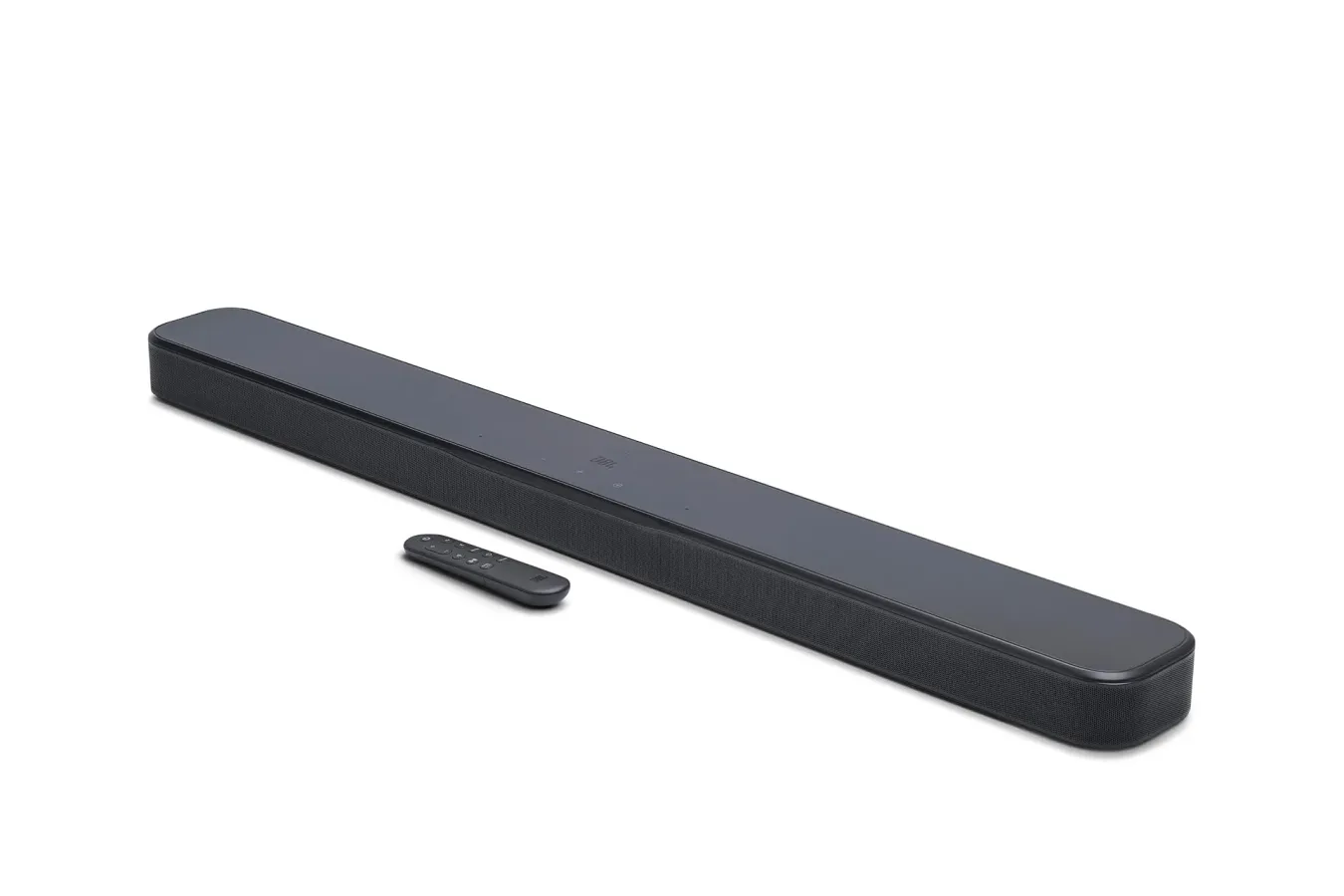
A large television can make a game world look spectacular, but it cannot do all the work alone. Built-in TV speakers are often one of the biggest compromises in a living-room setup: they are small, rear-facing or downward-firing, and frequently struggle to separate music, dialogue, effects, and ambient sound when a game becomes busy. For players using a console at the TV, or a PC connected to the big screen, a soundbar can be one of the more straightforward ways to improve the overall experience without building a full surround-sound system.
The JBL Bar 300MK2 is currently discounted to $280, a reduction of $170 from its usual price and roughly 38% off. That matches the model's reported lowest price. The offer is described as limited-time, so anyone considering it should verify the listing price before committing. At this price, the all-in-one 5.0-channel soundbar lands well below many premium home-theater upgrades while retaining features aimed at clearer speech and more expansive spatial audio.
What the JBL Bar 300MK2 brings to a gaming setup
The Bar 300MK2 is a 5.0-channel all-in-one soundbar. In practical terms, it is designed to deliver a broader and more layered presentation than standard TV audio without requiring a separate subwoofer or a collection of rear speakers around the room. That makes it particularly relevant for apartments, bedrooms, dens, and shared living rooms where cable management and speaker placement are real considerations rather than an afterthought.
JBL lists up to 450W maximum output for the unit. Output figures do not tell the entire story of sound quality, and room size will always affect the results, but the specification suggests considerably more headroom than the speakers housed in most modern flat-panel TVs. For games, that extra capacity can matter when a soundtrack swells, vehicles pass across the screen, or a multiplayer match shifts from calm communication to a wall of explosions.
For useful background on this topic, read Samsung B-Series Soundbar Deal Drops a Simple Gaming Audio Upgrade to $90.
The soundbar also supports Dolby Atmos. Atmos content is intended to create a more three-dimensional sense of placement than conventional stereo playback, with audio appearing to occupy areas around and above the listener. An all-in-one bar cannot replace every advantage of a carefully positioned multi-speaker system, and the exact effect will depend on the room, ceiling, source material, and settings. Still, it offers a simpler route to a more enveloping presentation for supported games, films, and television.
For players who switch between a current console, a gaming PC, and streaming apps on the same display, the appeal is less about chasing a complicated audiophile setup and more about bringing scale and separation to a central entertainment screen. Games with directional effects can benefit when movement, weather, engines, and combat no longer all feel compressed into the narrow area beneath the TV.
Dialogue clarity may be the most practical feature
Big effects are often the first thing people notice after upgrading from TV speakers, but dialogue is frequently the more important improvement in day-to-day use. Modern games can have densely layered mixes, especially during combat, and television dramas or movies can bury quiet exchanges under score and environmental sound. Turning the volume up is not always a solution; it can make the loudest moments overwhelming without making spoken lines much easier to understand.
For another perspective on this story, read JBL Bar 300MK2 Falls to $280 With 38% Off.
JBL's answer is PureVoice 2.0, a dialogue-enhancement feature that automatically adjusts spoken audio in relation to background sound and the soundbar's volume. Its purpose is to make voices more intelligible whether characters are speaking softly or shouting over a noisy sequence. That can be valuable in narrative-heavy games, where missing a mission detail or character exchange is frustrating, as well as in co-op sessions when players are trying to follow in-game voice lines between their own conversations.
There is no guarantee that one processing mode will suit every person or every mix. Some listeners prefer an untouched sound profile, while others will want dialogue emphasis available whenever a game or show is particularly dense. However, having a dedicated clarity feature is useful because it offers an alternative to constantly changing volume or immediately relying on subtitles. Subtitles remain essential for many people and are an excellent accessibility option, but clear audio is still an important part of a game's performance, atmosphere, and storytelling.
A compact alternative to a full speaker system
There are strong reasons to choose a traditional receiver-and-speaker arrangement, particularly for enthusiasts with the space and willingness to run wires. Separate speakers can offer greater flexibility in placement, future upgrades, and physical channel separation. But that route demands more room, more equipment, and often a larger budget. It can also be difficult to make work in rentals or multipurpose spaces.
The Bar 300MK2 takes the opposite approach. It places the upgrade in a single main enclosure, with bass designed to come from the bar itself rather than a separate subwoofer. For someone whose current setup consists of a TV on a stand and a console or PC nearby, that can mean a relatively tidy improvement. There is no need to find a location for a large bass cabinet, and no need to place satellite speakers behind a sofa.
This approach does involve trade-offs. People who prioritize very deep low-end rumble may still prefer a system with a dedicated subwoofer. Likewise, virtualized spatial effects will depend heavily on the room's surfaces and listening position. A small, irregularly shaped room with open sides will not behave the same way as a centered couch facing a TV wall. The value of the JBL option is convenience: it is built for buyers who want a meaningful step up from television speakers while keeping the setup manageable.
HDMI eARC can keep controls simple
Setup is another major consideration for a living-room gaming upgrade. A soundbar that introduces a second remote, confusing input changes, or a pile of extra connections can quickly become annoying for households where several people use the TV. The JBL Bar 300MK2 can connect through HDMI eARC, allowing users to control its volume with the television remote when the TV supports the feature and the connection is configured correctly.
That integration is especially helpful for a shared console display. Rather than teaching every visitor which controller or remote adjusts audio, the familiar TV remote can remain the primary volume control. HDMI eARC is also commonly used to send audio from television-connected devices back to the soundbar, which is useful when a console, PC, or media device is connected to the TV's available inputs.
Before buying, shoppers should check their television's HDMI ports and documentation. eARC availability and behavior can vary by TV model, while audio formats and pass-through support may require settings changes. Those who use older televisions may still have other connection options available, but the simplest single-remote experience specifically depends on compatible HDMI eARC equipment.
Where it fits best for console and PC players
The strongest case for this deal is someone who already plays or watches on a larger TV but has not made an audio upgrade. Console players can gain more presence from cinematic single-player releases, racing games, sports broadcasts, and action titles. PC players who move their system into the living room or use a television as their primary display can get a more room-filling option than desktop speakers. It is also a sensible upgrade for a media-focused room used for streaming, movies, and television between gaming sessions.
Physical installation is designed to be uncomplicated. The soundbar can sit on a TV stand beneath the display, or it can be wall-mounted using the included hardware. The right placement will depend on whether a TV's lower bezel or remote sensor is obstructed, as well as the height of the seating position. A bar placed too high or too low may still sound good, but placing it near the screen helps keep voices and on-screen action feeling connected.
At $280, the JBL Bar 300MK2 is not a substitute for every possible home-theater configuration, nor does Dolby Atmos alone guarantee identical results in every room. But its 5.0-channel design, 450W maximum output, built-in bass, PureVoice 2.0 dialogue feature, and HDMI eARC support add up to a practical package for a relatively simple entertainment upgrade. For gamers who have invested in visual fidelity but are still hearing their favorite worlds through thin TV speakers, this price drop makes the move to dedicated audio considerably easier to justify.
Community
Discussion
Start the conversation.
No comments have been posted yet.