


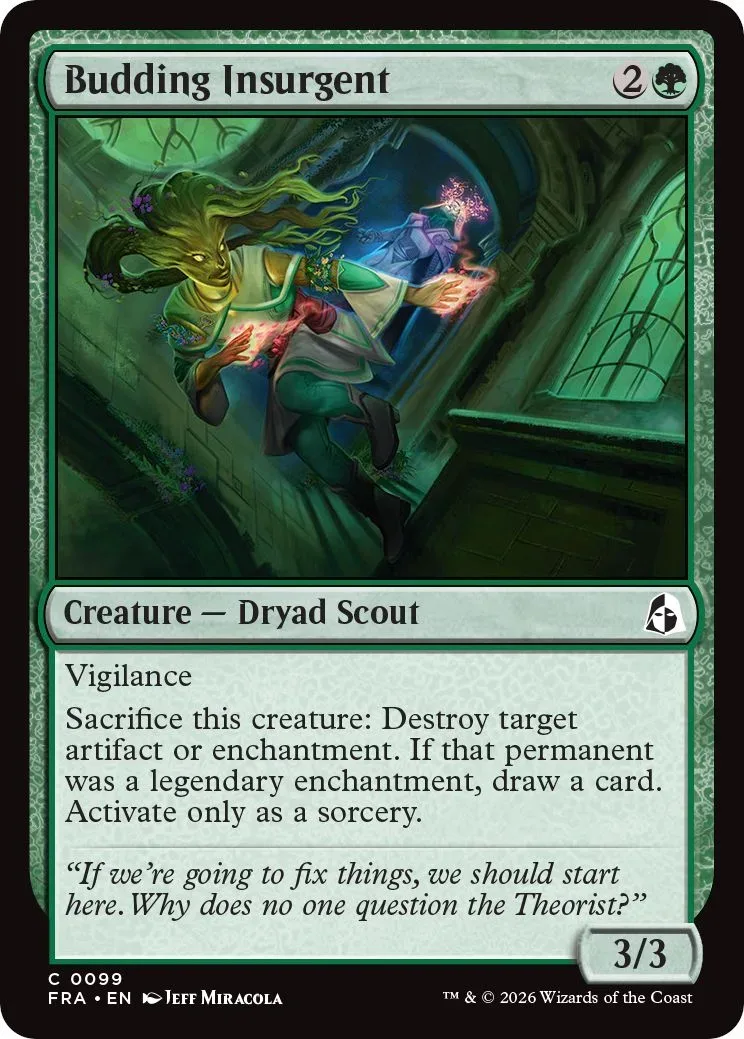
Magic: The Gathering has unveiled Budding Insurgent, a green creature card from the upcoming Reality Fracture set. The Dryad Scout is a compact but potentially troublesome tool for players who want their creature decks to do more than simply attack: it can pressure opponents in combat, then trade itself away to remove a key artifact or enchantment when the board demands it.
The card also offers an especially timely payoff when it takes down a legendary artifact. In that situation, its controller gets to draw a card, turning a one-for-one exchange into a more favorable piece of disruption. That makes Budding Insurgent a thematic fit for Reality Fracture's central conflict, while also giving green decks a flexible answer to permanent types that can otherwise become difficult to address once they are established.
Reality Fracture is scheduled to launch on October 2, with Play Boosters and Collector Boosters listed for pre-order. The set places Jace Beleren at the heart of a multiversal crisis, as the Planeswalker attempts to replace existing reality with an alternate version known as the Echoverse. The people and worlds threatened by that rewrite are not prepared to quietly disappear, and Budding Insurgent represents one small but determined part of the resistance.
Budding Insurgent at a glance
Budding Insurgent is a 3/3 green Dryad Scout that costs three mana: one green mana and two generic mana. Its baseline statistics are solid for a creature intended to arrive relatively early in a game, but its keywords and activated ability are what give it a distinct role.
For useful background on this topic, read All Star Tower Defense Codes for September 2026: Gems, Stardust, and a Special Unit.
- Mana cost: 2G
- Type: Dryad Scout
- Power/Toughness: 3/3
- Keyword: Vigilance
- Utility: It can be sacrificed to destroy an artifact or enchantment.
- Bonus: If the destroyed permanent is a legendary artifact, its controller draws a card.
Vigilance means Budding Insurgent does not need to tap when it attacks. In practice, that lets it contribute to offensive pressure without leaving its controller as exposed on defense. A 3/3 body with vigilance can attack into an opponent while remaining available to block on the next turn, creating a steady tempo advantage in creature-focused games.
Its sacrifice ability changes the calculation further. Rather than being merely a three-mana attacker, Budding Insurgent can be held in reserve as an answer to a dangerous noncreature permanent. If an opposing artifact or enchantment becomes the most important card on the battlefield, the Scout can be exchanged for it. That flexibility makes the creature more useful across a broader range of matchups than a straightforward attacker with the same mana cost.
A creature that can become removal
Artifact and enchantment removal is a long-standing part of green's toolkit, but attaching that effect to a relevant creature body can create meaningful choices. A player may deploy Budding Insurgent on curve and begin attacking, forcing an opponent to account for three points of damage while knowing the creature could later deal with a powerful permanent.
That threat can affect an opponent's sequencing even before the ability is used. An artifact-based engine or important enchantment may be safer in hand until Budding Insurgent has been removed, particularly if the opponent is relying on a single permanent to stabilize the battlefield or generate repeated value. Conversely, a Budding Insurgent controller must decide whether to preserve the 3/3 vigilance body, cash it in immediately, or wait for a more valuable target.
The sacrifice cost is significant. Trading away a creature means giving up future combat damage, blocking potential, and any other synergy that creature might have with the rest of a deck. Still, that cost can be worthwhile when the target is a permanent that would otherwise snowball a game. Destroying an artifact that produces mana, enables a combo, equips a creature, or generates recurring value may be more important than keeping a single attacker in play. The same applies to enchantments that reshape combat, create repeated resources, or lock down an opposing strategy.
Budding Insurgent therefore has the feel of a card that rewards careful timing rather than automatic activation. It can establish early pressure, punish opponents who overcommit to a vulnerable permanent type, and preserve its removal option until the moment it has the greatest impact.
The legendary artifact reward matters
The card's additional draw effect is limited to legendary artifacts, but that limitation is also what makes it especially interesting. When Budding Insurgent destroys an ordinary artifact or enchantment, the exchange is still a piece of removal paid for with a creature. When it destroys a legendary artifact, however, the card draw helps compensate for the sacrifice and can keep its controller moving through their deck.
That distinction could make Budding Insurgent more appealing in environments where legendary artifacts are central to deck construction or appear as high-impact build-around cards. A legendary artifact is often something an opponent wants to protect, either because it is unique to their plan or because it produces a particularly powerful effect. Being able to remove that permanent while replacing part of the resources spent on the exchange gives the Dryad Scout a sharper ceiling than a generic disenchant-style creature.
There is no guarantee that every match will offer a legendary artifact target, so players should view the card's draw clause as upside rather than its only purpose. The main function remains broad artifact and enchantment removal. But in the games where the condition is met, Budding Insurgent can swing both the board state and card economy at once.
How it may fit into green strategies
Green decks that use mana acceleration and large creatures may find the card particularly appealing as an early-game utility slot. Such decks often want to spend their first turns building resources before deploying bigger threats, but they can be vulnerable when an opponent's artifact or enchantment disrupts that development. Budding Insurgent offers a way to apply pressure during those setup turns without abandoning access to a useful answer later.
It may also be attractive in creature-heavy lists that need removal without committing many slots to spells that do not affect combat. Because it begins as a 3/3 with vigilance, Budding Insurgent contributes to the deck's central plan before it ever needs to sacrifice itself. In games where an opponent has no relevant artifacts or enchantments, it can simply remain a persistent attacker and blocker. In games where a target appears, it can pivot into interaction.
That does not mean it will automatically belong in every green deck. Strategies focused on highly efficient spells may prefer cheaper, more specialized removal, while decks with substantial sacrifice synergies could value the creature for entirely different reasons. Its usefulness will ultimately depend on the surrounding card pool, the prevalence of artifacts and enchantments, and how frequently legendary artifacts show up in the format.
Even so, the design gives players a practical combination of board presence and contingency planning. It is easy to see why an opponent would be wary of allowing the Scout to remain on the battlefield for too long.
An Echoverse rebel in miniature
Budding Insurgent's mechanical identity mirrors the story direction of Reality Fracture. The set's conflict concerns Jace Beleren's attempt to overwrite existence with the Echoverse, his preferred version of reality. The resistance to that plan is broad because the alternative is not a minor political disagreement; it is the erasure or replacement of those who already inhabit the worlds being rewritten.
Against that backdrop, a small green creature that can give itself up to destroy an artifact or enchantment feels appropriate. Budding Insurgent is not presented as an overwhelming force that wins through raw size. Instead, it represents disruption: a character capable of undermining the structures supporting an imposed reality, even at personal cost.
The legendary artifact clause adds another flavorful dimension. If a singular, important relic is helping sustain the opposition's position, destroying it and drawing a card suggests that taking down a key symbol or instrument of power can inspire new options for the rebellion. Mechanically, it is a focused reward. Narratively, it reinforces the idea that even a relatively small act of defiance can create wider momentum.
Reality Fracture arrives October 2
Magic: The Gathering--Reality Fracture is due to release on October 2. Play Boosters and Collector Boosters are among the products available for pre-order, and Budding Insurgent offers an early look at how the set intends to join its alternate-reality storyline to playable card mechanics.
For players who enjoy green creatures with practical utility, the Dryad Scout looks positioned to be more than a simple combat card. Vigilance lets it maintain pressure while guarding against counterattacks, its sacrifice ability answers two important permanent types, and its legendary-artifact bonus can turn a disruptive trade into a card-advantage opportunity.
Whether it becomes a regular feature of green ramp lists, a sideboard-style answer housed in the main deck, or a useful role-player in artifact-heavy environments will depend on the full Reality Fracture landscape. For now, Budding Insurgent stands as a concise expression of the set's resistance theme: attack when possible, remain alert, and be ready to tear down the machinery of a reality that should not exist.
Community
Discussion
Start the conversation.
No comments have been posted yet.