

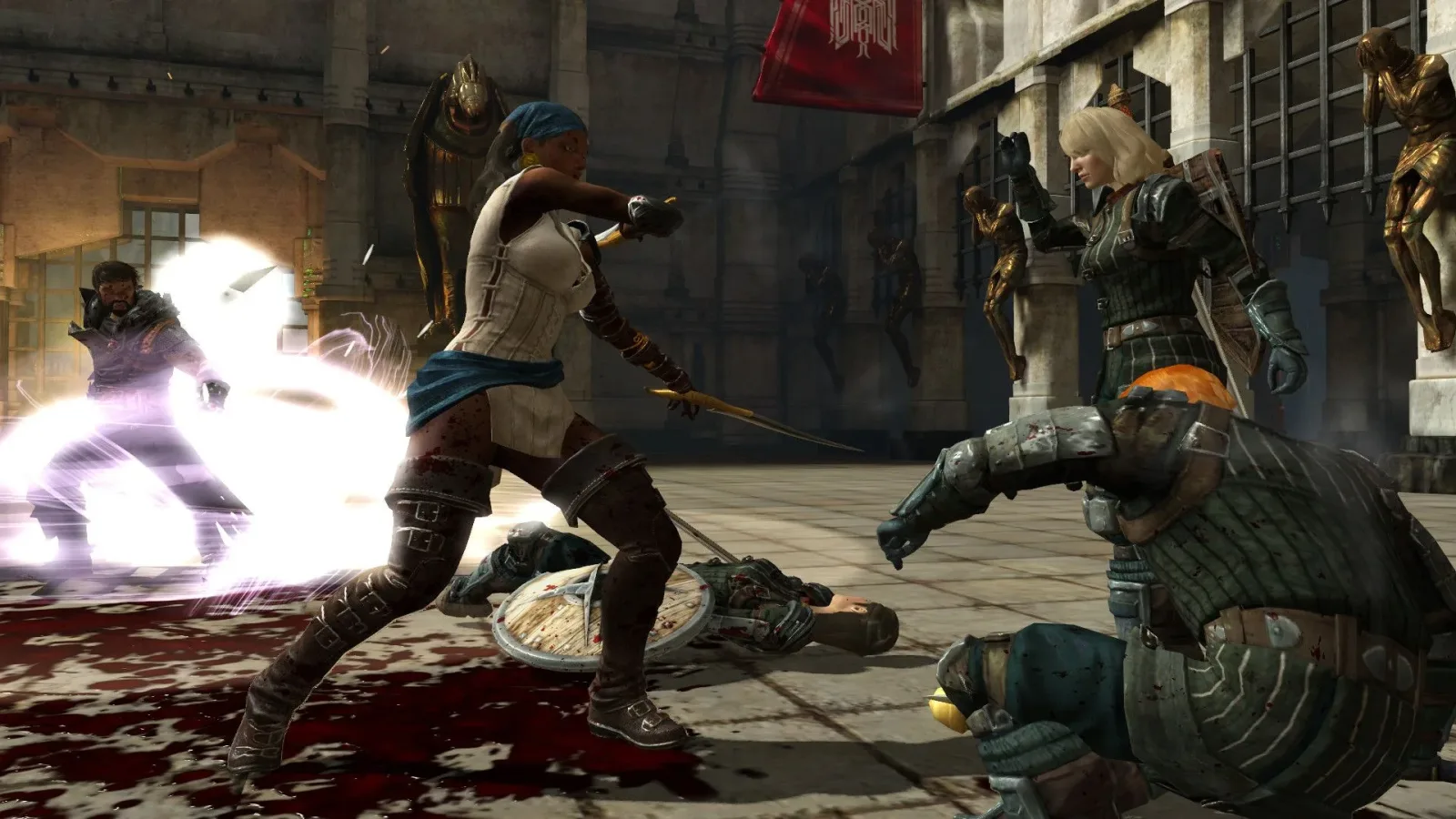
Former Dragon Age lead Mark Darrah has offered a stark view of the pressures he believes helped steer BioWare through some of its most difficult years. In comments discussing the RPG studio's history, Darrah argued that the central problem was not necessarily that BioWare was directly ordered to make every controversial decision. Instead, he described an environment in which financial expectations and limited alternatives made certain choices feel unavoidable.
BioWare, the long-running developer behind major role-playing series including Dragon Age and Mass Effect, was shut down by EA after the publisher was acquired by a private-investor group. The closure followed a turbulent period for the studio, whose later releases included Mass Effect: Andromeda, Anthem, and Dragon Age: The Veilguard. Each of those projects faced significant scrutiny, whether over reception, production troubles, commercial expectations, or some combination of all three.
While criticism of those games has often focused on BioWare itself, Darrah's comments place greater emphasis on the corporate conditions surrounding the developer. His argument is that decision-making cannot be judged solely by asking whether EA explicitly commanded a particular project or production plan. The more important question, in his view, is what options the studio had left once it was expected to meet financial targets under intense pressure.
A Choice on Paper, Pressure in Practice
Darrah recalled an unnamed person's description of EA's management approach: the publisher did not necessarily force a studio's hand outright, but would present an increasingly unpleasant set of possibilities and repeatedly demand an answer. The image is deliberately severe, conveying a system in which the nominal freedom to choose did not translate into a healthy or genuinely voluntary creative process.
For useful background on this topic, read GTA 6 Recompilation Effort Gains Momentum After Purported Xbox Executable Appears.
"The reality is that the options on the table were all terrible," Darrah said. "We chose the least terrible of the options."
That distinction is crucial to his assessment. A publisher could say that BioWare itself made its choices, and in the narrowest sense that could be true. Yet Darrah believes that statement misses the conditions under which those decisions were made. When a studio is told it must meet financial objectives, preserve momentum, and find a route to commercially viable output, doing nothing is not a realistic answer. A leadership team may technically select a path, but still be choosing between damaging compromises.
Darrah summarized that dilemma bluntly when discussing the circumstances behind Dragon Age 2. EA, he said, may not have literally ordered BioWare to make the sequel in that exact form, but it made clear the studio had to do something to satisfy its financial position. That pressure, he argued, changed the character of the decision before development priorities had even been settled.
Frostbite, Dragon Age 2, and Anthem
Darrah pointed to three major areas as examples of choices he believes were brought about by pressure from EA: BioWare's move to the Frostbite engine, the accelerated production schedule for Dragon Age 2, and the larger situation surrounding Anthem.
The Frostbite transition remains one of the most frequently discussed elements of BioWare's later development history. Frostbite had been created primarily for the Battlefield series and was associated with EA's internal technology strategy. Adapting an engine built around that kind of experience for sprawling, choice-driven RPGs created challenges for teams whose games needed tools and systems suited to conversations, companions, quests, branching storytelling, inventory management, and large amounts of bespoke content.
Engine decisions can determine far more than a game's visual presentation. They affect how quickly developers can prototype ideas, how easily designers can create content, how production pipelines are organized, and how much time must be spent building foundational technology before a game's most distinctive features can take shape. For a studio known for narrative role-playing games, any mismatch between tools and design goals can become a costly issue across an entire project.
Dragon Age 2 is another case Darrah raised. The game was developed on an unusually fast timeline, and its compressed production has long shaped discussion around its reused environments, narrower structure, and altered approach compared with Dragon Age: Origins. Its story, companions, and central conflict earned praise from many players, but its limited development window was difficult to ignore. Darrah's comments frame that breakneck schedule less as a straightforward creative preference and more as a response to the business demands facing BioWare.
Then there is Anthem, BioWare's ambitious online action game. The project became a defining example of the company's struggles to adapt to a changing market while handling a large-scale live-service-style production. Its path from concept to release was widely viewed as troubled, and the game's difficulties became part of the broader conversation about whether BioWare had been pushed away from the strengths that had made its name.
Darrah did not present these issues as isolated mistakes with a single cause. His comments instead connect them to a pattern: financial pressure produces constrained choices; constrained choices lead studios toward short-term solutions or difficult pivots; and the consequences of those moves can reverberate through years of game development.
The Mass Effect 2 Comparison
Darrah also contrasted those difficult circumstances with the development of Mass Effect 2, a game BioWare completed in roughly 18 months. On the surface, that turnaround might seem to challenge the idea that fast schedules are inherently destructive. But Darrah's explanation is that the conditions behind that project mattered enormously.
In his view, BioWare was able to make Mass Effect 2 on that timeline because it did not lay off its team, paid attention to player feedback, and became extremely disciplined about keeping the project's scope under control. Those elements are not trivial. Retaining experienced staff preserves institutional knowledge, avoids the disruption of rebuilding teams, and allows work to begin from a stronger foundation. Listening to player feedback can clarify which areas deserve attention. Ruthlessly restricting scope can prevent a project from collapsing under its own ambitions.
That is a very different scenario from simply demanding that a studio release something quickly. A short development cycle can be achievable when a team has continuity, clear direction, reusable foundations, and the authority to decide what not to make. It becomes much more dangerous when developers are simultaneously dealing with unfamiliar technology, shifting priorities, staffing disruption, or uncertainty about the game's fundamental identity.
Darrah's comparison suggests that production speed alone is not the lesson to take from BioWare's past. The key question is whether the team has the stability and focus necessary to make rapid development sustainable. Without those conditions, an aggressive schedule may turn from a productive constraint into an obligation that amplifies every existing problem.
A Broader Debate Over Studio Responsibility
BioWare's final years have prompted a persistent debate over accountability. It is possible to recognize that a studio's leaders and teams make real decisions while also acknowledging the influence of the corporate structure in which they operate. Darrah's remarks argue against an overly simple version of either position.
They do not claim that BioWare had no agency whatsoever. Rather, they question how much meaning should be attached to agency when the available alternatives are all harmful. A studio can decide to pursue a sequel, change its technology, or chase a new kind of game, but the context around those decisions may include deadlines, financial requirements, internal policies, and survival concerns that outside observers cannot easily see.
For players, that context does not erase disappointment with any release. Fans can still dislike a game, criticize its design, or feel that a beloved series lost its identity. But it may complicate the instinct to place every outcome entirely at the feet of the development team. Large games are created within business structures, and those structures influence what is possible long before a player sees the final product.
Darrah's account is therefore less a defense of every BioWare decision than a warning about how decision-making can work under sustained corporate pressure. When a company is repeatedly required to demonstrate financial results, creative questions can become survival questions. The visible choice may belong to the studio, but the terms of that choice may have been set elsewhere.
What BioWare's History May Still Illustrate
The story remains relevant beyond one developer or one publisher. The modern games business routinely asks studios to manage escalating budgets, long production cycles, technology transitions, shifting player expectations, and demands for predictable returns. Even established teams with celebrated franchises can find themselves navigating competing priorities that do not fit neatly together.
BioWare's history shows why strong franchises and talented developers are not always enough to guarantee stability. The studio's legacy was built over decades through landmark RPGs and an ability to create memorable worlds, player choice, and character relationships. Yet a legacy of that kind does not remove the operational pressures that can reshape a company's output.
Darrah's comments leave a challenging final thought: the most consequential pressure may not always arrive as a direct command. It can emerge through targets, incentives, limited resources, deadlines, and the repeated insistence that a studio must find an answer. Under those circumstances, the eventual decision can look voluntary from the outside while feeling inevitable to the people who have to make it.
Community
Discussion
Start the conversation.
No comments have been posted yet.