

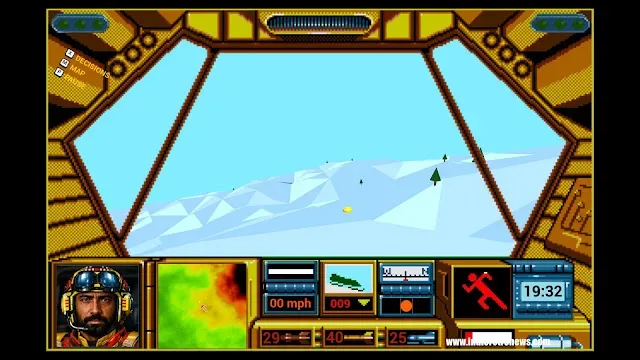
Midwinter Fan Remaster has entered Steam Early Access, bringing a famously ambitious 1989 game design back to modern PC players. Inspired by Mike Singleton's original Midwinter, the fan-made project returns players to an enormous frozen island under military invasion, where survival depends on recruiting allies, moving across hostile terrain, sabotaging enemy plans, and deciding when to fight, flee, or hand control to another member of the resistance.
It is a revival of a game that stood out even among the technically adventurous software of the Amiga and Atari ST era. The original Midwinter earned considerable critical praise and commercial attention for combining large-scale strategy with first-person movement and combat. Rather than limiting players to a single hero or a tightly scripted campaign route, it placed them in a sprawling conflict and asked them to build an effective resistance from the people scattered around its wintry setting.
The Early Access release aims to preserve that unusual scale while opening development to players who know the classic, as well as those encountering its ideas for the first time. Its creator has described the remaster as a solo passion project, with community feedback expected to help determine which of its many complex mechanics receive the most attention as development continues.
A return to a frozen island at war
The central premise remains strikingly broad. Players explore 160,000 square miles of icy territory while an invading army attempts to take control. The resistance is not made up of interchangeable units: there are 32 distinct survivors to locate and recruit, and each can become part of the effort to stop the occupation.
For useful background on this topic, read Diablo 5 Will Put the Lord of Terror at the Center After Diablo 4 Kept Him at Arm's Length.
That character-switching structure is one of Midwinter's defining ideas. A player can take direct control of recruited resistance members, using their individual positions and circumstances to respond to a changing war. This makes the conflict feel larger than the actions of one protagonist. A character's value can come from where they are, what they can accomplish, and how they contribute to the group's broader chances of survival.
It is also a framework that naturally creates player stories. One person may focus on travelling across the island to bring more survivors into the cause. Another may prioritize interference with the invaders' operations. A dangerous direct assault might be necessary in one moment, while avoiding contact and preserving a useful recruit could be the wiser choice in another. The game's scale and multiple playable characters mean there is room for plans to succeed, unravel, and be adapted rather than simply followed.
Why Midwinter still feels unusual
Modern players are accustomed to open maps, systemic missions, multiple approaches to objectives, and games that blend genres. In 1989, however, Midwinter was notable for bringing together concepts that were rarely presented in the same package. Its combination of strategic decision-making, stealthy movement, first-person action, recruitment, and vehicle travel gave it an identity unlike a conventional shooter or a traditional strategy game.
The original's broad territory was especially memorable. It was not just a backdrop for isolated levels; it supported the sense that a war was unfolding across an entire place. Snow-covered routes, settlements, enemy activity, and the location of potential allies all mattered because the player had to navigate the island and make choices about where to devote limited attention.
That does not mean today's open-world games directly descend from one title alone. The genre developed through many different technical and creative influences. Still, Midwinter remains an early and compelling example of a design philosophy that later became much more familiar: give the player a large space, overlapping systems, and goals that can be pursued in more than one way. Its appeal lies partly in seeing how boldly it pursued those ambitions with the hardware and design conventions of its time.
The fan remaster therefore has the potential to be more than a nostalgia project. For players interested in game history, it offers a chance to examine a landmark design through a contemporary PC release. For players who never owned an Amiga or Atari ST, it can serve as an introduction to an era in which creators often experimented with huge ideas despite strict technical limitations.
Early Access is intended to shape the priorities
The move into Steam Early Access is closely tied to the project's scope. A world built around freely moving through a vast landscape, changing characters, recruiting survivors, and responding to an invading force can generate situations that are difficult to anticipate through limited testing. The developer has chosen an open development approach in part because a single creator cannot realistically explore every possible player decision and system interaction alone.
Community participation is expected to influence what comes next. Players entering during Early Access will be able to provide feedback on the experience and help identify which mechanics should be expanded or refined first. That could be particularly important for a game whose appeal is rooted in interconnected systems rather than one linear sequence of missions.
There is a practical reason this approach fits Midwinter. A player who concentrates on recruitment may encounter different priorities from someone who experiments with aggressive attacks. Others may spend their time learning terrain, changing between characters, or testing how the wider invasion responds to resistance activity. Feedback from those different play styles can reveal where features are clear, where they need balance, and where the remaster can deepen the most promising parts of the original concept.
Early Access also means the project should be viewed as in development rather than a finished restoration. Its current launch provides access to the game and a route for feedback, but the creator's stated intention is for the community to help guide its eventual final form. Players interested in taking part should therefore expect an evolving project, with priorities potentially adjusted in response to what the audience finds most worthwhile.
A fan project carrying an influential legacy
Reviving Midwinter is an ambitious undertaking precisely because the original was so unusual. It is easier to remake a game around one defining mechanic than to revisit a design where travel, planning, combat, evasion, character management, and a large strategic conflict all overlap. The remaster's solo-development background makes that challenge even more notable.
At the same time, the original's unusual structure is why a modern return may be valuable. Some older games are remembered mainly for a particular visual style or a familiar arcade loop. Midwinter is remembered for its ideas: the notion that a player could wage a decentralized resistance across a huge map and inhabit multiple people within that struggle. Those ideas remain recognizable and interesting even after decades of advances in graphics, controls, simulation, and world design.
The Early Access version arrives at a moment when there is renewed interest in older design approaches that do not fit neatly into current genre labels. Players often seek games that allow experimentation, emergent setbacks, and personal solutions instead of directing every moment. Midwinter Fan Remaster has a natural place in that conversation because the game it revisits was mixing strategic and action-oriented play long before such combinations became commonplace.
Modern art mode includes fixed AI-created portraits
The project also includes an optional modern art mode. This mode uses character portraits for playable resistance members and enemy officers that were created during development with generative AI image tools. The developer has clarified that these are fixed image files included with the game build.
Nothing is generated during gameplay. The portraits are not produced dynamically in response to player actions, and the game does not create new imagery while it is being played. That distinction may matter to prospective players who want to know how the optional presentation mode was made and how it functions within the release.
As with the broader Early Access effort, players can decide for themselves whether the modern art option fits their preferred way of experiencing the remaster. The key point is that the project's defining gameplay remains rooted in the classic conflict: assembling a resistance, moving through a massive frozen environment, and trying to halt an army that has already seized the initiative.
An opportunity to revisit an unusually big idea
Midwinter Fan Remaster arrives with the difficult task of honoring a game celebrated for being ahead of its time while inviting feedback from a modern audience with very different expectations. Its Steam Early Access release does not promise a simple museum-piece conversion. Instead, it presents an active fan-led development project built around the original's enormous island, 32 recruitable survivors, character-switching system, and mix of strategic planning with immediate first-person danger.
For veterans, it is an opportunity to return to a memorable Amiga and Atari ST world in a new PC form. For newcomers, it is a chance to discover why Midwinter remains a frequent point of interest in discussions of ambitious late-1980s game design. And for those who join during Early Access, it is an opportunity to take part in determining how this singular frozen warzone develops from here.
Community
Discussion
Start the conversation.
No comments have been posted yet.