

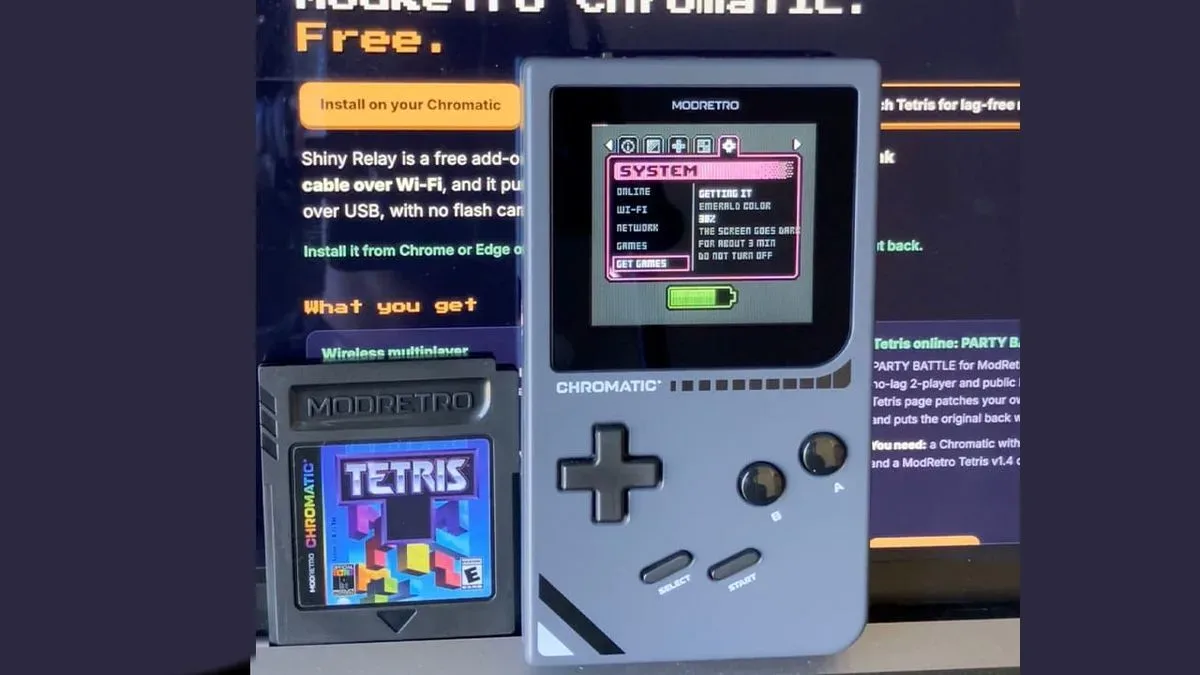
The ModRetro Chromatic's capabilities have expanded substantially with a ShinyRelay update developed by David Walter. The new functionality makes it possible to send games to the Game Boy-compatible handheld over Wi-Fi, eliminating a cable from a process that previously depended on USB transfers. It also introduces Wi-Fi firmware updating, while preserving options for local and online multiplayer.
For a handheld built around physical cartridges and a deliberately classic presentation, the feature set is an unusual but potentially important step. The Chromatic is designed to play Game Boy and Game Boy Color cartridges, but its flash-oriented Tetris cartridge and internal hardware have already created room for experimentation beyond a strictly cartridge-only experience. ShinyRelay now uses that flexibility to give owners several places to receive and store compatible game data wirelessly.
Walter, who develops under the ShinyGen name, has described the update publicly and demonstrated the result through ShinyRelay. His work gives Chromatic users the ability to download games through a Wi-Fi connection and place them onto the Tetris cartridge, the device's internal flash storage, RAM, or an SD card. Each destination has different advantages, particularly around whether a download remains on the system after power is switched off.
Embedded X/Twitter post
More than a wireless replacement for USB
The headline change is straightforward: a Chromatic with ShinyGen installed can receive games over Wi-Fi. In practical terms, this means owners no longer necessarily need to connect the handheld by cable merely to transfer software. The update broadens the ways the system can be used at home, at events, or in multiplayer sessions where moving software between devices quickly is useful.
For useful background on this topic, read Yoniq Duo Kickstarter Delayed as Dual-Screen Handheld Gets New Colour Options.
It is not limited to a single storage route. ShinyRelay offers several targets, allowing users to choose between persistent and temporary storage based on what they are doing. That matters because the Chromatic's available internal memory was not primarily intended to act as a broad game library. Walter has said that the handheld includes a few megabytes of flash storage intended for firmware, with some unused capacity available for games.
Using that free space can make a downloaded game remain available on the handheld's internal storage. RAM can also be used, but that route is temporary: content stored there disappears once the Chromatic is turned off. The distinction is important for anyone trying the feature for the first time. Internal flash is the option for retaining a downloaded game on the device, while RAM is better viewed as an immediate, session-based solution.
Storage choices at a glance
- Tetris cartridge: Game data can be written to the Chromatic's flash-oriented Tetris cartridge.
- Internal flash storage: Some unused space in the hardware's firmware storage can hold games persistently.
- RAM: A temporary option that works until the handheld is powered down.
- SD card: ShinyRelay also supports sending games to SD storage.
Those choices suggest the update is aimed at flexibility rather than replacing the core cartridge identity of the Chromatic. A user can keep a game internally if there is enough space, use RAM for a quick test, or make use of removable storage and the Tetris cartridge depending on their setup. The practical details will vary with the software being used and the storage available, but the important change is that Wi-Fi is now part of the transfer path.
Online multiplayer is part of the package
Wireless game downloads are only one portion of the ShinyRelay feature set. The update also supports multiplayer without requiring a physical link cable, including both local and online play. Link-cable multiplayer remains a defining part of the original Game Boy experience, so the ability to establish multiplayer connections through a modern network is a notable reinterpretation of that tradition.
Walter has indicated that both the internal-flash and RAM approaches work with local and online multiplayer. The RAM limitation still applies, of course: a game placed there will not survive a shutdown. But for a temporary multiplayer session, the ability to receive the required software, load it into memory, and play without physically linking systems could be especially appealing.
The update may be of particular interest to developers and communities working with compatible homebrew projects. A wireless delivery method can simplify testing across systems and reduce the friction involved in preparing multiplayer sessions. It also gives the Chromatic a more contemporary connectivity option while retaining its Game Boy and Game Boy Color cartridge compatibility.
Downloading to the Chromatic's internal flash is the persistent option, while downloading to RAM is temporary and is cleared when the system powers off.
That split between permanent and temporary storage is not simply a technical footnote. It defines the expected use cases. Internal flash can be treated as a small built-in holding area for software a player wants ready on the machine. RAM is more akin to a workspace: useful for trying something immediately or joining a multiplayer session, but not a location for anything that needs to remain available later.
Firmware updates can now happen over Wi-Fi
ShinyRelay 1.1.0 and later also add wireless firmware updates for the Chromatic. This is another change with a major convenience benefit, as it means a USB connection is no longer required for that maintenance task. Once the relevant setup is complete, owners can update through Wi-Fi rather than plugging the handheld into a computer.
Wireless firmware updating is familiar on newer consoles and handhelds, but it is a striking addition to hardware that intentionally evokes the Game Boy era. It further separates the Chromatic from a purely nostalgia-focused device. The system may be built around a classic format, but the surrounding tools are increasingly modern: remote software transfer, online multiplayer, and now network-delivered firmware maintenance.
Walter compared the approach to Wi-Fi updating on the M64. For Chromatic owners, the benefit is a more self-contained device workflow. The handheld can potentially receive both the software users wish to run and the updates required to maintain the supporting environment without being repeatedly connected by USB.
Development work and AI assistance
Walter has been open about using AI during the creation of this ShinyRelay update. He said he used Claude Opus 5.5 alongside his own software-development experience. Walter has worked professionally as a software developer for 10 years and holds a computer science degree from MIT.
That context is relevant because discussions around AI-assisted coding often blur the difference between tool-assisted work and unsupervised generation. In this case, Walter has presented AI as an aid used alongside his own technical knowledge, rather than as a replacement for engineering oversight. The resulting feature set touches networking, storage behavior, multiplayer functionality, and firmware delivery, all areas where testing and an understanding of the target hardware are especially important.
Regardless of the tools involved, the end result is a significant community-driven expansion for the Chromatic. It adds functions that are not usually expected from a Game Boy-style handheld, and it does so while offering users a choice in where their transferred games are kept.
What the update means for Chromatic owners
The Chromatic has always occupied an interesting place in retro gaming: it is a premium handheld that celebrates original cartridges but is built with modern manufacturing and display technology. ShinyRelay's new update pushes the machine further into hybrid territory. It remains a device for physical Game Boy and Game Boy Color software, yet it can now participate in Wi-Fi-based workflows that would have been unimaginable on the original hardware.
For everyday owners, the largest benefit may simply be convenience. USB transfers and wired updates can be useful, but wireless delivery is easier to fit into regular use. For multiplayer-minded players, removing the mandatory link cable opens a different way to organize sessions. For developers and homebrew enthusiasts, the expanded transfer methods could make distribution and testing more practical.
There are still clear limitations to understand. Internal flash space is measured in only a few megabytes and was intended for firmware, so it should not be mistaken for a huge permanent library. RAM downloads are explicitly temporary. And users should ensure they have the rights to any software they transfer or use. The update's value is in the new options it creates, not in removing the need to make sensible choices about storage, compatibility, or software ownership.
With ShinyRelay installed and updated to version 1.1.0 or newer, the ModRetro Chromatic can now receive games through Wi-Fi, update its firmware wirelessly, and support local or online multiplayer without relying on a physical link cable. For a handheld rooted in late-1990s portable gaming, that is a remarkably modern set of abilities--and one that could make the Chromatic more versatile for players who want classic hardware design with fewer old-fashioned logistical barriers.
Community
Discussion
Start the conversation.
No comments have been posted yet.