

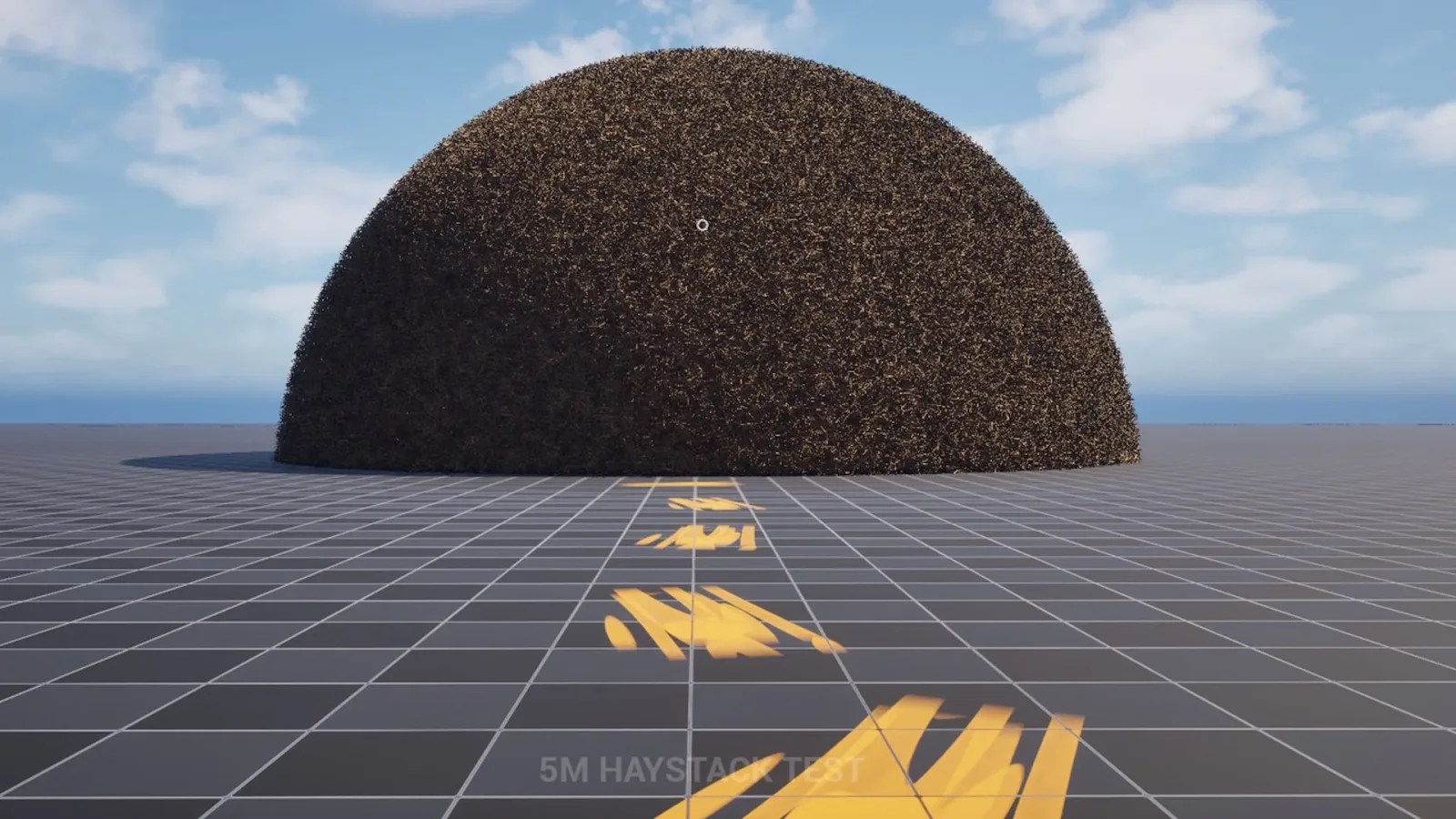
Needle In A Haystack Simulator has a deliberately simple premise: locate one needle inside a vast heap containing roughly five million individual pieces of hay. Yet before Studio Bitdot's game has even reached release, players browsing Steam may have to perform a smaller version of that same task just to identify the intended listing.
Since the game's Steam page went live, a number of similarly titled projects have appeared on Valve's PC storefront. At the time of writing, there are eight other listings built around nearly identical wording and a closely related concept: finding a needle that has been lost among an extreme amount of hay. In response, Studio Bitdot has added an unusually direct point of distinction to the promotional art for its own page: the word "Original."
The label is a concise answer to an increasingly familiar problem on large digital marketplaces. A game can gain attention through social media, its hook can become immediately recognizable, and near-identical names can begin appearing before the project that sparked the attention is available to buy. For an independent team with limited marketing reach, making sure prospective players can find the correct page becomes an issue in itself.
A joke premise with a substantial search area
The central idea behind Needle In A Haystack Simulator is as literal as its name suggests. Players search through an enormous collection of hay in pursuit of a single needle. It is an intentionally absurd task, with the scale of the haystack turning a familiar expression about difficulty into the game's core activity.
For useful background on this topic, read Arc Raiders Could Replace Expeditions Entirely After Frozen Trail.
There is more structure than simply clicking through hay indefinitely. Treasure can be uncovered during the search and sold, with the proceeds going toward tools designed to make the job more manageable. Even so, the essential appeal is the act of rummaging, leaping through piles, and gradually working through a ludicrously oversized search space.
That clarity is likely part of why the project has caught on online. The title explains the experience instantly, while the challenge is easy to understand whether someone sees a screenshot, a short video clip, or a streamer reacting to the prospect of sifting through millions of pieces of hay. It occupies the space often filled by meme-friendly games: a premise that sounds ridiculous, but is concrete enough to make people curious about how frustrating, satisfying, or unexpectedly compelling it may be in practice.
Studio Bitdot's game is planned for release in the final quarter of this year. Until then, the unusual situation surrounding its storefront identity is likely to remain part of the conversation around it.
Many names, one very familiar phrase
The competing listings do not merely share a broad genre or an adjacent joke. Their titles closely circle the same well-known phrase, sometimes with only small capitalization, spelling, or wording changes. Examples include Needle In A Haystack, another listing also called Needle In A Haystack, Needle in a Haytask, Needle in a Haystack, A Needle In a Haystack, and Needle in a Million Haystacks.
Some of the pages have different visual styles, but their common premise makes the overlap hard to miss. Searching the phrase on Steam can therefore produce a collection of titles that are difficult to distinguish at a glance, particularly for someone who has only heard about the game through a clip or recommendation and does not already know Studio Bitdot's name.
This is where the "Original" marker carries practical weight. It is not a claim that the phrase "needle in a haystack" originated with the developer; it plainly predates any video game adaptation by a considerable margin. Instead, it is a storefront-facing effort to clarify which project is the one that built early visibility around this specific simulation concept and presentation.
The choice also underlines how much a game's discoverability can depend on its packaging. In a crowded storefront, title, logo, thumbnail, capsule art, tags, screenshots, and developer name all function as wayfinding tools. If several products converge on the same searchable words, those small details become much more important.
Discoverability is a challenge before a game launches
Steam's sheer volume is a major advantage for players who want a broad catalog, but it can make visibility difficult for smaller releases. Independent developers often spend months or years building a game, then must compete for attention against an ever-changing feed of new announcements, demos, updates, discounts, and releases. A distinctive pitch can help cut through that noise, though it can also invite fast followers once it begins circulating online.
For Needle In A Haystack Simulator, the issue is especially ironic. The intended player experience is about locating one specific object amid overwhelming visual clutter. Its Steam presence now risks reflecting that metaphor, with players needing to separate the authentic Studio Bitdot listing from a group of similarly named alternatives.
That does not necessarily mean every similarly named project is identical in implementation or quality. Titles can share a broad idea while differing significantly in mechanics, assets, scale, interface, and design goals. But close overlap in both title and basic pitch creates a real possibility of confusion, particularly before the original project has launched and had the opportunity to establish itself through player reviews or wider word of mouth.
For consumers, the situation is a reminder to check the developer name and the details of a store page before adding a game to a wishlist or making a purchase. For developers, it illustrates why early branding choices matter even when the central concept seems self-explanatory. A highly descriptive title may communicate a game's premise perfectly, but it can be difficult to protect as a unique search term when the description relies on a common saying.
Why the game's hook still stands out
Despite the rush of lookalike names, Studio Bitdot's version has a specific identity built around its exaggerated scale. Roughly five million pieces of hay is not just a decorative number; it establishes the fantasy of undertaking a comically unreasonable task. Players are not being asked to solve a conventional hidden-object puzzle with a carefully arranged scene. They are being asked to confront an almost intentionally impractical search.
The treasure-and-tool loop also gives the premise room to develop beyond the initial gag. Finding valuables during the hunt and exchanging them for equipment provides a sense of progression, while better tools can presumably change how players approach the haystack. That framework may be particularly useful for turning a joke that works in a short clip into an experience that can sustain longer sessions, whether played alone or alongside friends.
There is a natural streamer and group-play appeal as well. A task that is monotonous by design can become entertaining through reactions, shared frustration, competition, or the inevitable moment when someone finds something valuable--or perhaps the needle itself. The game's appeal does not have to come from the inherent glamour of searching hay. It can come from the social experience of taking an obviously unreasonable assignment seriously.
Finding the intended Steam page
Players interested in the version from Studio Bitdot should verify that the developer name matches and look for the updated artwork carrying the "Original" wording. With numerous closely related titles already present, relying on a title search alone may not be enough to ensure the desired listing is selected.
The situation is a strange but fitting pre-release obstacle for Needle In A Haystack Simulator. The game turns an idiom about impossible searching into a simulation. Its creators are now using an "Original" stamp to help players find their game in a pile of nearly identical names.
Whether the influx of similarly branded pages changes by launch remains to be seen. What is clear is that Studio Bitdot's project will enter its planned fourth-quarter release window with an additional challenge beyond the five million pieces of hay: making sure the audience can identify the right needle on Steam.
Community
Discussion
Start the conversation.
No comments have been posted yet.