

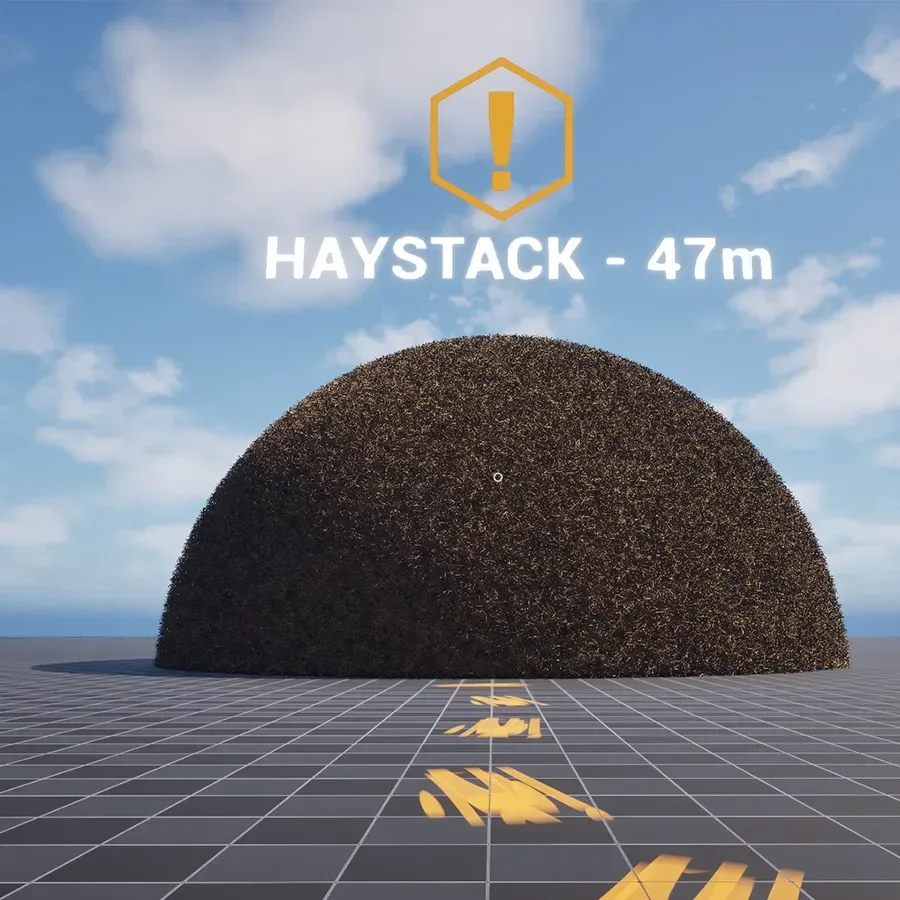
Needle in a Haystack Simulator has built its identity around an intentionally absurdly direct premise: players search a haystack for a needle. Now its creator, NasNakarus, is applying the same joke to a less amusing reality for independent developers. After seeing a growing number of similarly named and styled projects appear around the concept, the developer has revealed a mock game mode called Find the Original Game.
The gag is simple, but pointed. Rather than combing through straw, players would search through a heap of game cases. Most are labelled Needle in a Haystack Clone, with the word "Clone" highlighted in a conspicuous red box. In other words, the supposed challenge is far easier than finding a real needle in real hay. The joke turns the project's central concept into a comment on how difficult it can be for players to distinguish an original game from a rush of imitators.
NasNakarus shared a short demonstration of the idea on October 27, presenting it as a response to how often the forthcoming game has been copied. Whether the mode will become a real feature remains unclear. Its significance is less about a new activity for players and more about the frustration behind it: an unreleased solo-developed game has already become surrounded by lookalike titles.
Embedded X/Twitter post
A joke with an uncomfortable target
Comedy has long been one of the ways developers handle difficult situations in public. In this case, the humor works because the comparison is immediate. If the game asks players to identify one tiny, hard-to-find object in an enormous mass of similar material, then a pile of near-identical game cases becomes an effective metaphor for storefront clutter.
For useful background on this topic, read Resident Evil's Long-Running Story Could Reach Its Ending Within 10 Years.
The mock-up does not need a detailed explanation. The cases spell out the joke, and the red label makes the authentic entry obvious. That deliberate lack of difficulty is the entire point. It suggests that identifying the actual creator ought to be easy, even when the marketplace environment can make it feel needlessly confusing.
Responses to the post embraced the bit while recognizing the more frustrating situation underneath it. One reaction characterized the experience as a tragicomedy: something that leaves a person uncertain whether laughing or crying is the appropriate response. Another person suggested expanding the idea through Roblox, where the objective would be to locate a particular Roblox game among many others. Those replies underline why the concept has resonated. The joke is specific to Needle in a Haystack Simulator, but the underlying concern is familiar across digital game platforms.
An unusually literal concept, and an easy one to imitate
Needle in a Haystack Simulator's basic pitch is memorable precisely because it is so literal. A player sees the title and immediately understands the task. That clarity is useful for a viral indie project: it is easy to describe, easy to share, and naturally invites people to test their patience and observation skills.
It also creates a vulnerability. A concept that can be summed up in a few words can be reproduced in a few words, too. Similar titles, comparable store imagery, and broadly adjacent search-based experiences can appear quickly. Not every game built around a related idea is necessarily an improper copy; games routinely share genres, mechanics, and themes. Searching for objects, solving visual puzzles, and using familiar sayings as game premises are not exclusive ideas.
But the issue becomes more pointed when numerous projects crowd around an identifiable original, particularly before that original has even launched. Similar naming, visual presentation, or promotional framing can make it harder for an audience to know what it is looking at. For a small team--or a single developer--visibility is often one of the most limited resources available. A viral moment may produce attention, but it can also attract people looking to capitalize on that attention.
NasNakarus' response avoids turning the situation into a lengthy public argument. Instead, it makes the audience part of the punchline. Find the Original Game mirrors the act consumers may already be performing as they scroll through digital listings: comparing names, artwork, descriptions, and branding to work out which game came first or which one they intended to support.
The original is still not available
The timing makes the situation especially notable. Needle in a Haystack Simulator has not yet been released. It is currently planned for launch during the fourth quarter of 2026, and playtests are scheduled for this week. That means the project is still in a stage when developers are trying to turn early interest into wishlists, testing participation, community awareness, and eventually sales.
For an independent creator, the period before release can be as important as launch day itself. A game needs to establish a recognizable identity before it is put in front of a much wider audience. If players encounter several comparable-looking products first, the creator faces a tougher challenge in making sure people understand which version represents the work they have been following.
There is also an awkward asymmetry in that process. Making a highly polished original game can take months or years of design, development, testing, presentation work, and community building. Producing something that echoes a trend can require much less investment, especially if the imitator is not trying to match the original's full scope or quality. The result is an environment where the person who made the idea visible may have to work hardest to maintain ownership of their own identity in the public eye.
The joke mode does not solve that broader problem, nor does it claim to. It does, however, give the developer a memorable way to draw attention back to the project ahead of its playtests and expected Q4 release window. It is a piece of self-promotion that doubles as criticism, while remaining faithful to the dry humor that made the game premise stand out in the first place.
AI adds another complication to cloning concerns
The conversation arrives during a period of rapid change in how game content is made, modified, and redistributed. Advances in AI tools have intensified concerns around reverse-engineering, imitation, asset production, and the speed at which developers or hobbyists can assemble work that resembles existing games. The technology is not the only reason cloning happens, and copying predates modern generative AI by decades. Still, faster tools can reduce the effort required to create promotional material, reproduce recognizable structures, or construct superficially similar projects.
That larger trend is complicated. Players and modders have used emerging tools to bring games to web browsers, combine worlds and characters in unconventional ways, and create experimental projects based on established properties. Examples of cross-game modifications, such as placing Spider-Man into Batman: Arkham Asylum, demonstrate the playful and technically impressive side of the culture.
At the same time, the ease of creating derivative work raises difficult questions. Some rightsholders have pursued legal action against mods or unauthorized projects, while others have publicly expressed more openness toward modding activity. The difference often comes down to context: a private experiment, a fan-made modification, a commercial-looking product, a project using protected characters, and a title designed to exploit another game's visibility can all raise different concerns.
For solo creators, formal legal action may not be a realistic first response. It can be expensive, slow, uncertain, and emotionally draining. Even when a developer believes another project crosses a line, proving that claim and pursuing a remedy can be far beyond the resources available. That leaves other tactics: public messaging, stronger branding, community support, platform reporting systems, and, in this case, a well-aimed joke.
Why the gag matters beyond one game
There is an important distinction between protecting a specific creative work and claiming ownership over an entire idea. No one should be able to monopolize every game about searching, haystacks, or difficult visual challenges. Yet independent developers can reasonably want recognition for the particular package they created: the title, execution, presentation, messaging, and work that transformed a simple phrase into a project people wanted to follow.
That distinction is why the Find the Original Game mock-up lands. It is not asking audiences to believe that no one else can make a search game. It is highlighting how a recognizable concept can become surrounded by products that make discovery harder, especially when an original project has generated enough attention to inspire opportunistic imitation.
Needle in a Haystack Simulator now has an additional layer to its public story. Players may initially come for the literal promise of searching through hay, but the developer's playful response gives them another reason to remember its name. The hope, presumably, is that when the game reaches its planned Q4 2026 launch, people will not need a special mode to identify the real thing.
Community
Discussion
Start the conversation.
No comments have been posted yet.