

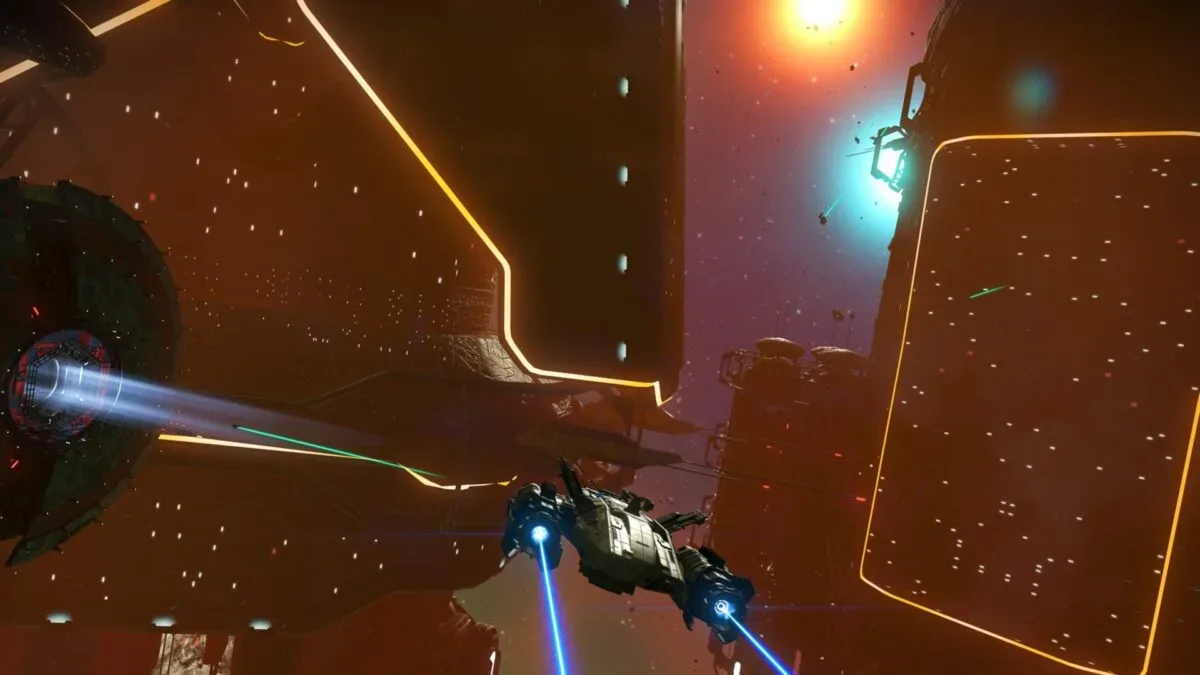
No Man's Sky has spent a decade reinventing itself through free expansions, but its Cosmos update may be one of the game's boldest changes yet. Released on September 9, the update pushes Hello Games' immense procedural universe further into the fantasy of truly owning a place in space. Players can now claim space stations and construct bases beyond planetary surfaces, opening the door to orbital cities, expedition hubs, asteroid outposts, and extravagant projects suspended in the void.
The premise is simple enough to explain: building is no longer confined to a world beneath a player's feet. In practice, though, the new feature changes what the game's most dedicated explorers and architects can aspire to create. Space stations have always been important waypoints for trading, warping, missions, and meeting other travelers. With Cosmos, they can become personal landmarks as well--provided a player has accumulated the enormous resources and status required to take control of one.
Community creations appearing after the update already show why the feature has sparked such enthusiasm. Players are using the additional freedom to imagine dense, neon-lit settlements that resemble science-fiction megacities, as well as more practical orbital bases designed around travel routes. For a game built around the promise of discovering a universe and making a home within it, being able to establish that home in open space is a significant next step.
Building moves beyond the surface
Base construction has long been one of No Man's Sky's defining long-term activities. Players have made elaborate homes, farms, industrial complexes, museums, racetracks, underwater facilities, and towering landmarks on planets across the galaxy. Those projects were shaped by terrain, weather, gravity, local resources, and the limits of a chosen world. Cosmos expands the canvas dramatically by making orbital construction possible.
For useful background on this topic, read Wardogs, Valheim 1.0 and a Packed Week of indie games to Watch.
That means players are no longer limited to selecting a picturesque planet or moon for their biggest builds. An asteroid can be part of a construction project. Empty space can become a destination. A seized station can evolve from a functional stopover into a large-scale social or logistical center. The update's appeal is not just about having another place to put walls and decorations; it is about removing a boundary that had remained in place despite the game's interstellar scope.
For creative players, the opportunity is obvious. The visual language of space stations--metal corridors, windows facing stars, ships passing through, and glowing technology--naturally supports the kinds of cyberpunk cities and deep-space colonies that players have long wanted to build. A base positioned against a colorful nebula or near a heavily traveled system has a different identity than anything possible on a planetary plain.
For survival-focused players, an orbital base can also be more than a showcase. Positioning a station near an important warp route could make it an effective operations center for expeditions and resource runs. A well-placed outpost might become a familiar rendezvous point for friends, a storage and crafting location, or simply a strategically useful home base in a busy area of the galaxy.
A billion-unit ambition
The ability to claim a space station is not being presented as an easy early-game reward. Players have reported that the process requires one billion units, an intentionally daunting amount of currency even for experienced travelers. On top of the financial cost, a player needs to reach reputation level 40 before gaining the right to establish a space base.
Those requirements make station ownership a prestige goal as much as a building option. No Man's Sky has accumulated years of systems for earning currency, upgrading ships, gathering rare materials, engaging with factions, and building wealth through trade or production. Cosmos gives veterans who have already mastered much of that progression another major objective--one that is visible, ambitious, and potentially valuable as a central point for further activity.
The high price also adds an interesting social dimension. A claimed station is not merely a personal house tucked away on an obscure world. It can be a declaration that someone has reached an advanced stage of the game's economy and reputation systems. Players who choose popular, scenic, or useful locations may turn their purchase into a public monument to that accomplishment.
Of course, the cost introduces pressure as well. A billion units is not something most players will want to spend impulsively. Choosing where to establish a station matters, particularly for anyone hoping to build an elaborate long-term project around it. The system encourages planning: scouting locations, deciding whether a station is close to desired routes, and ensuring the player is ready with the necessary resources before committing.
Prime locations may not stay available
That planning has become particularly important because players are already discussing competition for desirable stations. Reports from the No Man's Sky community indicate that travelers have been finding popular locations and claiming them quickly. Anyone who discovers a striking system, a convenient warp point, or an area with substantial player traffic may need to act before another ambitious builder reaches it first.
This possibility gives the update a light frontier-rush feeling. No Man's Sky is vast enough that there will never be a shortage of places to explore, but not every location carries the same value. A station with useful connections, an impressive backdrop, or proximity to a community hotspot is inherently more attractive than a random point far from established travel patterns.
It also creates a new reason to share discoveries carefully. Before Cosmos, players might proudly show off coordinates for a remarkable planet, creature, ship, or base location. Now, broadcasting a particularly appealing station could invite others to investigate--and perhaps claim it before the original discoverer has met the ownership requirements. The result is an unusual blend of cooperation, creativity, exploration, and friendly competition.
For visitors, these player-controlled places could make the universe feel more lived-in. A traveler who warps into a frequently used station might encounter a richly developed base rather than a purely standardized stop on the galactic map. Whether those builds become bustling community landmarks or ostentatious displays of accumulated wealth, they should add more authored character to a game famous for procedural variety.
Cosmos adds more than construction
Station claiming and space building are the headline features drawing the most attention, but Cosmos appears to be a much broader update. Its patch notes include an especially striking addition involving the sun. Players can now fly into it, with the unsurprising result of burning up. It is an absurdly direct interaction for an object that has always dominated the skybox, and it fits No Man's Sky's willingness to turn even a dangerous cosmic spectacle into something players can test for themselves.
The detail is memorable because it highlights the scale of the update's ambitions. After ten years, No Man's Sky is still expanding both its systems and its sense of possibility. The game launched in 2016 with enormous expectations around exploration and planetary discovery. Over time, Hello Games has continued to add major features without charging separately for those content updates, broadening the experience with mechanics and activities that reshaped how travelers approach its universe.
Cosmos continues that pattern by focusing on a part of the fantasy that feels obvious in hindsight: if players can cross the galaxy, command fleets, own freighters, and construct elaborate settlements on worlds, why should their architectural ambitions end at the edge of an atmosphere?
A new endgame for travelers and architects
The most exciting thing about open-space construction is how many different kinds of players it can serve. Builders gain a larger stage. Explorers gain a new category of destination to search for. Wealth-focused veterans get a massive goal for their units. Social players may find new gathering places. Even lone travelers can use a carefully chosen station as a personal base of operations in an otherwise overwhelming universe.
Not everyone will immediately have the billion units or reputation level needed to participate. That is likely by design. The requirements preserve the sense that claiming a station is a significant achievement rather than another routine step in base construction. At the same time, the spectacle of player-made orbital settlements may offer a motivating glimpse of what is waiting at the far end of that progression.
Ten years after launch, No Man's Sky is still finding fresh ways to make its galaxy feel bigger. Cosmos does not merely add more things to discover. It gives players the tools to leave a more dramatic mark on the space between those discoveries. For anyone who has ever looked out from a planet and wanted to build something among the stars, that is a powerful invitation.
Community
Discussion
Start the conversation.
No comments have been posted yet.