


NVIDIA is presenting DLSS 5 as a defining next step for game graphics, calling it its biggest advance since real-time ray tracing arrived in 2018. The technology is scheduled for a fall release, and the company says it can use a neural rendering model to deliver "photoreal" lighting and materials in real time. But instead of receiving universal excitement, the announcement has drawn an unusually intense reaction from players, artists and developers.
The dispute is not simply another argument about whether AI belongs in games. Earlier generations of Deep Learning Super Sampling, or DLSS, were primarily understood as performance tools. DLSS 5 appears to move into a more subjective and potentially more disruptive role: it can change the appearance of the image a developer created. That distinction is at the heart of concerns that the technology could make games look smoother, glossier and more generically AI-generated rather than more visually convincing.
Attention returned in a major way on August 28, when an early version of DLSS 5 reportedly emerged through an early-access PC release of NBA 2K27. Modders soon began attempting to inject the feature into games that were never designed around it, including Control and Monster Hunter Rise. Those experiments have produced mixed results, but they have also given the public a clearer, if unofficial, view of what the technology may do outside carefully prepared demonstrations.
How DLSS 5 differs from earlier DLSS releases
To understand why DLSS 5 is controversial, it helps to separate it from the DLSS tools that came before it. Since 2018, DLSS has broadly focused on increasing performance. A game could render at a lower internal resolution, then use AI-assisted reconstruction to produce an image that looked sharper than a conventional upscale. Later iterations added frame generation, creating additional frames between traditionally rendered ones to raise perceived smoothness.
For useful background on this topic, read Overwatch Teases a Mysterious Omnic Support Hero With an Umbrella Weapon.
The essential point is that prior DLSS versions were meant to make a game's existing output cheaper to produce. The artists, lighting teams and developers still determined what was on screen. NVIDIA said at CES in January that DLSS 4.5 with Dynamic Multi Frame Generation could create 23 out of every 24 on-screen pixels through its combined pipeline. That is an enormous technical claim, but it still fits the familiar promise of extracting higher frame rates from a game without fundamentally redesigning its visual identity.
DLSS 5 is different because NVIDIA says it can alter the image itself. The system reportedly takes each frame's color information and motion vectors and passes them through a real-time neural rendering model. That model can redraw or enhance features including lighting, fabric, hair, skin and surface materials, while remaining tied to the game's 3D scene and maintaining consistency from one frame to the next.
NVIDIA says this process can operate in real time at resolutions up to 4K. At its March 16 GTC presentation, CEO Jensen Huang described the technology as "the GPT moment for graphics." Bethesda, Capcom, Ubisoft, Tencent, NetEase and Warner Bros. Games were named among the publishers supporting DLSS 5 from day one.
That lineup makes DLSS 5 difficult to dismiss as a niche experiment. If the technology becomes common in large-scale releases, it could become one of the most visible uses of neural rendering in mainstream PC games. It could also redefine what players expect a graphics option to do: improve image quality and speed, or actively reinterpret the art on screen.
Why the initial demos created such a negative reaction
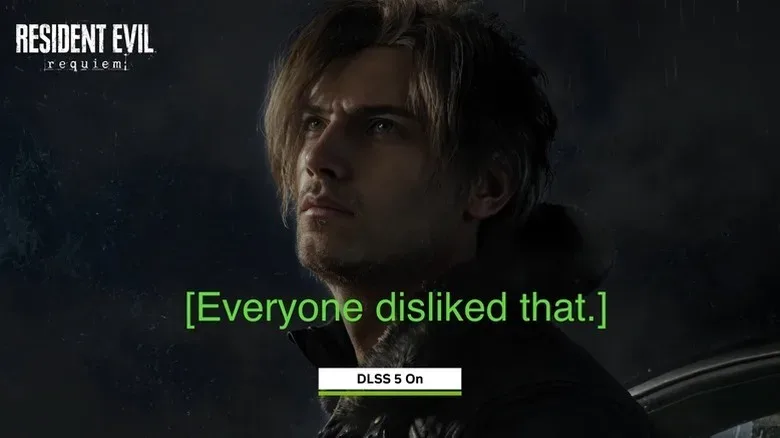
NVIDIA's own demonstrations appear to have sparked much of the early resistance. During the March GTC showcase, DLSS 5 was shown running over Resident Evil Requiem and Starfield. Viewers quickly focused on changes to character faces, particularly those of Leon Kennedy and Grace Ashcroft. Rather than seeing greater realism, many felt the characters looked overly softened and polished, as though a beauty filter had been placed over them.
The phrase "yassified" became a popular shorthand for that reaction. Critics argued that the faces appeared less like detailed game characters and more like stylized, synthetic-looking images. One widely shared response compared the result to AI-generated imagery, while another joked that games had been made to resemble YouTube thumbnails. The response was especially damaging because DLSS 5 is being marketed around realism; if viewers interpret the output as artificial or homogenized, NVIDIA's central pitch becomes much harder to sell.
The criticism also reflects how much visual character matters in modern games. Imperfections in a face, a deliberately harsh lighting setup, a painted material texture or an unusual color grade can all be purposeful. A game does not necessarily aim for the same kind of realism as a film, photograph or technical rendering. Horror, fantasy, anime-inspired and stylized games frequently depend on visual choices that would be weakened if a generalized system attempted to make everything appear conventionally photorealistic.
Art direction, authorship and the fear of visual convergence
The sharpest objection to DLSS 5 is that a common AI model could overwrite or dilute a studio's intentional art direction. Karla Ortiz, an artist whose work includes projects with Ubisoft and Blizzard, criticized the concept on Bluesky as disrespectful to developers' artistic choices. Her argument was straightforward: if a team wanted a hyperrealistic look, it could choose to make one itself.
There is also concern about convergence. If numerous games are processed through the same neural model, trained around the same assumptions about what realism should look like, then their differences may begin to erode. A distinctive face shader, a strange material response, muted skin tones, rough textures or stylized lighting could all potentially be pulled toward the model's preferred visual patterns.
This is not only a question of whether DLSS 5 looks good in a still image. It is a question of who gets final authority over a game's presentation. Players may reasonably want an optional enhancement mode, especially if it can improve perceived material detail or lighting. Developers and artists, meanwhile, may not want an outside model to reinterpret the work after it leaves their rendering pipeline.
Bethesda has addressed early Starfield footage by saying its art teams will tune the effect and that players will be able to turn it off. That optional status is important, since it gives users a way to compare the developer's standard presentation with the neural-rendered version. Capcom, however, was reportedly not aware that its game would be included in the DLSS 5 demonstration, adding another uncomfortable dimension to the discussion about communication and control.
NVIDIA says developers remain in control
NVIDIA's response has been that DLSS 5 is not merely a visual filter applied to completed frames. A company representative responding to criticism on the reveal video said developers have detailed artistic control so they can preserve the distinct aesthetics of their games. Huang made a similar technical case during a GTC Q&A, arguing that the feature works at the geometry level and remains under developer control rather than functioning as a simple post-process effect.
That explanation matters, but it has not immediately reassured critics. In fact, Huang's initial response to the criticism -- saying detractors were "completely wrong" -- aggravated the situation before the company's more detailed argument about developer tuning could be heard. The key test will not be whether NVIDIA can describe the controls in technical terms. It will be whether final games demonstrate that teams can use those controls to protect their own intended look.
Developer-tuned releases should provide a more meaningful comparison than an early technology showcase. A team that understands its own characters, lighting and materials may be able to limit unwanted smoothing, prevent distracting shifts in color or texture, and decide exactly where neural rendering is useful. Conversely, if even carefully integrated versions still make disparate games resemble one another, the concerns about convergence will become much stronger.
The leak has complicated the conversation
The late-August leak has given the debate a second life. Modders have pushed the early DLSS 5 build into a range of titles, creating examples that are less curated than NVIDIA's official material. Testing in Control prompted complaints about image quality and the performance cost. Those issues are notable because DLSS has historically been sold as a way to improve performance; a feature that introduces a substantial computational burden while delivering disputed visual gains will face a particularly difficult reception.
At the same time, not every reaction to the modded footage has been negative. Some clips have impressed players enough to suggest that opinion may be shifting in parts of the community. That split is likely to remain. People who value extremely polished lighting and material definition may see DLSS 5 as a remarkable step forward, while those who prioritize authored visuals may consider the same changes intrusive.
DLSS 5 is due to officially arrive this fall, when its developer-tuned implementations will be under much closer scrutiny. The eventual result may not be a simple victory or failure for NVIDIA. The technology could prove valuable when studios use it carefully and make it genuinely optional, while remaining unwelcome in games where its idea of photorealism clashes with a deliberately crafted style.
For now, the backlash is best understood as a demand for restraint rather than a rejection of rendering innovation itself. Players are asking whether faster, more detailed graphics should also mean allowing an AI model to repaint the worlds developers made. DLSS 5 will need to show that it can enhance a game without making that game look like every other one.
Community
Discussion
Start the conversation.
No comments have been posted yet.