

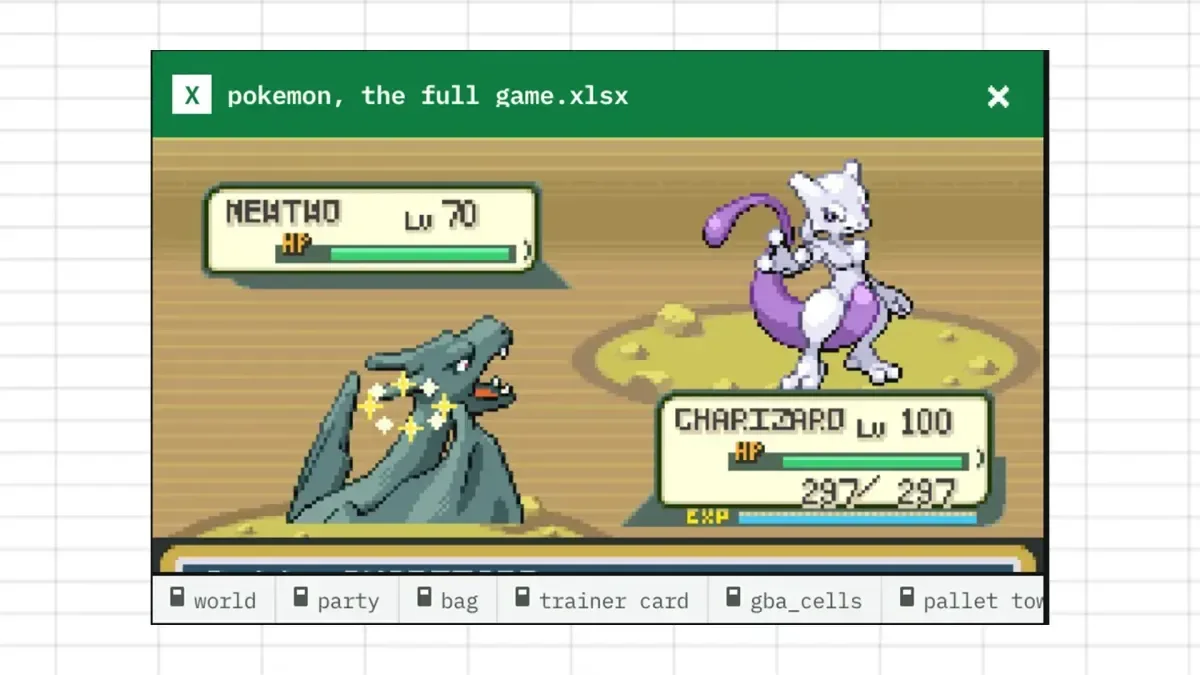
Microsoft Excel has become an unlikely destination for game experiments over the years, with hobbyists repeatedly testing how far spreadsheet software can be pushed beyond budgets, charts, and formulas. Doom is one of the better-known examples, but a new unofficial project takes the idea in a distinctly retro direction: a playable slice of Pokémon FireRed rendered inside an Excel workbook.
The project is being developed by an Instagram creator using the name justaspreadsheet. Rather than merely presenting a static recreation of a Pokémon screen, the workbook is designed to run a portion of the Game Boy Advance game within Microsoft's desktop spreadsheet application. It is an unusual technical demonstration, turning Excel's familiar grid into a game display and using its built-in editing possibilities as part of the gimmick.
There is an important caveat from the start. Pokémon FireRed and its characters, locations, and assets are copyrighted intellectual property. The project is unofficial, and a full version is reportedly being offered for payment. That raises serious legal and ethical concerns around distributing and monetizing an unlicensed version of Nintendo-owned material. A free demo is also available for curious users, but anyone considering the project should understand that it is not a Nintendo release, endorsement, or authorized port.
A Game Boy Advance screen made from spreadsheet cells
The premise works because of the Game Boy Advance's original display dimensions. The handheld outputs at 240 by 160 pixels, and the Excel sheet has been arranged around that same 240-by-160 layout. In practice, each cell serves as an individual pixel, changing its fill color to reproduce the image that should appear on screen at a given moment.
For useful background on this topic, read GTA 6 Players Can Find Dolores After Leaving Key Lento.
That means the workbook has to manage more than 38,000 cells for its visual output. Excel is not built as a conventional real-time game engine, so the result is as much about the novelty of the method as it is about revisiting Kanto. A normal spreadsheet grid becomes a tiny mosaic of color blocks, refreshed to represent the player character, overworld tiles, menus, battles, and other elements from the selected section of the game.
The project reportedly uses substantial AI assistance in its development. That detail is notable because spreadsheet-based game projects often require a mix of formulas, macros, scripting, formatting rules, and painstaking visual setup. AI tools can potentially speed up code experimentation and help solve repetitive spreadsheet problems, although the finished result still depends on the creator's implementation and the limitations of the software itself.
The appeal is not that Excel is the best way to play a Game Boy Advance RPG. It plainly is not. Instead, it is a demonstration of how flexible office software can become when someone is willing to treat every cell as a programmable display element. The fact that the layout maps so neatly onto the GBA's 240-by-160 resolution gives this particular experiment a satisfying technical logic.
What players can see in the available build
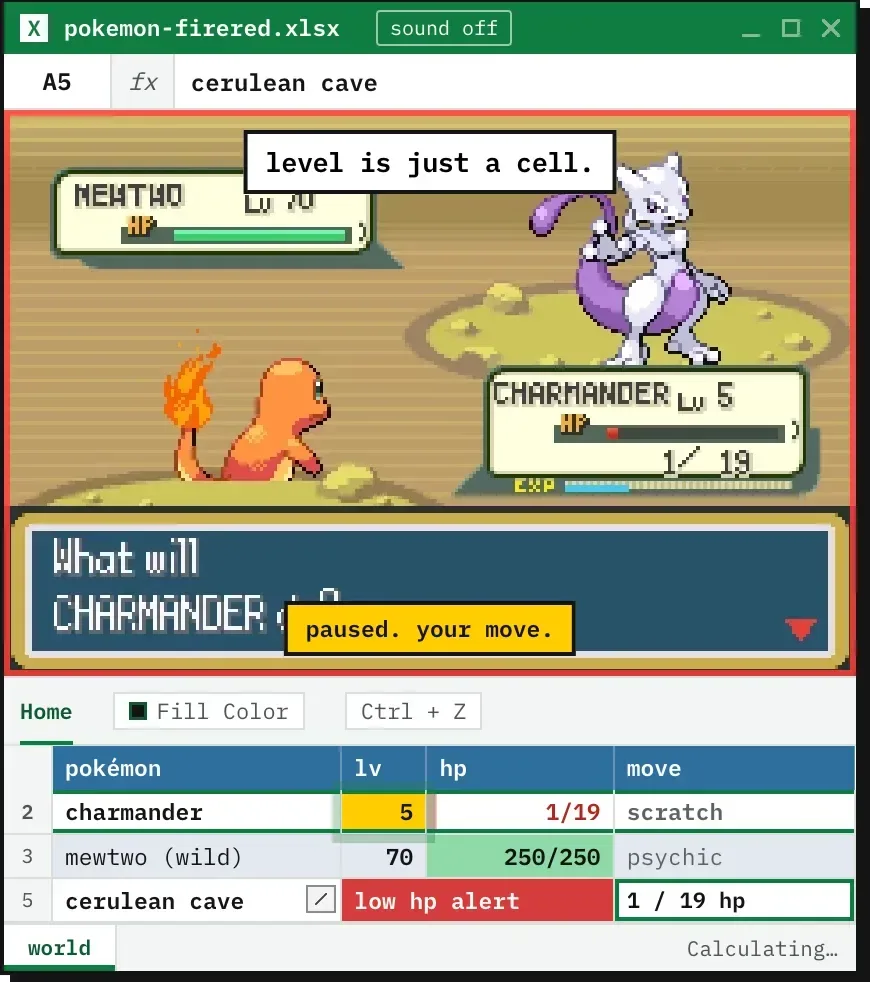
The available material describes access to several recognizable areas, including Pallet Town and Cerulean Cave. Those locations span very different moments and moods in the original adventure: Pallet Town is the quiet opening point of the journey, while Cerulean Cave is associated with one of Kanto's most famous late-game encounters. Their inclusion helps show what the spreadsheet format can handle beyond a single room or title screen.
It is not presented as the complete Pokémon FireRed experience. The project currently covers only a limited section rather than the entire game, so players should not expect a full replacement for the original Game Boy Advance release. That distinction matters particularly because screenshots and short demonstrations can make an experimental build appear more extensive than it actually is.
Still, the selected locations make sense for a showcase. Pallet Town is instantly recognizable even at a very low-resolution, cell-based scale, while Cerulean Cave provides an opportunity to demonstrate more complex maps and the mystique surrounding Mewtwo. For a project built around visual novelty, famous places are a useful way to communicate what is running without requiring viewers to study the spreadsheet mechanics first.
Excel editing is part of the experiment
One of the stranger features is the ability to pause the game with the Escape key and then interact with the cells as one normally would in Excel. Since the game image is made from cell colors, pausing opens the door to directly editing pieces of the display. In a conventional emulator, players see pixels but generally do not modify the screen by clicking into a grid and changing formatting. Here, the spreadsheet environment is inseparable from the game's presentation.
That setup also supports a number of custom alterations. The project describes options for cheat-like changes, including making Pokémon shiny, adjusting a Pokémon's level, and spawning Mewtwo. There is also a nod to one of the longest-running Pokémon playground myths: finding Mew beneath the truck. In the original first-generation games, rumors about a truck near the S.S. Anne led countless players to search for a hidden path to Mew. Later games and fan projects have repeatedly referenced that legend, and this Excel experiment apparently lets users play along with it.
These additions are less about preserving the intended balance of FireRed and more about embracing the fact that the game is sitting inside a modifiable worksheet. Excel users are accustomed to altering values and formatting, so it is fitting that the project treats spreadsheet customization as a route to Pokémon oddities that would not normally be available in a standard playthrough.
For viewers, that may be the most entertaining part of the concept. A classic RPG can be reduced to a grid of colored cells, frozen instantly, and manipulated like a work document. It is a bizarre collision between office productivity software and one of the most recognizable handheld role-playing games ever made.
Windows desktop Excel is required
The technical requirements are narrow. The full project requires the desktop version of Microsoft Excel on Windows 10 or Windows 11. It does not work on Mac, and it is not compatible with Google Sheets. Anyone hoping to open the workbook in a browser-based spreadsheet app or on macOS should therefore not expect the same functionality.
Those restrictions are unsurprising. Interactive workbooks often depend on desktop-specific behavior, especially when they use features unavailable in web spreadsheet tools or differently implemented across operating systems. Google Sheets may look superficially similar to Excel, but it has its own scripting model, formulas, performance characteristics, and rules for handling files. Likewise, Excel for Mac does not always match the Windows edition feature for feature.
The Windows requirement also reinforces that this is a technical curiosity aimed at people who want to see how the trick works, rather than a broadly accessible new way to revisit Kanto. Traditional hardware, official releases, and legally obtained games remain the straightforward choices for anyone seeking a reliable Pokémon experience. The spreadsheet project's value is in the novelty of its construction, not convenience.
A familiar game in an unfamiliar place
Projects like this continue a long-running fascination with putting games on platforms that were never intended to host them. The challenge is rarely about creating the most practical version. It is about proving that a program can be bent into doing something unexpected, whether that means a calculator running a game, a printer displaying graphics, or a spreadsheet imitating a handheld console screen.
Pokémon FireRed is especially suited to that kind of attention because it is both technically modest by modern standards and culturally enormous. The 2004 Game Boy Advance remake revisited the Kanto setting from the original Pokémon games, giving experimenters a familiar visual language of towns, caves, sprites, menus, and monsters. Even a partial, low-fidelity rendition is immediately legible to people who know the series.
At the same time, the project highlights an uncomfortable line that fan experiments can cross. Technical ingenuity does not erase the ownership issues created when copyrighted game content is distributed or sold without permission. The free demo may satisfy people who simply want to witness the Excel concept, but the paid full-build angle deserves caution. Fans can appreciate the spreadsheet engineering while recognizing that an unofficial commercial release of protected material is not equivalent to an authorized game.
For now, the Excel version is best viewed as an eccentric programming and formatting experiment: thousands of cells assembled into a playable-looking fragment of a beloved Game Boy Advance adventure. It will not make anyone abandon a proper handheld, emulator, or official Pokémon release. But as another example of people turning everyday software into a game machine, it is hard to deny the charm of seeing Kanto emerge from a workbook one colored square at a time.
Community
Discussion
Start the conversation.
No comments have been posted yet.