

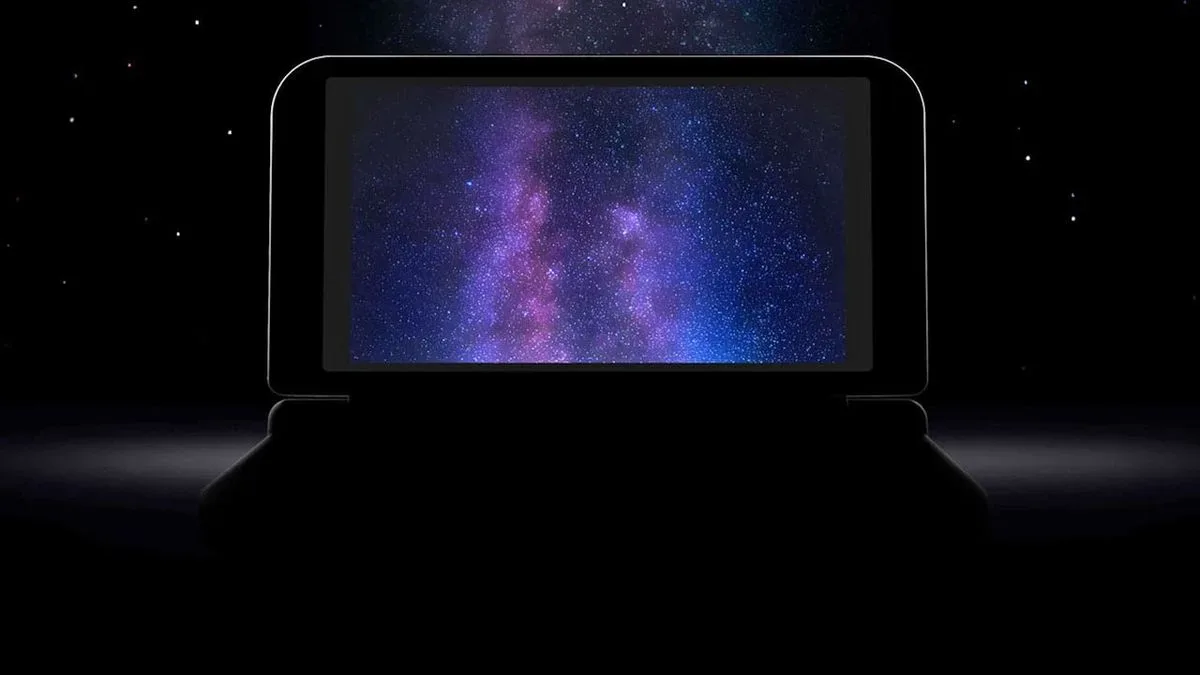
Retroid has offered the first tease of the Retroid Pocket Duo, an upcoming handheld that appears set to become the company's first purpose-built dual-screen device. The reveal is extremely brief, but it establishes two important points: the product is called the Retroid Pocket Duo, and Retroid is moving away from a clip-on second-display concept toward a handheld designed around two screens from the start.
The company shared the teaser on Instagram and X, accompanied by the line "no clips, two screens, one pocket." That wording is not a specification sheet, and it does not confirm the device's processor, display technology, controls, software, price, or launch timing. Still, it is a meaningful statement of intent. Retroid is clearly presenting the Pocket Duo as a more complete answer to dual-screen portable play than an accessory attached to an existing single-screen handheld.
For retro handheld fans, the timing is notable. Interest in DS-style portable hardware has grown as players look for more convenient ways to run software designed around two displays, touch input, and distinct screen layouts. Retroid's teaser arrives shortly after ANBERNIC announced its RG DS Plus, placing another manufacturer in an increasingly active dual-screen handheld space.
Embedded Instagram post
What Retroid Has Actually Confirmed
At this stage, the confirmed details are limited. Retroid has revealed the Pocket Duo name and has communicated that the device will have two screens without relying on clips. The phrase "one pocket" also suggests portability will be a central part of its pitch, although the teaser does not provide dimensions, weight, or an image detailed enough to settle how compact the final hardware will be.
For useful background on this topic, read Pokémon Synthesis Demo Opens the New Veldan Region for Up to Eight Hours.
There is no official word yet on whether the Pocket Duo will use a clamshell form factor, a vertically stacked fixed-screen design, or another configuration. It is also unknown whether both displays will support touch controls, whether they will match in size and panel type, and how Retroid will approach hinges, screen protection, speaker placement, cooling, battery capacity, or docking.
Most importantly, Retroid has not announced a chipset. Any claims about performance targets should therefore be treated as speculation rather than product information. There has also been no confirmed compatibility list for Nintendo DS, Nintendo 3DS, PlayStation 2, GameCube, Wii, Android games, streaming services, or any other platform.
The Pocket Duo teaser establishes the concept, not the final technical package. For now, Retroid's message is about integrated dual-screen convenience rather than raw specifications.
A Move Beyond the Previous Screen Attachment
Retroid has already explored the idea of a second display through an add-on made for Retroid Pocket hardware. That accessory gave owners a way to add another screen to a compatible handheld, but the approach had practical limitations. Some users encountered cable-related problems, while the physical nature of stacking an attachment onto an existing device could make the setup feel less elegant than a system built around dual displays from day one.
The Pocket Duo's "no clips" message seems designed to draw a line between that earlier experiment and this new direction. An integrated design could remove some of the compromises that naturally come with an attachment: additional connections, the need to fit around another product's body, and the awkward balance that can occur when extra hardware is mounted above a standard handheld screen.
That does not automatically mean the Pocket Duo will solve every challenge. Dual-screen devices create their own engineering questions. A clamshell needs a durable hinge and reliable display cabling. Two screens can demand more battery power. The placement of analog sticks, face buttons, triggers, speakers, and vents becomes more complex when the top half of the machine must house a display. Software also matters, particularly if Retroid expects users to configure different screen arrangements across multiple emulators.
Even so, an all-in-one unit has the potential to be more comfortable and more practical than an accessory-based setup. A good dual-screen handheld should feel coherent in the hands rather than like two separate products working around each other. That is likely the standard Retroid will be judged against once it shows the device in full.
Why Two Screens Matter for Emulation
Modern retro handhelds can play a broad range of older games, but single-screen designs are not an ideal match for every system. Nintendo DS software in particular was created with two displays as a basic part of its interface. One screen might hold maps, inventory menus, puzzles, touch controls, playfield information, or a simultaneous alternate camera view. Running those games on a single display often requires players to swap screens, shrink both images, or use layouts that compromise readability.
A dedicated second display could make DS games much more natural to use. It may also be useful for Nintendo 3DS emulation, where two screens are similarly central, though 3DS performance depends heavily on the processor, graphics capabilities, emulator development, and individual game demands. Retroid has not promised 3DS support for the Pocket Duo, so it would be premature to treat it as a confirmed focus.
Beyond Nintendo's dual-screen libraries, a secondary panel can be useful for other purposes. Depending on the operating system and software support, it could potentially display control overlays, manuals, achievement information, chat, streaming controls, game artwork, system statistics, or companion apps. These possibilities depend entirely on how Retroid designs the hardware and how developers and users are able to configure it.
The practical value of dual screens will ultimately come down to execution. Screen resolution, brightness, aspect ratios, orientation options, touch response, bezel size, and software flexibility are all likely to matter more than the simple fact that there are two displays. A poorly matched pair of panels or awkward default layouts could limit the appeal of an otherwise powerful device. Conversely, a polished interface that makes screen switching and per-game configuration easy could help the Pocket Duo stand out.
Performance Is Still the Biggest Question
Retroid's recent handhelds provide some context for why enthusiasts are already discussing ambitious possibilities. The Retroid Pocket 5 and Retroid Pocket 6 have been associated with strong performance in demanding PlayStation 2 titles, leading to understandable interest in what an integrated dual-screen model might attempt. However, past products do not confirm the Pocket Duo's internals.
There is currently no official basis for saying the Pocket Duo will use a Snapdragon 8 Gen 2 processor, AMOLED panels, or any particular amount of memory and storage. Those ideas are part of early community speculation about what Retroid could choose if it wants to position the system as a premium entry in the dual-screen category. They should not be mistaken for announced features.
Retroid may choose to build a high-end machine intended for broad emulation coverage, or it could target a lower price point and concentrate on DS-era use cases. Either direction would affect nearly every part of the final product, from screen quality and cooling to battery expectations and the type of software users can run comfortably. The teaser does not reveal which route the company has taken.
There is also a broader distinction worth making: hardware power is not the sole measure of a successful DS-inspired handheld. A device designed for dual-screen content needs an interface that respects how those games were originally played. Fast processing is valuable, but accessibility, reliable suspend-and-resume behavior, touchscreen accuracy, control mapping, and simple display layout management can be just as important in everyday use.
Competition Is Beginning to Take Shape
The Pocket Duo enters a market that has long been interested in dual-screen experimentation but has often lacked dedicated, widely available hardware. The recent announcement of ANBERNIC's RG DS Plus indicates that manufacturers see an opportunity for devices aimed at players who want something more tailored to DS-style games than a conventional horizontal handheld.
Retroid's potential advantage may lie in its established portable design language and its experience producing Android-based systems with stronger performance than many entry-level retro machines. Yet that advantage will only matter if the Pocket Duo has a compelling balance of build quality, ergonomics, software support, and price. A powerful chip alone will not guarantee a better experience, and neither will having two screens.
There is also no reason to assume the Pocket Duo and competing hardware will aim at exactly the same buyer. One may prioritize compactness, another may emphasize premium displays, and another may focus on affordability. Until specifications and pricing are announced, direct comparisons remain incomplete.
What to Watch for Next
The next official Pocket Duo update will need to answer several basic questions. Fans will want clear images of the full device, confirmation of its physical design, the sizes and properties of both screens, and details on whether either panel supports touch input. Processor, RAM, storage, battery capacity, operating system version, wireless connectivity, video output, and controller layout will all be crucial details.
It will also be important to see the device running software rather than simply appearing in a teaser. Demonstrations of dual-screen layouts, touchscreen controls, menu navigation, sleep behavior, and real-world ergonomics would say far more about the Pocket Duo's potential than a name reveal can. If Retroid wants the handheld to be viewed as a major step beyond its attachment solution, it will need to show that the integrated approach improves both reliability and the feel of play.
For now, the Retroid Pocket Duo is a promising but largely mysterious addition to the handheld market. Its announcement confirms that Retroid is taking dual-screen hardware seriously and intends to package it in a single portable unit. Everything else--from its power level to its screens and eventual audience--awaits official confirmation. The concept is clear; the details that will determine whether it becomes a standout retro handheld are still to come.
Community
Discussion
Start the conversation.
No comments have been posted yet.