

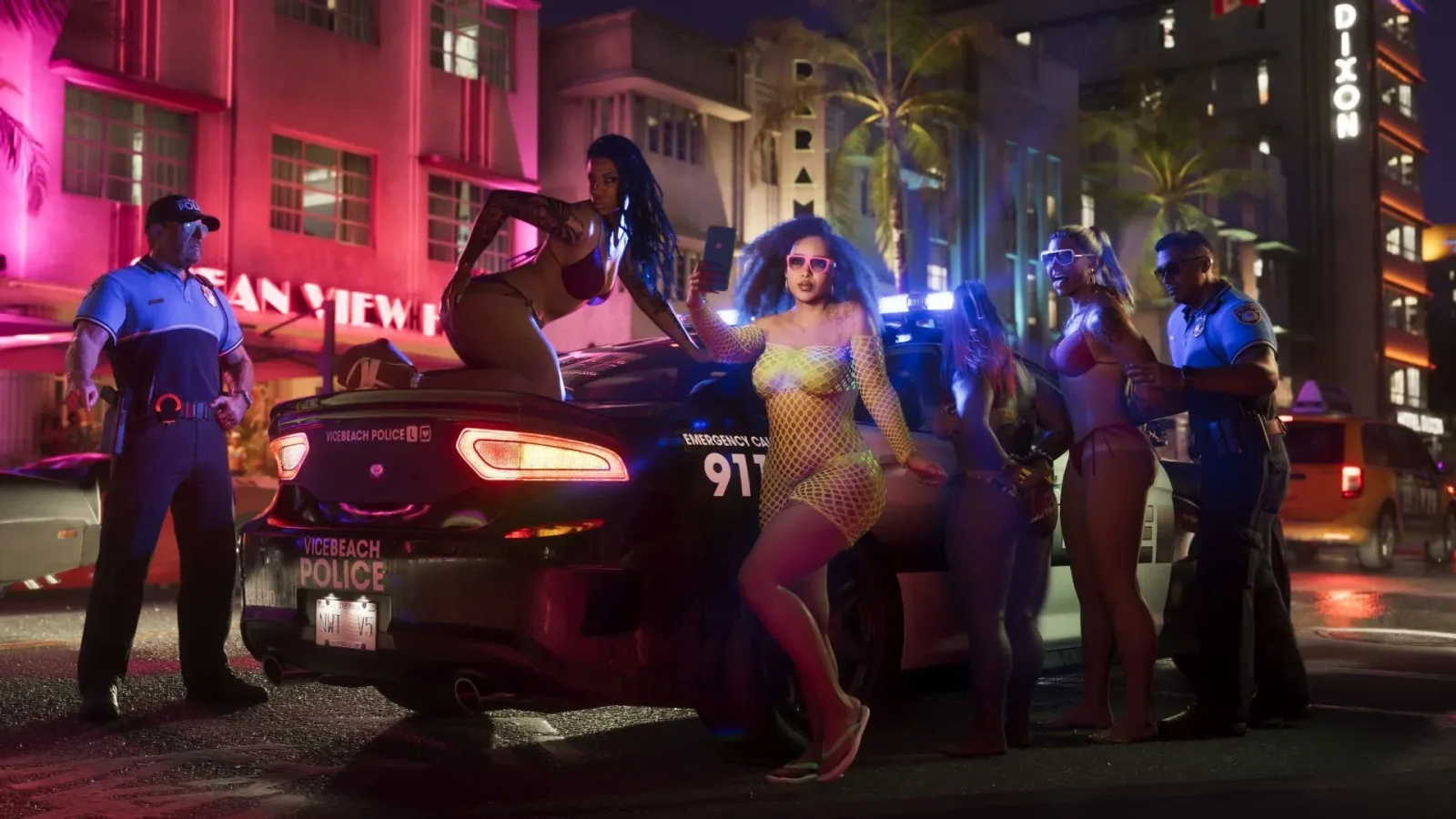
Grand Theft Auto 6 carries forward many of the activities, vehicles, and criminal systems associated with Rockstar Games' long-running open-world series. Players can still steal cars, carry out robberies, use the radio, modify vehicles with upgrades such as turbo, and even drive tanks. But one familiar element from the modern Grand Theft Auto formula is absent: players cannot hire sex workers from the street.
It is a notable break from a feature that has appeared throughout the series' 3D-era mainline games since Grand Theft Auto III in 2001. Rockstar has addressed the omission by pointing to the priorities behind GTA 6's story and systems. The studio says the game was built around Jason and Lucia, a couple facing difficult circumstances while on the run, and that included features were chosen because they supported that specific tone, narrative, or expanded gameplay design.
Rather than treating every historical GTA activity as mandatory, Rockstar's explanation presents GTA 6 as a game willing to selectively retain, revise, or leave behind series traditions. The decision may be especially striking because the franchise is known for its broad satirical worlds and densely layered optional interactions. Yet it also underlines a straightforward point: a Grand Theft Auto game can remain enormous in scope without reproducing every feature that appeared in its predecessors.
A 25-year shift from GTA III's template
The ability to approach and pay sex workers was first introduced in Grand Theft Auto III, released in 2001. It subsequently became a recurring part of the mainline series, appearing alongside the many other bits of environmental interactivity that helped establish GTA's reputation for letting players experiment within a city. For decades, it was one of those features that could be easy to overlook during a typical playthrough while still feeling like part of the expected GTA package.
For useful background on this topic, read GTA 6's New Zealand Unlock Sends Xbox Network Traffic Soaring.
GTA 6 ends that uninterrupted run. After more than 150 hours spent playing the game, the absence became apparent when the streets of Vice City were specifically checked for sex workers. None were found because Rockstar did not include the activity. The discovery was not necessarily obvious during ordinary play, particularly given the volume of other content and systems competing for a player's attention.
That context matters. Grand Theft Auto games are often remembered as much for the sheer range of distractions as for their missions. A player might spend a session racing through traffic, changing a vehicle's look and performance, browsing radio stations, provoking a wanted level, or robbing a store. In an experience built around so many choices, individual features can be less central than the broader sensation of inhabiting a reactive, dangerous, and often absurd criminal world.
Rockstar's comments indicate that GTA 6 was not designed as a checklist of every prior activity. The studio has retained major pillars of the series while making room for systems it considers more relevant to this entry's goals.
Jason and Lucia shape the game's priorities
Rockstar characterizes GTA 6 as the story of "a couple in a bind" and "lovers on the run." That description places Jason and Lucia's relationship at the center of the game's identity. The developer says it has brought many ideas forward from earlier GTA titles, but that every implemented element was meant to reinforce the spirit of the story it wanted to tell and the gameplay areas it aimed to develop.
The studio specifically identified the wanted system, radio, robberies, and car theft as examples of systems that fit that approach. These are not minor callbacks. They are foundational aspects of the Grand Theft Auto experience, and they can all naturally contribute to a story about two people navigating crime, pressure, pursuit, and escape. A wanted system turns criminal acts into immediate consequences. Car theft provides both utility and danger. Robberies give players a direct expression of outlaw activity. Radio remains an important part of setting the mood while traveling across the world.
In that framing, GTA 6's omissions are not presented as accidental gaps. Rockstar says several aspects of earlier games are not present, while emphasizing that the elements included are necessary to the feelings and motivations it wants players to experience through Jason and Lucia's story. The explanation does not single out the removed street activity as a special case; instead, it treats it as part of a larger process of determining what belongs in this particular installment.
That is a meaningful distinction for a sequel with a legacy as large as GTA's. Long-running series often face tension between nostalgia and reinvention. Bringing back everything can preserve familiarity, but it can also make a new entry feel constrained by old assumptions. Removing something that once seemed standard can invite discussion, especially when it has been present for roughly a quarter-century. Still, the developer's position is that returning mechanics need to earn their place by fitting the newer game's story and systems.
Vice City still includes adult material
The removal of street sex workers does not mean GTA 6 avoids adult content altogether. Strip clubs remain in the game, including nudity. Players can also return home and have Jason and Lucia have sex. The change is therefore narrower than a complete departure from mature themes or sexual material. It concerns one specific optional interaction that had become associated with past GTA games.
That distinction will likely matter to players discussing the decision. Grand Theft Auto has never relied on a single feature to create its adult tone. Its worlds draw that tone from crime, violence, satire, dialogue, nightlife, radio programming, businesses, characters, and the freedom to engage with a variety of illicit activities. GTA 6 still has many of those ingredients, even as it removes one legacy interaction.
It also means that the decision should not be read as a simple binary between an unrestricted past and a restrained present. Rockstar is still presenting an adult-oriented world, but it has adjusted what types of interactions are considered useful for this story. With Jason and Lucia positioned as a caring couple, their relationship provides another way for the game to depict intimacy without retaining the old street-based activity.
What the omission says about GTA 6
For some players, the missing feature may be a curiosity rather than a major loss. It was not immediately noticed across a lengthy playthrough, which speaks to the density of GTA 6 and the number of other things available to do. For others, it may stand as a symbol of how Rockstar is approaching a series entry expected to carry enormous expectations: not by preserving every piece of old design, but by deciding which components most strongly support the new game.
There is also a practical creative lesson in Rockstar's explanation. A feature can be historic without being essential. GTA III established a blueprint that later games expanded in countless directions, but its individual details do not all have to be permanent fixtures. The defining qualities of Grand Theft Auto are broader than any one roadside encounter: open-ended movement through a city, criminal escalation, vehicles, missions, satire, and the unpredictable stories that emerge from player actions.
GTA 6 appears to retain much of that core while putting particular emphasis on Jason and Lucia. The couple's role is not merely narrative decoration around a familiar sandbox. Rockstar's statement suggests their circumstances informed the choices behind the game's mechanics and activities. Systems such as robberies, theft, and police pursuit can all reinforce the pressure of being fugitives and partners in crime, while the radio and world design help establish the atmosphere surrounding them.
Ultimately, the absence of sex workers is less significant as an isolated removed feature than as evidence of Rockstar's wider selection process. GTA 6 includes tanks, vehicle customization, store robberies, car theft, radio stations, strip clubs, nudity, and its expanded wanted system. At the same time, it leaves out some aspects of prior entries, including a series fixture dating back to 2001. Rockstar's reasoning is that GTA 6 should be defined by what serves its particular characters, story, and gameplay ambitions--not by an obligation to recreate every tradition that came before it.
Community
Discussion
Start the conversation.
No comments have been posted yet.