

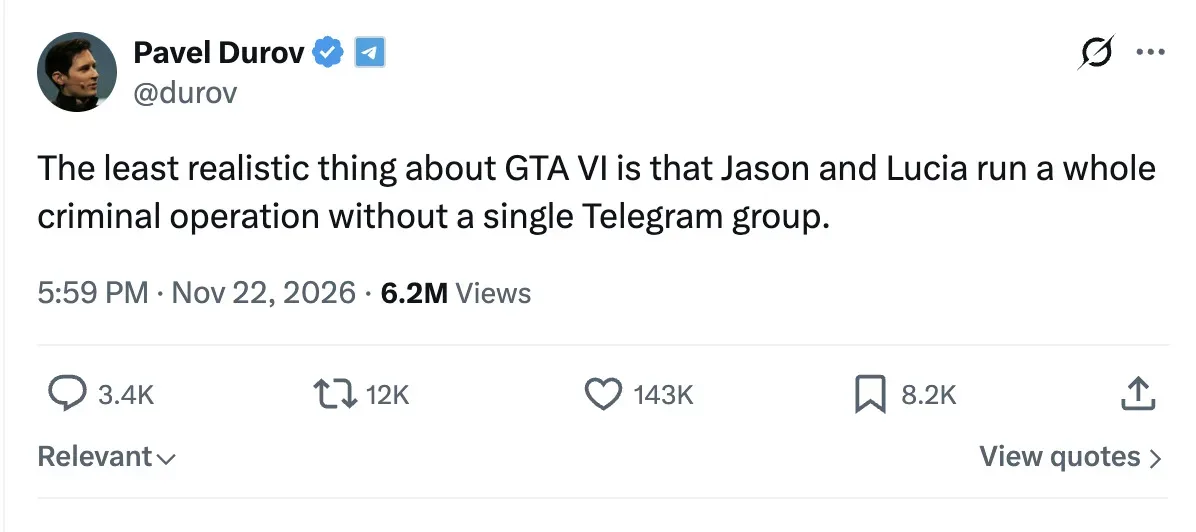
Telegram CEO Pavel Durov has weighed in on the realism of Grand Theft Auto 6, but the detail he singled out was not a car chase, a police response, or the fictional state of Leonida. Instead, Durov suggested that the game's criminal protagonists, Jason and Lucia, should be coordinating their operation through a Telegram group.
In a post on X made late last week, Durov called it the least believable part of GTA 6 that the pair could run a criminal enterprise without using the messaging platform he leads. It was a short joke, and clearly framed as an observation about how modern organized communication works. Yet it has landed awkwardly given Telegram's years-long association with private criminal communities and the ongoing legal scrutiny surrounding its moderation practices.
The comment also highlights an unusual collision between a hugely anticipated crime-fiction game and a real-world communications service that has repeatedly been criticized over how it handles unlawful activity. Grand Theft Auto has always satirized contemporary culture, technology, consumer behavior, and media habits. Durov's post effectively argues that a prominent encrypted messaging app would be a natural part of a modern-day criminal story.
A joke with real-world baggage
On its face, the observation is not difficult to understand. Messaging apps are a routine part of daily life, and a game built around smartphones, social media, surveillance, online personalities, and digital communication could reasonably include them in some form. A pair of fictional outlaws managing contacts, planning jobs, and keeping tabs on associates through group messages would fit the broad shape of a modern open-world crime narrative.
For useful background on this topic, read Shinji Mikami Warns AI Could Threaten Game Jobs Despite Studio Experiments.
However, Telegram has an especially complicated place in that conversation. The service is used around the world for ordinary chats, broadcasting channels, communities, journalism, activism, labor organizing, and communications by people operating under restrictive governments. Its privacy-oriented features can be important for users who need to avoid monitoring, intimidation, or censorship.
Those same characteristics have also made it attractive to people using private or semi-private groups for illegal activity. The platform has developed a public reputation as a gathering place for a wide variety of criminal networks, including extremist communities and cryptocurrency fraud schemes. That reality is central to why Durov's joke about fictional criminals seemingly being unable to function without Telegram has attracted criticism.
It is one thing for players to recognize that a fictional crime saga should reflect the ways people communicate today. It is another for the head of a real service accused of not doing enough to prevent harmful material and illegal trade from circulating on that service to make that connection himself. The juxtaposition is what gives the post its bite.
Telegram's legal pressures remain significant
In 2024, Durov was indicted in France on 12 charges tied to allegations that Telegram had failed to sufficiently curb activity including drug trafficking and the distribution of child sexual abuse material. The case put an intense spotlight on the company's moderation tools, its willingness to cooperate with law enforcement, and the responsibilities carried by large global messaging platforms.
Durov has disputed the characterization of Telegram as a haven for criminals. He has said the company actively removes illegal material and works against abuse of the platform. The broader debate, however, is not simply whether Telegram takes any action; it concerns whether those efforts are fast, comprehensive, transparent, and effective enough given the scale of the service and the nature of the material alleged to have circulated through it.
Earlier in 2026, Russia also charged Durov with facilitating terrorism, alleging that Telegram had not removed information said to have been used to target Russian soldiers, infrastructure, and civilians during the Russia-Ukraine war. As with the French case, the matter sits within a difficult and politically charged argument over content moderation, state demands, user safety, privacy, and the power governments seek over online communications.
These cases do not erase Telegram's legitimate uses. Nor does the existence of misuse make every user or group on the service suspect. But they explain why a joke positioning Telegram as an obvious tool for a fictional criminal operation can be received as more than a harmless aside. It touches directly on the issue Durov and his company have spent years trying to address publicly.
Why GTA is an easy target for this kind of observation
Grand Theft Auto is uniquely suited to comments like Durov's because its worlds are deliberately built around recognizable versions of real life. The series has mocked television, advertising, politics, celebrity culture, online outrage, corporate branding, and the strange behavior produced by new technology. A contemporary messaging platform, whether it resembles Telegram or another service, would be an easy fit for that tradition.
Jason and Lucia are presented as the central criminal duo in GTA 6, making them natural subjects for speculation about how the game will depict planning, contacts, scams, street-level work, and larger operations. But there is a substantial difference between saying a game might include private group chats and implying that it should specifically mirror the reputation of a real-world app.
Rockstar Games has historically created fictional brands and services rather than directly building every major piece of its satire around real companies. That approach gives the studio room to exaggerate, parody, and criticize modern institutions without being bound to the precise behavior or image of a particular platform. If GTA 6 includes a messaging system, players may encounter a fictionalized version designed for its own jokes and gameplay needs rather than a named real-world product.
That would also be consistent with the series' larger style. The point is rarely to reproduce reality exactly. It is to create an exaggerated reflection of reality where recognizable cultural trends can be turned into missions, radio ads, background chatter, and visual gags.
Privacy, moderation, and the limits of a one-line post
Durov's remark has renewed a familiar argument around encrypted and privacy-focused communications platforms. Supporters stress that secure messaging is not inherently suspicious. Journalists protecting sources, protesters organizing in dangerous circumstances, workers coordinating collective action, families communicating across borders, and ordinary people seeking greater privacy all have reasons to use such tools.
Critics counter that privacy features cannot become an excuse for allowing serious abuse to persist. They argue that large platforms need credible reporting systems, meaningful enforcement, adequate staffing, and policies that account for the harm caused when illegal networks are permitted to grow. The challenge is heightened when services operate internationally, where legal standards, government demands, and human-rights concerns can vary dramatically.
Telegram's position in this debate is particularly visible because it has long promoted a privacy-conscious identity while becoming associated with high-profile claims of illegal use. Durov's public comments are therefore examined through both lenses. To some, his post is simply a playful comment about the ubiquity of group chats. To others, it is an unexpectedly candid acknowledgment of the exact public perception his company has been attempting to push back against.
The bigger question for GTA 6
For players, the post ultimately raises a more entertaining question: how deeply will GTA 6 engage with contemporary online life? The game has already generated enormous interest around its setting, its protagonists, and its potential to satirize the culture of the mid-2020s. Messaging apps, influencer culture, viral clips, digital scams, and constant online documentation all provide obvious material for a series that thrives on social commentary.
Still, no single real platform needs to appear for Rockstar to explore those ideas. A fictional group-chat service could capture the same comedy while allowing the game to take sharper, stranger, and more expansive creative swings. In the world of Grand Theft Auto, the most likely outcome is not a straightforward replica of any one app, but a warped digital ecosystem that borrows from many of them.
Durov's post may have been just a quick joke between gaming commentary and social-media banter. But because it came from the CEO of Telegram, it has become a reminder of the company's real-world controversies. It also underlines how closely modern crime fiction is now tied to digital communication--and how difficult it can be to separate a fictional gag from the public reputation of the technology being invoked.

Community
Discussion
Start the conversation.
No comments have been posted yet.