


The Abbey of Crime, the revered 1987 Spanish adventure created by Paco Menéndez and Juan Delcán, has received a new tribute port for the Commodore Amiga 500. Developed by vnomis, the release is designed to work on a standard PAL Amiga 500 with just 512 KB of RAM, running directly from a single self-booting floppy disk.
The project is built around a difficult balancing act: retaining the original game's unusual logic, strict structure and oppressive atmosphere while smoothing out several points that could make the classic especially daunting for newcomers. The result is still intended to be the same deeply regimented isometric murder mystery, but one with selectable presentation and usability features that make it easier to approach on original-style Amiga hardware.
A monastery mystery governed by the clock
Originally released by Opera Soft, The Abbey of Crime casts the player as Friar William, who arrives at a remote monastery with his novice companion Adso. A series of disturbing deaths has taken place within its walls, and the pair must determine who is responsible. Their investigation has a hard deadline: seven days.
That premise makes the game sound like a conventional detective adventure, but its defining feature is the degree to which everyday monastic life controls the investigation. Friar William cannot simply roam freely, interrogate everyone at leisure and treat the abbey as a puzzle box waiting to be opened. The Abbot expects the correct attendance at meals, services and other scheduled moments. Failing to respect that routine can result in being expelled, ending the effort before the mystery has been resolved.
For useful background on this topic, read Hot Dogs, Horseshoes & Hand Grenades 2 Launches on Meta Quest 3 and 3S.
Time, therefore, is not merely a backdrop. It is one of the game's central systems. Players need to learn the geography of the monastery, understand where they are expected to be at particular hours, track the behavior of its inhabitants and fit their own detective work into the small spaces between obligations. The pressure comes as much from discipline and planning as it does from finding objects or uncovering clues.
This structure has long given The Abbey of Crime a reputation for being uncompromising. It asks players to observe closely, accept that mistakes can have serious consequences and gradually master a dense daily rhythm. The new Amiga version does not discard that identity. Instead, it supplies tools that can reduce unnecessary friction without removing the core challenge of successfully navigating abbey life.
Made for a standard PAL Amiga 500
The technical target is central to the appeal of the port. It has been created for a PAL Amiga 500 configuration with 512 KB of RAM, rather than requiring a more elaborate setup. It also boots from a single floppy disk, a format that suits the period hardware and makes the release feel like a deliberately authentic home-computer edition rather than a modern reinterpretation that happens to use retro visuals.
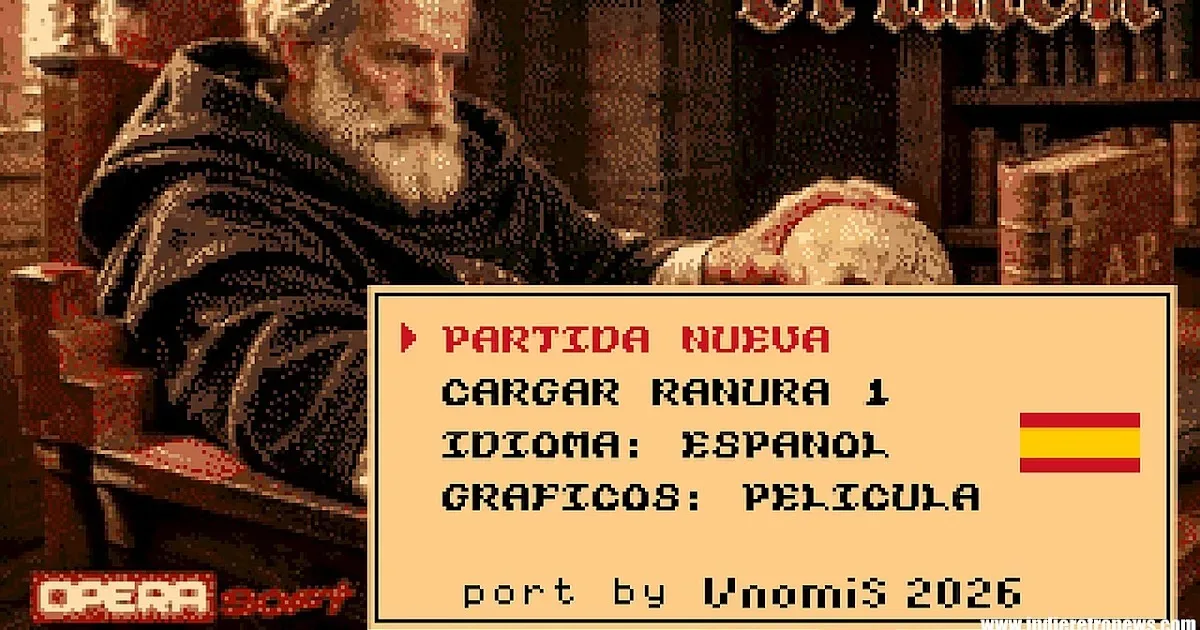
Despite the hardware restrictions, the port includes several configurable features. Text can be switched between English and Spanish, allowing players to choose the language that best suits them. The Spanish option also has particular significance for a game originally created in Spain, while English gives a wider audience a way into its demanding mystery.
Audio is likewise selectable. Players can choose between original sound and enhanced audio, making it possible to favor a more historical presentation or a version with added sonic polish. The availability of both options reflects the broader philosophy behind the project: preserve the classic experience, but let players decide how closely they want to adhere to it.
Three visual approaches, one investigation
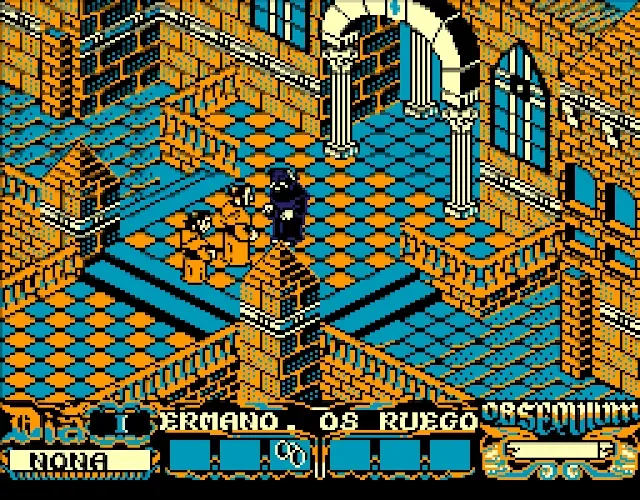
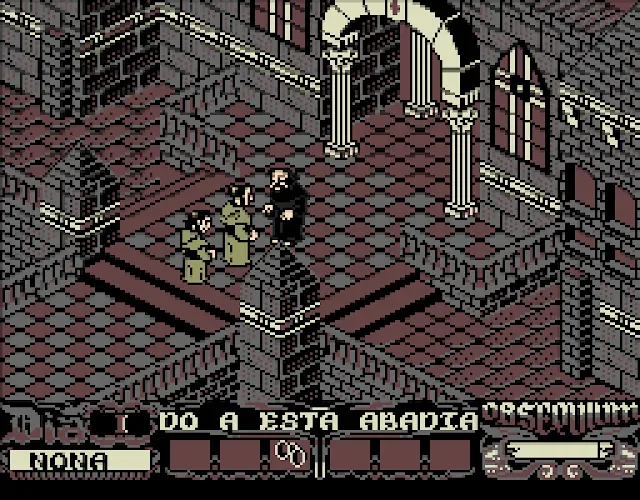
The Amiga edition offers three visual styles. One recreates the familiar Amstrad CPC palette associated with the original era, while an enhanced mode presents an updated look. A third option, called Film mode, provides another aesthetic interpretation of the game's shadowy monastery setting.
These choices are more than a simple display preference. The Abbey of Crime depends heavily on atmosphere. Its isometric rooms, corridors and courtyards establish an environment that is at once orderly and unsettling: a place governed by rules, secrets and watchful authority. Offering several ways to view that environment lets returning players revisit a favored style while giving new players alternatives that may make the layout and details more readable.
Importantly, the underlying game logic remains intact. The mystery, its rigid progression and the demands imposed by the Abbot are not being replaced by a simplified remake. The selectable visuals instead frame the same fundamental adventure through different visual lenses.
Controls intended to make the classic more approachable
One of the most notable adjustments concerns movement. The release retains the original tank-style control approach, preserving a major part of how the 1987 game handled navigation. At the same time, it adds direct directional controls as an alternative. For players accustomed to more immediate movement in isometric games, that option may make the abbey's rooms and hallways less awkward to traverse.
Navigation matters enormously in a game where timing is so strict. Missing a meal, prayer or appointment because of a control struggle is not the same as failing to solve an intentional puzzle. Direct directional input is therefore a practical quality-of-life feature: it can help focus the challenge on observation, deduction and schedule management rather than on mastering an older movement convention.
The port also includes save slots on the disk. This is a significant convenience for a game based around experimentation and precise use of time. Players can preserve progress at key points, test an idea, and return if a decision leads to an unwanted outcome. The original's stakes remain, but the process of learning its many rules need not demand a complete restart every time something goes wrong.
Dedicated object and mirror screens have also been added. These interfaces reduce reliance on the keyboard and make important interactions more directly accessible. In an adventure full of investigation-related tasks, clearer access to relevant tools can make a substantial difference, particularly for those playing with a joystick-focused Amiga setup.
Help with the routine, without abandoning the routine
Perhaps the most interesting addition is a bot designed to handle Friar William's daily routines between canonical hours. The original structure requires careful adherence to the abbey's timetable, and that is fundamental to its identity. Yet repeatedly performing routine travel and attendance can become a barrier for players whose main interest is the investigation itself.
The bot provides a way to manage those expected activities between the important scheduled points. This does not erase the world's rules; the daily cycle remains part of the game. Rather, it offers assistance with the mechanical burden of maintaining that cycle, potentially leaving more attention for clue gathering, character observation and the complex spatial puzzles inside the monastery.
It is a thoughtful compromise for an adventure known for asking a great deal of its audience. Veteran players can still engage manually with the original-style rhythm, while people who want guidance through its most repetitive demands have a built-in option. That kind of flexibility is especially appropriate for a tribute port, where historical faithfulness and practical playability can otherwise pull in opposite directions.
A movie mode for seeing the whole mystery
The Amiga port includes a self-playing movie mode that can complete the entire mystery automatically. Players are able to intervene and take control if they choose, turning the feature into more than a passive demonstration.
For a famously demanding adventure, this mode has several potential uses. It can provide a guided introduction to the game's unusual systems, show how the monastery's schedule intersects with the investigation, or offer a way to see the complete narrative path for those unable to overcome every obstacle themselves. It may also be useful as a reference point for players who have become stuck and want to understand the broader shape of the solution without necessarily remaining spectators.
At the same time, the ability to jump in preserves player agency. The movie mode does not have to be an all-or-nothing replacement for play. Someone can watch the early stages, take over when ready, or return to automatic progress later. That makes it an unusually flexible educational tool for a game whose systems can be difficult to grasp from a cold start.
A careful revival for a singular adventure
The Abbey of Crime occupies a distinctive place among 1980s adventure games because it is willing to make routine, hierarchy and timekeeping central to the drama. Its monastery is not just a setting for a murder mystery. It is an institution with rules that shape every attempt to uncover the truth. That combination of detective fiction, isometric exploration and enforced daily life remains striking decades later.
vnomis' Amiga 500 tribute port appears designed to respect exactly that character. It does not present the game as a loose inspiration or a heavily modernized reboot. The original logic is preserved, including the pressure of solving the case within seven days while staying on the Abbot's good side. But it supplements that foundation with language choices, alternate sound, multiple visual modes, friendlier controls, disk saves, streamlined interaction screens, routine support and an optional full-play movie mode.
For longtime admirers, the release offers a new way to experience a Spanish classic on period-appropriate Amiga hardware. For curious players, it creates several routes into an adventure that has always rewarded patience, attention and a willingness to live by the bell. The monastery's demands remain severe, but this version gives players more ways to meet them.
Community
Discussion
Start the conversation.
No comments have been posted yet.