

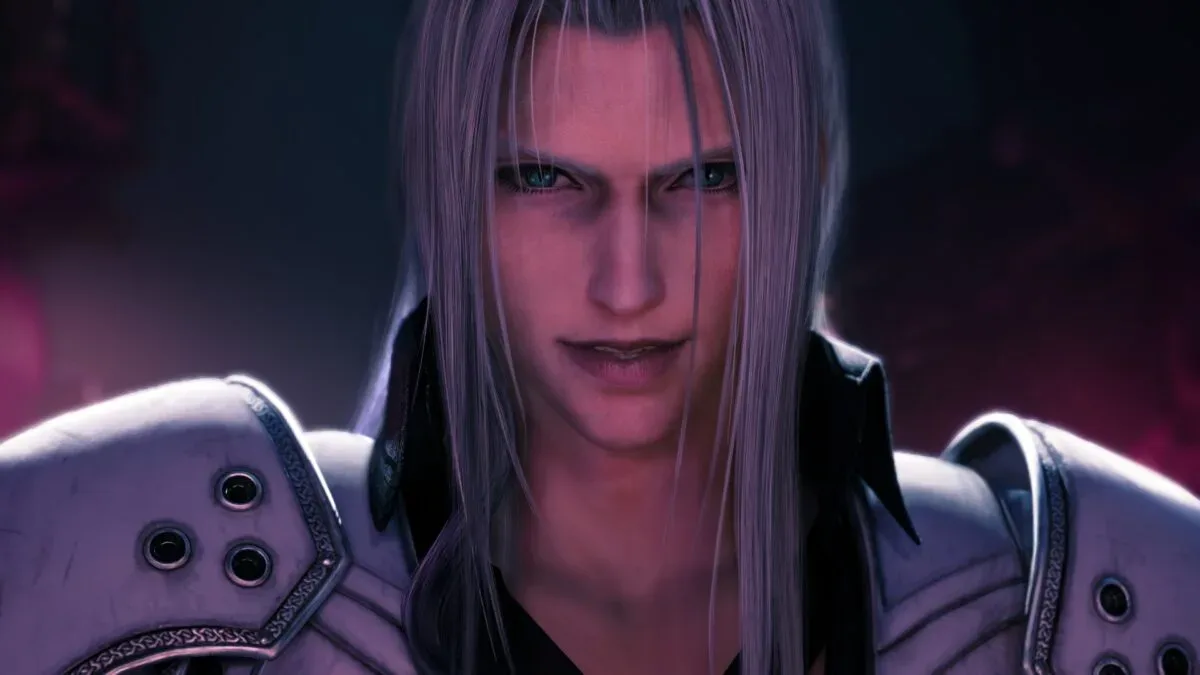
Travis Willingham will voice Sephiroth in Final Fantasy VII Revelation, stepping into one of gaming's most recognizable villain roles for the final chapter of the Final Fantasy VII Remake trilogy. Willingham takes over after previous English-language actor Tyler Hoechlin had to leave the part because of scheduling conflicts.
The casting was discussed during a Final Fantasy VII Revelation panel at New York City Comic-Con, where the game's performers gathered to reflect on their time with a cast that has been revisited and reinterpreted over multiple entries. While many of the actors have been involved with the remake project for years, Willingham is joining at a particularly consequential moment: the trilogy's concluding installment and a story in which Sephiroth's presence looms over nearly every major question.
For Willingham, the role is both an opportunity and an enormous responsibility. Sephiroth is not simply an antagonist attached to a popular game. He is a character with decades of history, several interpretations across games and related projects, and a performance legacy that makes every new casting decision subject to intense attention from longtime fans.
A new voice for a familiar threat
Willingham acknowledged the significance of joining a franchise with such an established identity, describing it as an honor to become part of the game and its cast. He said he had spent time studying the work already done across the trilogy, including watching videos and interviews with the other performers to better understand the creative environment he was entering.
For useful background on this topic, read Marvel's Wolverine Disc Sales Accounted for 35% of September Launches, Retail Data Indicates.
That preparation matters for a role such as Sephiroth. The character's power is not limited to direct confrontation. Sephiroth's menace often comes from distance, mystery, and the unsettling sense that he knows more than everyone else in the room. A replacement actor needs to fit alongside an ensemble that has already built relationships, emotional rhythms, and recognizable versions of beloved characters over several games.
Hoechlin's departure was attributed to scheduling conflicts, rather than a creative change in direction for Sephiroth. That distinction is important. A recast near the end of a major storyline can be jarring for audiences, especially when the outgoing actor's work has become tied to a particular interpretation. The task for Willingham is therefore not to erase what came before, but to carry the role forward while preserving the character's essential qualities.
Toshiyuki Morikawa remains a guiding influence
Willingham identified Toshiyuki Morikawa as his primary point of inspiration in approaching Sephiroth. Morikawa has voiced the character in Japanese across Final Fantasy and Kingdom Hearts projects, making his interpretation one of the most enduring elements of Sephiroth's modern voice identity.
Willingham praised Morikawa's ability to move between lighter, more alluring moments and a dangerous, intimidating edge. That range gets to the heart of why Sephiroth is difficult to perform. The character cannot be played as a straightforwardly angry villain at all times. His appeal lies partly in his composure and in the ambiguity that surrounds his intentions. He can appear inviting, reflective, distant, cruel, or terrifying without necessarily changing his volume.
"There's nothing more dangerous than the villain in the room that doesn't need to shout to be heard," Willingham said while discussing his approach to Sephiroth.
That observation provides a useful lens for what players may hear from the new performance in Revelation. Sephiroth's intimidation comes from restraint. He does not need to prove that he is in command through constant displays of rage; the confidence that he already controls the situation is often what makes him unnerving.
Willingham also pointed to guidance from voice director Kirk Thornton, who characterized Sephiroth as someone who always seems to be in control. In this view, Sephiroth is not easily confused and is rarely caught off guard. That emotional steadiness is crucial. Even in moments where the world around him becomes chaotic, the performance needs to suggest a character who believes he has anticipated every turn.
Why Sephiroth's restraint matters
Villains are frequently remembered for explosive speeches, sudden outbursts, or theatrical threats. Sephiroth has room for spectacle, but his most distinctive quality is often the inverse: an unnaturally calm manner that makes his words feel more deliberate. The danger is not always in what he says plainly. It can also be in the pauses, the certainty, and the implication that he is operating on a level others cannot fully see.
That is why Willingham's emphasis on ambiguity is especially notable. A performance can reveal too much if it turns every line into an obvious statement of motive. Sephiroth works best when players are asked to interpret him, to question whether an invitation is sincere, whether a promise is a manipulation, or whether he is simply several steps ahead of the heroes.
The final entry of a trilogy also raises the stakes for that approach. The more a story moves toward resolution, the more pressure there can be to make its antagonist explicit and definitive. Yet Sephiroth's mystique has long been a major part of his impact. Maintaining a sense of uncertainty while still giving the character the force needed for a finale will be one of the key balancing acts in Final Fantasy VII Revelation.
Willingham's comments suggest that he is approaching the part through control rather than imitation alone. Morikawa's work serves as a "North Star," but the goal is not merely to duplicate another actor's delivery. It is to understand the qualities that make Sephiroth effective: allure, menace, stillness, confidence, and the feeling that his calm is never accidental.
A cast addition beyond Sephiroth
Willingham is not the only performer associated with Critical Role joining the remake trilogy for Revelation. Marisha Ray was also confirmed for the game during the Comic-Con panel. Ray will play Polydroid Shiva, an NPC the party encounters during its journey.
Her addition reunites her with Matt Mercer, her husband and fellow Critical Role cast member, who is also involved with the game. The presence of several performers from the tabletop entertainment group adds another point of interest to an ensemble that already has a substantial history with the remake project.
Ray's character, Polydroid Shiva, was described as a non-player character the party will meet, though further details about the role's place in the story were not provided. Even so, the announcement underlines how Revelation is continuing to expand its voice cast as it prepares to bring the trilogy to a close.
The pressure of a trilogy finale
Voice casting in a long-running series is never judged in a vacuum, but a change involving Sephiroth carries unusual weight. The character is central to the emotional and dramatic identity of Final Fantasy VII. Fans know his voice, his cadence, and the particular mixture of beauty and menace that defines him. They also bring their own expectations shaped by different eras of the franchise.
Willingham's background across video games and anime gives him a broad performance foundation, while his position as CEO of Critical Role has made him a familiar figure in the tabletop and voice-acting communities. Still, this is a role that demands a very specific kind of presence. Sephiroth must feel larger than the scene without necessarily dominating it through force.
There is also a practical challenge in arriving late in a multi-game project. Other cast members have had years to establish how their characters sound, react, and interact. A new actor portraying the principal villain must find a natural place within that existing framework while making the transition feel as seamless as possible for players.
Willingham's stated focus on studying the trilogy's cast and following Morikawa's example indicates an awareness of that responsibility. His comments do not frame the role as a blank canvas. Instead, they recognize Sephiroth as a character shaped by many performers, directors, and versions over time.
Final Fantasy VII Revelation arrives in April
Final Fantasy VII Revelation is scheduled to launch on April 8. As the final chapter of the remake trilogy, it will bring particular scrutiny to every major returning character, and Sephiroth will inevitably be among the most closely watched.
For Willingham, the assignment is not simply to deliver a famous villain's dialogue. It is to inhabit the silence between the lines: the calm certainty, the allure, and the sense of danger that can be more effective when it is never shouted. With Morikawa's longstanding portrayal as a creative reference point and the trilogy's established cast as the world he is entering, Willingham's Sephiroth will be tasked with guiding one of gaming's most enduring antagonists into the story's final act.
Community
Discussion
Start the conversation.
No comments have been posted yet.