

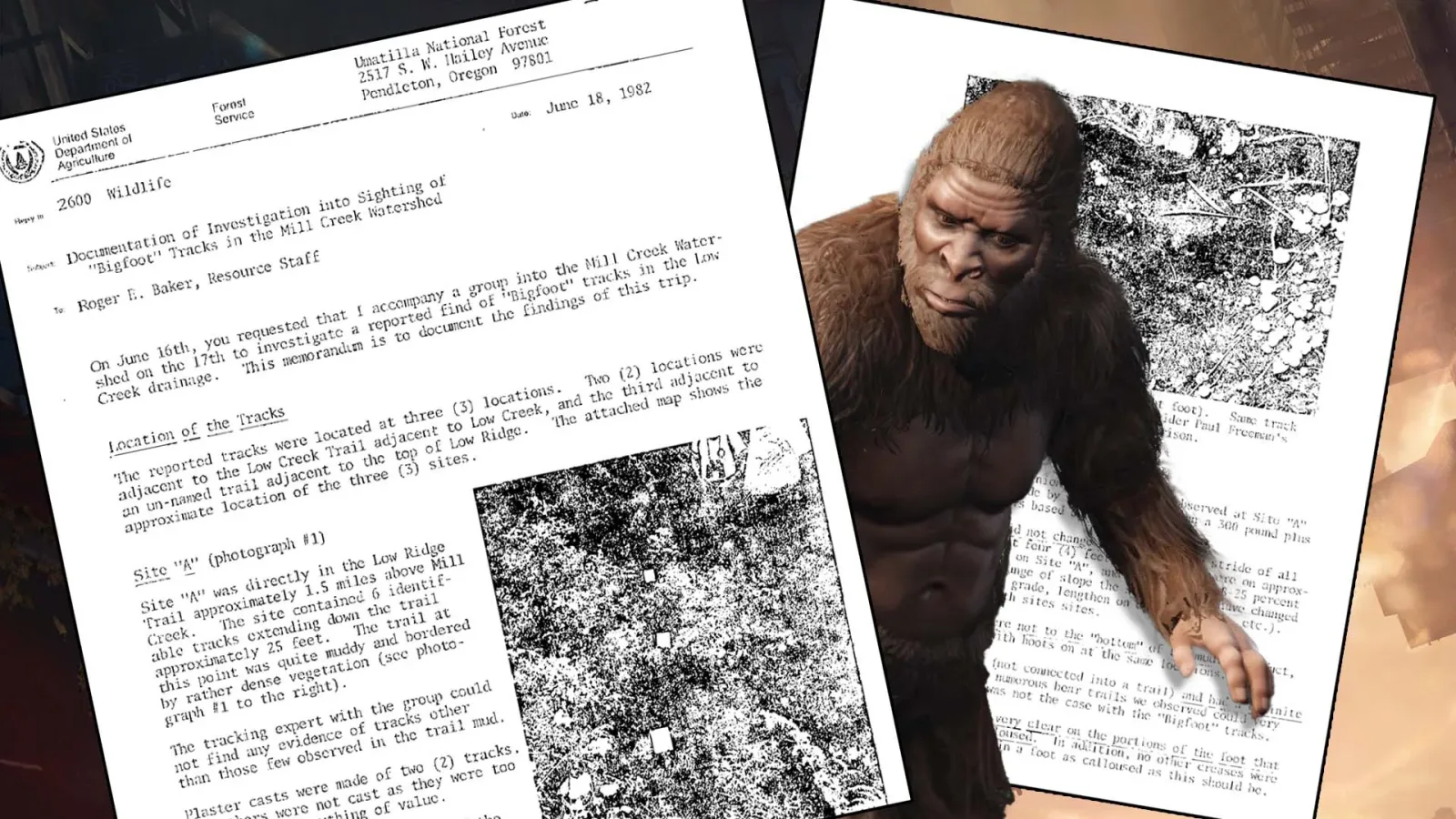
There is a particular kind of horror that does not need a monster to appear on screen. Sometimes all it needs is a worn government form, an official seal, a few clinical observations, and one sentence that suggests the person writing it encountered something they could not comfortably explain. Recently released U.S. Forest Service material related to Bigfoot has that exact quality: a strange mixture of bureaucracy, wilderness folklore, skeptical investigation, and testimony from people who clearly did not want to continue following whatever had left tracks ahead of them.
The documents were published last month in response to a Freedom of Information request. They do not confirm that Bigfoot exists, and one of the more detailed records specifically argues that a set of alleged tracks was fabricated. But that is almost beside the point. Read as a collection of archival artifacts, the files have the unnerving texture of the fictional case documents that make paranormal games such as Control so memorable. They are grounded in ordinary details--snow, trails, elk remains, leaves disturbed on the forest floor--until an observation pushes the story somewhere much less ordinary.
For players who enjoy environmental storytelling, found documents, and the feeling that a massive institution has quietly filed away impossible events rather than solved them, these records are fascinating. The Forest Service paperwork is not trying to build a monster mythology or launch a cinematic reveal. It is simply recording claims, examining evidence, and preserving local recollections. That matter-of-fact approach makes the more alarming passages land even harder.
A real-world archive with paranormal-game energy
Control is especially known for turning reports, memos, altered-item notes, and institutional language into a major part of its atmosphere. A player can pick up a document that begins with dry procedural phrasing and ends with a warning so bizarre that it reshapes how they see the room around them. The game's recently released follow-up, Control Resonant, continues to invite comparisons to that style of strange-fiction bureaucracy, even if the original remains the stronger example for some fans.
For useful background on this topic, read Beyond GTA 6: Better Ways to Start a Gaming Conversation This Thanksgiving.
The newly available Forest Service material creates a similar contrast without needing any fictional embellishment. There are black-and-white images, typewritten passages, official markings, and the sort of presentation associated with historical field records. One file is comparatively simple: a clipping from a Montana newspaper during the 1980s concerning unusually large footprints in the snow. The other documents are where the archive becomes much more evocative.
One is an investigation from 1982 into reported Bigfoot tracks near Mill Creek, Oregon. The other is a brief historical account focused on Petty Creek, Montana, including a recollection of an incident said to have occurred decades earlier. Together, they show two sides of the Bigfoot story: the deliberate attempt to test a claim and the persistence of a wilderness tale that remains powerful precisely because it is not resolved.
The Mill Creek investigation reached a skeptical conclusion
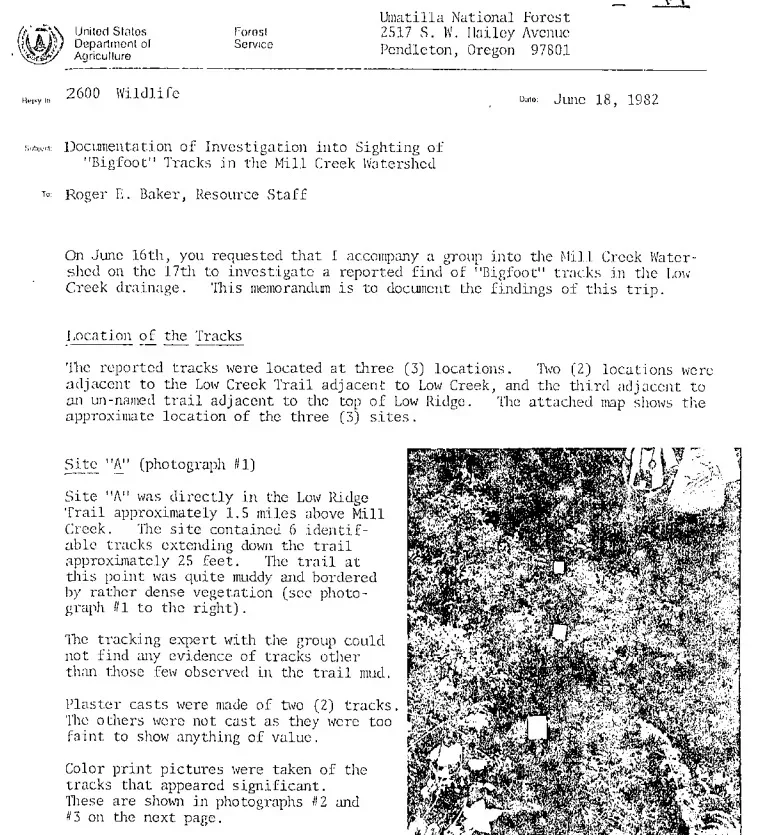
The 1982 Mill Creek report is the closest thing in the released group to a conventional field examination. Its author was sent to assess alleged tracks in Oregon and documented the prints in considerable detail. That level of attention is important. Instead of accepting the premise that large tracks automatically pointed to an unknown creature, the report considered the physical evidence surrounding them.
The conclusion was not mysterious. The investigator determined that the tracks were not made by a huge bipedal animal. The report cited problems with the apparent gait pattern, indications that leaves had been manipulated, and additional inconsistencies that undermined the idea of a genuine animal moving through the area. Its final assessment was that the marks had been created by something other than a two-footed creature weighing more than 300 pounds.
That skeptical result does not make the document less interesting. If anything, it gives the archive a more believable tone. In a good paranormal game, not every note reveals an authentic supernatural event. Some leads are misunderstandings, hoaxes, incomplete sightings, or mundane explanations that exist beside the truly unsettling cases. The act of documenting a false claim still tells players--and readers--something about the culture around it. It shows that someone considered the report worth checking, and it reveals how the investigator separated an extraordinary interpretation from the evidence that was actually present.
The Mill Creek file also offers a reminder that the Bigfoot legend has always existed in tension with examination. Enthusiasts may see tracks as proof; investigators look for pressure patterns, stride consistency, alterations to surrounding material, and other clues that can distinguish an animal trail from a human-made display. The Forest Service record lands firmly on the investigative side of that divide.
Petty Creek's story is much harder to shake
The Montana document is different. Rather than reading as a formal attempt to validate tracks, it appears to be a short piece of writing from someone eager to preserve Petty Creek's historical significance. Bigfoot enters the account not as a neatly examined specimen of evidence, but as part of local memory--an experience the writer and companions initially did not even label as a Bigfoot encounter.
The central event is placed in 1949, in the South Fork of Petty Creek, in an area described as being near where the Garden Point road now runs. Four people had gone into the area to pack out a six-point bull elk. When they arrived at the expected location of the animal, they reportedly found only the entrails. In the snow leading to and away from the site were large tracks.
At first, the group considered whether a very large bear could have been responsible. The account then explains why that possibility was rejected: bears do not typically travel upright over long distances, and the animal in question was said to have been too large to be dragged away in the manner expected. The writer believed whatever took the elk had lifted it entirely clear of the ground.
The group followed the tracks for roughly half a mile. The passage that follows has the vivid, specific quality that makes old accounts linger. The trail reached a fallen log described as three feet in diameter. Marks in the snow atop the log appeared to show where the elk's antlers had scraped across it as the animal was carried over.
That was the point at which the search stopped. The group held a discussion and decided they were not eager to catch up with whatever had made the tracks. The account says that, in later conversations, the people involved realized they had all felt a profound unease, accompanied by chills. Whether a reader views the story as folklore, misidentification, exaggeration, or a sincere description of something unknown, the emotional detail is difficult to miss. The people in the recollection did not frame themselves as heroic hunters pursuing a trophy. They chose to leave.
Tracks, odor, and a grunting sound
The Petty Creek document adds a second alleged event from the following year. In 1950, W.W. Schmitz was hunting in the upper Bills Creek area when he reportedly encountered similar tracks. The account also mentions a strong smell and a grunting noise. Schmitz, like the earlier group, supposedly decided that elk could be found somewhere else and departed the area.
One detail gives the recollection its peculiar historical flavor: the writer says that at the time of the 1949 encounter, they had not heard of Bigfoot. They therefore did not attach a familiar name to what they thought they had encountered. Instead, they treated it as something they preferred not to deal with and moved on.
That does not transform the account into evidence of an undiscovered creature. Memories written down long after an event can be altered by time, later cultural knowledge, and the storytelling habits of a community. Nor does the document establish that the tracks, sounds, and odor came from one source. Still, as a preserved piece of local testimony, it is compelling. It captures how an encounter becomes a legend: not through a definitive answer, but through sharp details and a decision to retreat before an answer can be found.
The power of paperwork in horror and games
Video games often use documents to make an invented world feel larger than the player's immediate path. The best examples imply that an organization has accumulated years of records, arguments, cover-ups, failures, and cases too strange to fit into a clean explanation. A typed report can be more frightening than a cutscene because it asks the audience to imagine what happened between the lines.
These Forest Service files work in much the same way. The Oregon investigation provides a rational counterweight, showing how a strange claim can be tested and dismissed. The Montana account does the opposite: it leaves behind a sequence of images that cannot be fully verified but are hard to forget. An elk gone from the snow. Large tracks. Antlers apparently dragging over a fallen log. A group of people deciding that the safest outcome was not to learn more.
There is no need to treat the documents as proof of Bigfoot to appreciate their appeal. The enduring appeal of Bigfoot stories is partly about the possibility that wild places can still resist easy classification. Forests, mountains, remote roads, and deep snow create conditions where evidence is partial and confidence can quickly become uncertainty. A report can be official without being conclusive. A witness can be sincere without being correct. And a file can remain eerie even when the most likely explanation is entirely mundane.
That unresolved space is where these records become especially enjoyable for fans of paranormal fiction and games. They feel less like a final chapter and more like optional lore found in a locked cabinet: a few pages from a larger archive, containing both a debunked case and an unsettling story that has never been decisively closed. Whatever readers make of Bigfoot itself, the paperwork proves that the legend can be just as effective when presented in faded ink, careful language, and the lingering sense that somebody once walked away from the trail for a reason.
Community
Discussion
Start the conversation.
No comments have been posted yet.