


Wardogs is emerging as one of Steam's biggest multiplayer shooter success stories, reportedly reaching more than 300,000 concurrent players shortly after launch. The Early Access MMO FPS is built around 100-player conflicts, but its appeal is not simply the scale. It is the way a match turns a wide range of jobs--fighting, healing, driving, flying, hauling supplies, reviving allies, and constructing defenses--into meaningful contributions through an in-game economy.
At first glance, the pitch could sound familiar. Players enter a large battlefield as one of three mercenary factions competing to secure a central objective zone. There are assault rifles, snipers, armored positions, transport vehicles, helicopters, forward operating bases, and the sudden bursts of gunfire expected from a modern military shooter. Yet Wardogs appears to distinguish itself by slowing the entire experience down. It treats the space between firefights, the trip to the front line, and the cost of gear as important parts of the battle rather than empty time between respawns.
That approach will not suit everyone. Players looking for a fast, constant-action shooter where death is a brief interruption may find Wardogs demanding. But for those who want a more deliberate large-scale FPS without necessarily requiring the full complexity of a hardcore simulation, its systems create the conditions for memorable, spontaneous stories.
A battlefield where logistics can be as valuable as a kill
The most important feature in Wardogs is cash. Players earn money for actions that benefit their side, including holding the key zone, eliminating opponents, treating wounded teammates, reviving downed soldiers, and helping construct or maintain defenses. That money is then used when spawning to purchase weapons, armor, medical equipment, and other tools.
For useful background on this topic, read Roblox Everywhere Will Let Creators Turn Experiences Into Standalone Apps.
In a typical shooter, a player who is not collecting eliminations can sometimes feel disconnected from the match's momentum. Wardogs gives those players several direct paths to success. A medic can earn through healing. A builder can strengthen a vulnerable base. A pilot can shuttle people across the map. A truck driver can keep a forward base stocked with needed equipment. The game also lets players tip one another, so a useful ride, timely revival, or supply delivery can result in a quick payment from an appreciative teammate.
This creates a small but significant social economy in every battle. A player can choose to play as a traditional frontline soldier, but the team also needs people willing to operate in the background. Someone hauling supplies from headquarters to a base near the combat zone may be just as valuable as a skilled rifleman. In one reported match, a player focused entirely on driving supply trucks and accumulated thousands in tips. In others, players found lucrative roles building walls or serving as airborne taxis.
It is an elegant answer to a familiar problem in team shooters: how to make support work feel rewarding. Wardogs does not merely give these jobs a score bonus. It attaches them to the same money that determines what players can afford to carry into their next life.
Every spawn comes with a financial decision
The economy means loadouts are not disposable. Players want their time alive to be profitable, ideally earning more cash than they spent on their equipment. A status indicator tracks when a life has crossed that threshold. While that could sound punishing, the game's design reportedly makes steady income attainable for cooperative players, even if they are not elite shots.
The pressure comes from deciding how much to risk. A basic weapon may be free, while stronger guns, armor, vehicles, and useful equipment require investment. Buy expensive gear, and a bad push can erase the value of that purchase. Take a cheap kit, and survival may become harder. Secure a more capable weapon from a defeated enemy, and suddenly there is a strong reason to avoid reckless movement.
That risk extends to vehicles. Players with enough money can acquire their own transportation, but losing it does not lead to a refund. A helicopter or vehicle can dramatically cut down travel time, but it also represents a gamble. Is it smarter to spend cash on personal mobility, or flag down a driver and offer a tip? Is a downed teammate worth the danger of attempting a rescue if they are offering a bonus? Wardogs turns such questions into an ongoing part of play.
Because money, equipment, and time all matter, deaths have more weight than they do in many mainstream arena shooters. A downed player can wait for a possible revival rather than immediately respawning. Choosing to give up sends that player back to base, and the return journey to active fighting can be substantial. The headquarters may be several minutes away on foot, making trucks and helicopters strategically important rather than decorative vehicles.
Long matches create room for quiet moments
Wardogs matches can run for more than an hour, a length that changes how players experience the battlefield. The action is not a continuous sprint from one capture point to the next. Instead, the rhythm can shift between sudden, frightening firefights and stretches of preparation, travel, defense, and conversation.
A forward base may become a temporary community hub, with players unloading supplies, checking walls, repairing defenses, organizing transport, and listening for distant gunfire. Player-created fortifications can shape those spaces, with concrete barriers and walls protecting a position until a weak opening is discovered or attackers force their way through. A base is not just a map prop; it is something participants can help establish, protect, resupply, and improve.
That produces a style of warfare where a battle can feel local despite the match's 100-player scale. A squad may hear fighting in the distance while working to keep its own section of the line operational. Then the calm breaks: shots crack from outside the perimeter, defenders are downed, and an enemy team finds a hole in the walls. The result is a more grounded pace, where tension can build before a fight instead of every second being filled with explosions.
For players fatigued by shooters that emphasize relentless movement mechanics, this breathing room may be one of Wardogs' most compelling traits. There is less incentive to depend on hyperactive sliding and hopping to survive. Cover, positioning, ammunition, armor, and measured movement appear to matter more.
Deadly weapons make caution a genuine strategy
The combat itself is described as hard-hitting and dangerous. Without armor, players can be taken down in only a few hits. A fast time-to-kill makes firefights stressful, but it also creates opportunities for new players. Someone using the free starter rifle can still defeat a better-equipped enemy with patience and accurate shots.
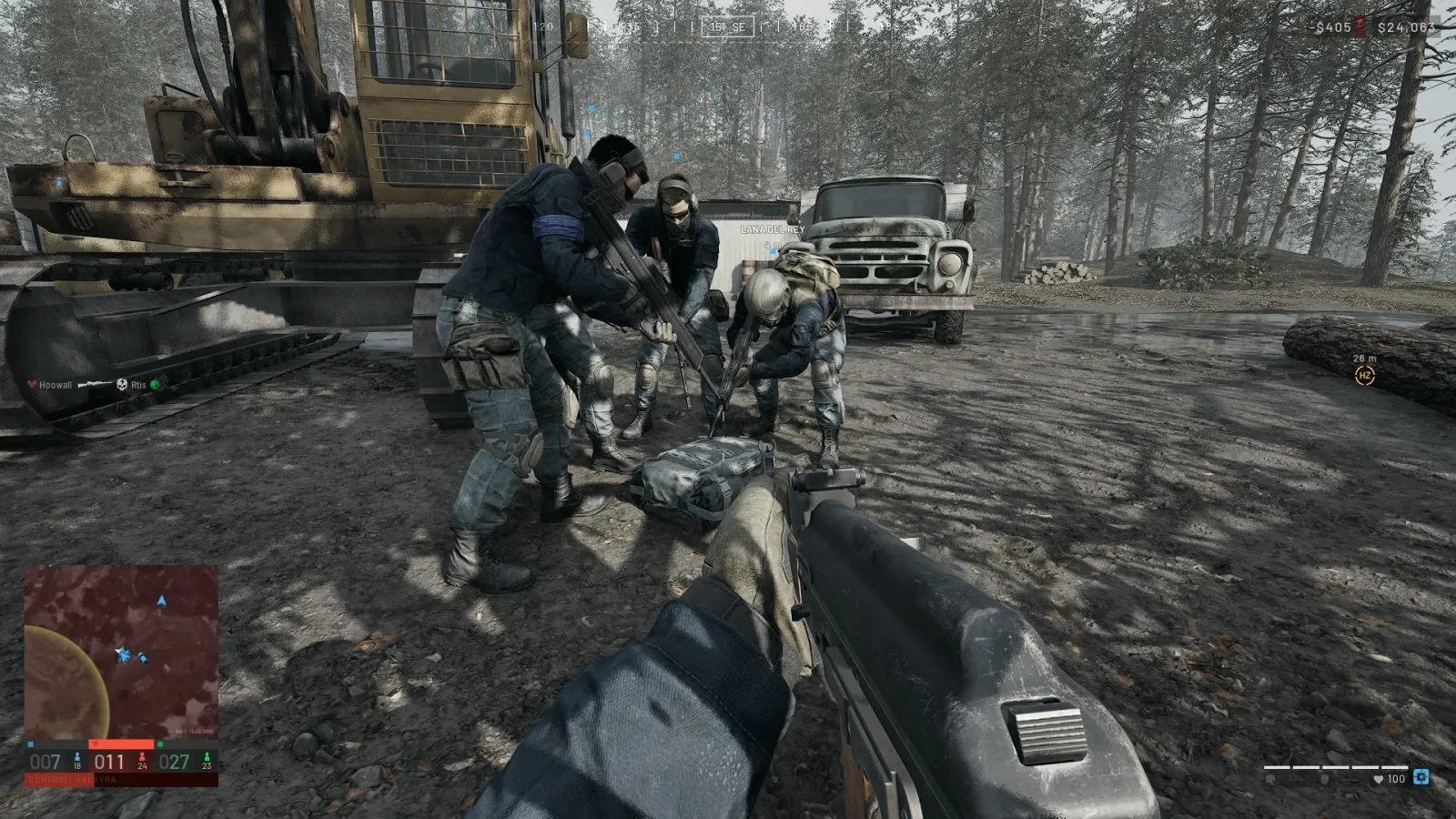
Victories can have immediate material consequences, too. Defeated opponents can be looted, allowing a player to acquire weapons, ammunition, and armor they may not yet be able to purchase from base due to progression restrictions. That makes bodies into temporary objectives. After a kill, teammates may gather around the fallen opponent in hopes of grabbing a desirable gun or supplies before anyone else does.
The system is especially unusual because a downed player may remain present while allies attempt a rescue, able to hear nearby enemies and teammates as their inventory is picked over. It adds a grimly comic edge to the otherwise high-stakes extraction of valuable gear, while also reinforcing the importance of deciding whether to wait for help or return to base.
These mechanics push players away from treating every encounter as a chance to charge forward alone. A soldier carrying expensive equipment has reason to pause. A defender may prioritize holding a wall over chasing a retreating enemy. A transport pilot may build a reputation as a reliable route to the front. A medic can become indispensable during a costly assault. Wardogs' economy is not separate from combat; it changes the behavior around combat.
An Early Access shooter with a specific audience
Wardogs is still in Early Access, so its long-term standing will depend on continued development, stability, balance, and the ability to sustain its substantial early player interest. Large multiplayer games can rise quickly, and maintaining a healthy community requires ongoing attention to maps, tools, progression, matchmaking, and the many small frustrations that emerge once players spend hundreds of hours inside a system.
Even so, the core idea already appears unusually clear. Wardogs aims for a middle space between accessible modern military shooters and more demanding simulation-focused experiences. It retains recognizable FPS fundamentals while allowing players to matter through far more than gun skill. The person who gets teammates to the battlefield, opens a base gate for a supply truck, raises defensive walls, or pulls a wounded player away from enemy fire may change the match as surely as the person who captures the objective.
That philosophy makes Wardogs a particularly promising option for squads, role-players, support-minded players, and anyone who enjoys war stories that emerge from unscripted player behavior. It may feel slow to those who want instant respawns and uninterrupted engagements. For others, that slowness is precisely the point: it gives every journey, purchase, rescue, and burst of gunfire more consequence.
In a multiplayer landscape often built around speed, Wardogs is making a case for friction. The long ride to the front, the cost of a rifle, the choice to revive an ally, and the need to keep a base supplied all make its wars feel less disposable. When a game can make driving a truck, fixing a wall, or offering someone a ride feel like a vital part of a 100-player conflict, it has found something worth watching.

Community
Discussion
Start the conversation.
No comments have been posted yet.