

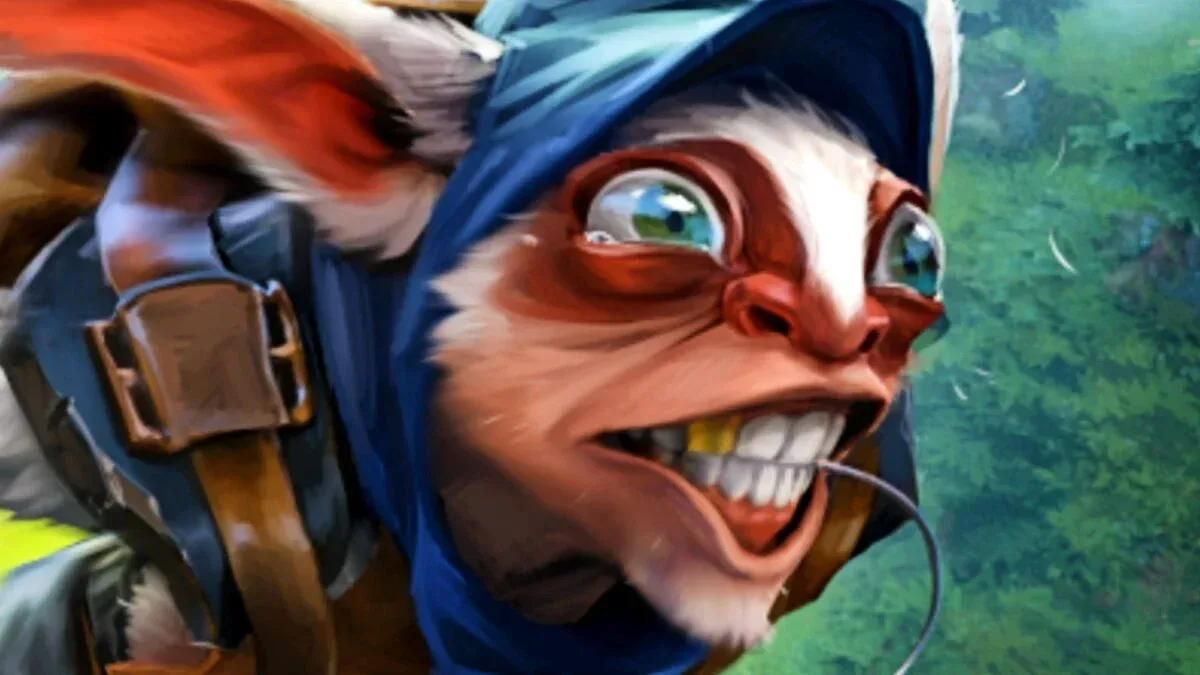
Some games are remembered as favorite places. Players talk about the worlds they explored, the friends they made, or the difficult periods that a familiar game helped them through. Then there is Dota 2, the long-running Valve multiplayer arena game that can inspire an entirely different kind of devotion: thousands of hours logged, countless matches played, and a level of anger that makes the idea of launching it again sound like a terrible decision.
William Pugh, co-designer of The Stanley Parable and a founder of Crows Crows Crows, has described that contradiction with remarkable clarity. In a recent interview about his Steam library and experiences with online games, Pugh said that Dota 2 is his most-played game by a huge margin. His recorded total stands at 1,603 hours, surpassing even his time in Team Fortress 2.
Yet Pugh's assessment of whether those hours were enjoyable was not sentimental. His answer was, in essence, an emphatic no. He portrayed the game as an exhausting catalogue of team failures: supports and carries failing to fulfill their roles, teammates positioned badly, players overcommitting to dives, and questionable item choices turning a tense match into an hour-long frustration.
It is an account that will sound extremely familiar to anyone who has spent meaningful time in a multiplayer online battle arena. Dota 2 is built around five-person teams, strategic roles, a gigantic list of heroes, shifting objectives, item builds, vision control, timing windows, and opponents trying to exploit every small lapse in coordination. One player's error is rarely isolated. A missed move can weaken a lane, cost an objective, reshape a later fight, and create a sense that a match is slipping away before everyone involved has agreed that it is over.
For useful background on this topic, read The Witcher 3: Wild Hunt -- Remastered Details Major Combat, Visual and Accessibility Changes.
A game players resent but cannot quite leave
The striking part of Pugh's reflection is not that he got mad at a competitive game. That is practically a universal feature of online competition. It is that he kept playing for more than 1,600 hours despite being unable to describe the experience as a good time.
That is the peculiar pull of games such as Dota 2. They are not necessarily designed to produce uncomplicated comfort. Instead, they create intense cycles of problem-solving, setbacks, blame, improvement, near-success, and the perpetual belief that the next match could be different. A defeat can feel unfair because a team was disorganized. A victory can feel earned because, for one match, five players made enough correct decisions at enough of the right moments.
The result is a game that can be deeply compelling even when it is not reliably pleasant. Players do not always return because the previous game made them happy. They return because it left something unresolved. Maybe they lost to an unfamiliar strategy. Maybe a teammate disconnected. Maybe they made a decisive mistake. Maybe they came within one fight of winning and are convinced they would get it right next time.
Pugh's memories of Dota 2 are shaped by that conflict. He joked that merely thinking about the game was enough to make him feel heated. His frustration extended beyond individual teammates to the entire culture surrounding high-level competitive play, including the relentless pressure to perform, know the optimal strategy, and avoid wasting the time of four strangers.
There is an important difference between losing to a computer and losing in a team game where every participant can potentially judge the others. In a single-player challenge, failure is often private. The player can pause, retry, or step away. In an online match, every bad decision is observed by teammates who may be annoyed, impatient, or eager to identify someone to blame. Voice chat and text chat can turn an ordinary error into a confrontation.
Pugh contrasted this with chess, another game with an enormous competitive ceiling and a long history of intense players. Chess can certainly create stress, but it generally does not involve a teammate angrily informing another teammate that they are ruining a full hour of everyone's lives. The social pressure in a five-person MOBA is uniquely combustible because success requires individual skill and collective coordination at once.
The five-dimensional puzzle at the heart of Dota 2
For all his anger, Pugh also identified what makes Valve's game so effective at holding a player's attention. He compared its mental demands to attempting to solve a five-dimensional Rubik's Cube. It is a useful image for a game that asks players to keep a staggering number of changing variables in mind.
A player must track their own hero, abilities, items, resources, lane matchup, team composition, enemy composition, map information, objective timers, possible ambushes, teammate locations, and the probability that an opponent is preparing a move somewhere outside their vision. Even this is only a fraction of the decision-making involved. Because each match evolves differently, the game discourages players from leaning entirely on memorized answers.
That density produces a powerful kind of focus. For an hour, or sometimes longer, the outside world can disappear beneath a stream of immediate decisions. Where should the team move? Is it safe to farm? Should a player save gold for a major item or buy something now? Is an enemy missing because they are returning to base, or because they are waiting in the trees with the rest of their team?
In that sense, Pugh's criticism also contains an explanation for why people endure the experience. Dota 2 can quiet the rest of a player's thoughts by giving their brain too much to process. It is difficult to be distracted by daily worries when every second is demanding attention. The mental lock-in can be satisfying, even if the satisfaction is often followed by rage when a key fight collapses.
That structure also makes it easy to lose track of time. Pugh noted the grim irony of investing roughly 1,600 hours without considering himself particularly good at the game. It is a feeling that many players recognize. Time played does not translate cleanly into mastery, especially in games with a large, experienced player population and constantly evolving strategies. A player can improve significantly while still feeling overwhelmed by the skill of the people around them.
Competitive games do not need to be lovable to be powerful
Pugh's blunt remarks are funny because they expose an uncomfortable truth about the way people talk about their game libraries. Hours played are often treated as a straightforward marker of enjoyment. If someone has spent hundreds or thousands of hours in a game, the assumption is that they must love it.
But time is not always affection. Sometimes it is habit. Sometimes it is competition. Sometimes it is friendship, routine, the search for improvement, or the wish to erase the memory of one particularly bad loss with a better result. In games built around ranked ladders and repeatable matches, players can be motivated by dissatisfaction as much as satisfaction.
That does not mean those hours are meaningless. The ability to concentrate completely on an intricate challenge has value, as does the shared language players develop with friends and rivals. A difficult multiplayer game can deliver unforgettable victories precisely because it has also delivered so many painful defeats. The trouble is that those losses are rarely easy to laugh about while they are happening.
Pugh's story begins even earlier than Dota 2, with his experiences playing the 2005 game Worms 4: Mayhem, and it reflects a long-running ambivalence toward online multiplayer. Competitive games can be absurd, sociable, ingenious, and maddening within the space of a single session. Their appeal is not cleanly separable from their capacity to frustrate.
For players who have uninstalled Dota 2, sworn never to return, and then felt the faint urge to reinstall it months or years later, Pugh's reaction will land hard. The game can feel like a machine made to test patience and punish misplaced confidence. It can also offer a complete hour of concentration unlike almost anything else.
That may be the most honest measure of its power. A player can hate nearly every memory of a game, regret the time spent in it, feel angry just hearing its name, and still understand exactly why the next queue remains tempting.
Community
Discussion
Start the conversation.
No comments have been posted yet.