
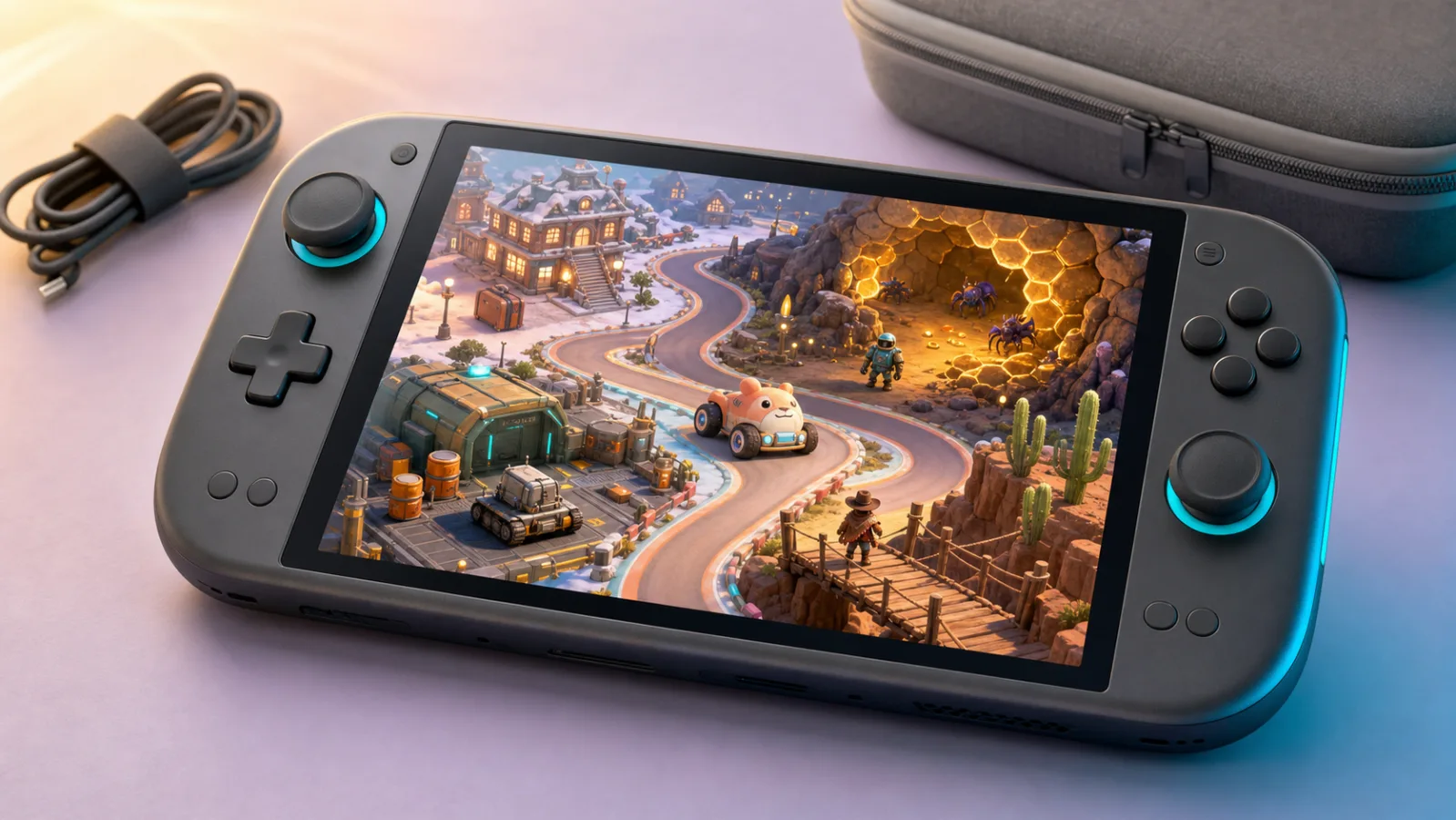
Handheld gaming is not one genre, one device, or one kind of player. It is a way of fitting games into real life. A good portable game can turn a few spare minutes into a satisfying run, race, level, or match, while a deeper adventure can make a long journey feel shorter. The trick for beginners is not simply finding games with a portable version. It is choosing games whose pace, controls, structure, and demands make sense on a smaller screen and in shorter play windows.
This starter guide uses a broad mix of action games, racers, arcade challenges, fighting games, and retro titles to explain what to look for. Some picks are best for quick solo sessions, others shine with nearby friends, and a few are better treated as goals to explore once you are comfortable with more demanding arcade-style design. There are also upcoming games worth keeping an eye on, but a starter library should begin with games that match the way you actually play now.
Start with your portable play habits
Before choosing a game, decide what "handheld gaming" means in your routine. Do you play in ten-minute gaps, settle in for an hour before bed, share a device or screen with friends, or want something that can be paused and resumed without losing momentum? The answers matter more than whether a game belongs to a fashionable genre.
For short sessions, arcade games, racing games, and run-based action usually work well because they create a clear loop: begin, react, improve, and finish or restart. For longer sessions, a platform adventure with exploration and steady progression can offer more of a sense of place and accomplishment. Social players should prioritize local multiplayer support rather than assuming every competitive game will be easy to share. A game can be excellent alone and still be a poor choice for a group gathering.
Also be honest about your tolerance for difficulty. Portable play is not automatically casual play. Classic shooters and fighters may be immediately understandable but mechanically intense. Their appeal is often repetition and mastery rather than a gentle learning curve. That can be ideal if you enjoy chasing a better result, but it can be frustrating if you only want a relaxed distraction.
The four qualities of a strong handheld game
Readable action on a small screen
A handheld-friendly game needs visual clarity. You want to understand where your character is, what can hurt you, and what your next objective is without squinting or constantly stopping. Side-scrolling platformers, focused racing circuits, and board-clearing arcade stages often communicate their goals quickly. A screen packed with enemies can still work, but only if you enjoy processing that pressure.
Controls that feel natural in your hands
Portable controls reward games with direct inputs. Running, jumping, shooting, steering, punching, and blocking are easy concepts to grasp; the question is how much precision the game expects. A new player may find a racer or a straightforward action-platformer more welcoming than a demanding fighting game or vertical shooter. There is nothing wrong with starting simple. Control confidence is what makes more complex games rewarding later.
A satisfying stopping point
Good handheld games respect interruptions. This does not mean every session must be tiny. It means the game gives you useful milestones: a race, a stage, a boss attempt, a cleared route, or a run. Games built around discrete levels are especially convenient. Exploration-focused games can be excellent too, but they are best when you can remember where you were heading after returning from a break.
Replay value that suits your personality
Some players replay to improve execution. Others replay to unlock vehicles, outfits, challenges, or new routes. Others want procedural variation so that no two attempts feel identical. These are different kinds of longevity. Do not buy into the idea that a game needs endless content to last. A tightly designed arcade challenge can stay compelling for years if learning its systems appeals to you.
Build a starter library around different moods
A smart first collection does not need dozens of games. It needs contrast. One approachable racer, one action-platformer, one arcade score-chaser, and one game to share locally can cover a surprising range of situations. This prevents the common beginner mistake of buying several games that all demand the same attention and then leaving most of them untouched.
- For a colorful action adventure: Guacamelee! Super Turbo Championship Edition combines Metroidvania-style exploration, melee combat, platforming, and parallel dimensions in a world inspired by traditional Mexican culture and folklore.
- For classic run-and-gun intensity: Gunman Clive HD Collection brings two western-themed action-platforming adventures together, with jumping, shooting, challenging stages, and major bosses.
- For immediate arcade competition: Gunbird 2 is a vertical shooter built around flying characters, enemy patterns, and a treasure-hunting chase against the Queen Pirates.
- For a playful group race: Hello Kitty Kruisers with Sanrio Friends offers racing over land, water, and air, along with solo play and multiplayer for up to four players.
- For a surprising arcade hybrid: Gunbarich turns block breaking into a puzzle-shooter challenge where a flipper launches a puck and can reflect enemy bullets.
These choices are not interchangeable. The best one depends on the feeling you want when you pick up your system. A player looking for a compact, clearly structured challenge may gravitate toward Gunbarich or Gunbird 2. Someone who wants a longer solo campaign and an expanding move set may prefer Guacamelee! Super Turbo Championship Edition. A household or friend group may get more from a racer with multiplayer than from a technically excellent solo game.
A beginner-friendly route through the games
Begin with racing if you want low-pressure competition
Hello Kitty Kruisers with Sanrio Friends is a useful entry point for players who enjoy character-driven racing and want variety in how courses are presented. Its races take place on land, through the air, and over water, which gives it more than one visual rhythm. The game also includes an Adventure Mode, unlockable outfits and vehicles, and multiplayer for up to three friends. Those features make it a natural fit for solo players who want goals beyond individual races as well as groups that want a simple shared activity.
When starting any racer, resist the urge to judge it only by winning immediately. Learn one course at a time. Notice when to brake, when to hold a clean line, and when the game asks you to react to a change in terrain or vehicle handling. Unlockables are a useful incentive, but the real portable strength of racing games is that a single event offers a complete session.
Choose an action-platformer when you want momentum and exploration
Guacamelee! Super Turbo Championship Edition is for players who want fighting and platforming to share equal importance. Its melee-driven action gives every encounter a physical feel, while its sprawling structure and parallel dimensions make exploration part of the experience. This edition adds levels, powers, challenges, and refinements, and same-screen co-op can change the mood from focused solo progress to a shared brawl.
For newcomers to this style, take the opening hours slowly. Learn how movement and melee attacks fit together before worrying about every challenge or hidden route. In an exploration platformer, new powers often reshape what you can do in familiar spaces. That is part of the appeal. Keep a simple mental note of routes that seem unreachable; coming back later with new abilities is more satisfying than forcing progress through frustration.
Pick a focused western challenge for traditional platforming
Gunman Clive HD Collection is an especially clear choice for players who like direct objectives: jump, shoot, reach the end, and defeat imposing bosses. The collection contains both Gunman Clive and Gunman Clive 2. Its 18XX setting, thugs and outlaws, kidnapped mayor's daughter, and globe-spanning second adventure provide a straightforward adventure frame, but the core draw is challenging action-platforming.
This is a strong choice if you want a game that lets you feel your improvement. Begin by learning enemy placement and the shape of each level rather than rushing through. Side-scrolling action rewards controlled movement. A difficult section is often asking for better timing and positioning, not reckless speed. For handheld sessions, a level-at-a-time mindset keeps the challenge enjoyable.
How to approach arcade games without bouncing off them
Arcade design can feel unforgiving to new players because it makes failure visible. You may lose quickly, miss a score target, or see a run collapse in seconds. But that clarity is also its strength. You always know whether your decisions worked. The aim is not necessarily to clear everything immediately. It is to understand one more pattern, survive one more section, or use one mechanic more deliberately than before.
Gunbird 2: learn the screen before chasing the treasure
Gunbird 2 is a vertical arcade shooter with seven playable characters and a pursuit of the world's biggest treasure hoard. It is a great fit for players who want an energetic, stage-based game that gets to the action quickly. The basic lesson of vertical shooting is simple: do not stare only at your own character. Watch the open space around them and move deliberately into safe gaps. Small movements are often safer than panicked sweeps across the screen.
Give yourself modest goals. On an early session, focus only on reaching a section consistently. On the next, pay attention to the enemy patterns that caused trouble. Character choice can also be part of the fun, since seven characters offer a reason to experiment. This approach turns a difficult shooter from an opaque wall into a sequence of learnable problems.
Gunbarich: a distinct blend of timing, angles, and defense
Gunbarich is not a conventional shooter and not a conventional block breaker. You use a flipper to launch a pink puck, break blocks, and clear stages. The flipper can also reflect enemy bullets, and reflected shots can heavily damage enemy characters. Its left and right inputs affect the activation of both the puck and enemy bullets struck by the flipper.
That unusual combination makes Gunbarich an excellent choice for a player who wants arcade action but prefers planning angles and timing over constant character movement. Start by treating block clearance as the primary objective. Once that feels comfortable, begin to see bullet reflection as a deliberate defensive and offensive tool rather than a lucky accident. It has the kind of compact ruleset that becomes deeper the more carefully you play.
Heavy Barrel: retro action with an arcade spirit
Heavy Barrel is a classic action shooter set in a post-apocalyptic world. As a commando infiltrating a secret enemy base, you fight waves of enemies while searching for the powerful Heavy Barrel weapon. Its origins as an arcade adaptation are evident in the emphasis on intense combat and cooperative play.
For a beginner exploring older games, the important adjustment is expectation. Retro action can be less forgiving and less explanatory than newer games. Instead of taking quick defeats as a sign that the game is unsuitable, treat early attempts as practice. Learn the role of enemy waves, keep your attention on the immediate space around the commando, and enjoy the simple mission-driven premise. It is best for players who want the feel of an older arcade challenge rather than a long modern progression loop.
Fighting games: start with the fundamentals, not the full move list
Guilty Gear is a fighting game set in the 22nd century, where artificial beings called gears have rebelled under Justice. A Sacred Order tournament seeks someone capable of stopping Justice, bringing characters such as Sol Badguy and Ky Kiske into a high-stakes contest. Its story frame is dramatic, but a beginner should approach it through the basics of fighting games.
Choose one character and learn a small reliable toolkit. Find a normal attack that reaches comfortably, an option for a jumping opponent, a simple sequence you can repeat, and a defensive habit. You do not need to understand every character or every advanced possibility during your first sessions. The portable advantage of a fighting game is that training can happen in short bursts: a few minutes spent on movement and one consistent response can make the next match much more satisfying.
This particular pick is for players who enjoy one-on-one competition, expressive characters, and the process of building skill. It is not the easiest choice for someone seeking a passive experience, but it can be one of the most rewarding if you enjoy gradual mastery.
Multiplayer: choose the right kind of shared play
"Multiplayer" can mean very different things. Hello Kitty Kruisers with Sanrio Friends supports up to four players, making it the clearest party-oriented option in this group. Hive Jump supports up to four players locally or online and asks JUMPERS to battle through procedurally generated alien hives, avoid traps, collect treasure and relics, and take on bosses. Guacamelee! Super Turbo Championship Edition supports same-screen co-op, which makes its action-platforming adventure a collaborative experience. Heavy Barrel brings cooperative arcade action into its commando mission.
For beginners, do not make the mistake of choosing a co-op game solely because it supports more people. Think about coordination. Racing allows players to compete while still enjoying the same course. A brawler or shooter may require closer cooperation, especially when the screen becomes busy. Procedurally generated play in Hive Jump can keep sessions unpredictable, while a designed platform adventure can make shared progress feel more purposeful. Pick based on whether your group enjoys light competition, teamwork under pressure, or an ongoing campaign.
Games to watch rather than games to start with
Two supplied games are scheduled for future release, so they are better viewed as possibilities for a later handheld library rather than immediate recommendations. Warhammer Survivors is planned as a fast-paced roguelite survivors game spanning the Warhammer 40,000 and Warhammer: Age of Sigmar settings. Its bullet-hell combat, endless enemy swarms, character selection, and evolving iconic weapons suggest a strong match for players who enjoy repeatable runs and escalating chaos. It is scheduled for Nintendo Switch and Nintendo Switch 2, as well as Android and iOS among other platforms.
He-Man and the Masters of the Universe: Dragon Pearl of Destruction is planned as a retro-inspired two-player 2D magic-brawler. It features He-Man, Teela, Man-At-Arms, and other familiar Eternian heroes in arcade-style hack-and-slash and beat 'em up action, with pixel-art visuals and large detailed sprites. Its planned Nintendo Switch version makes it one to watch for fans of couch co-op brawlers and the Masters of the Universe setting.
Make your first month of handheld gaming count
A simple first-month plan can help you discover your tastes without turning game selection into homework. Start with one game that has short, complete sessions, such as a racer or arcade title. Add one deeper game with a campaign structure, such as Guacamelee! Super Turbo Championship Edition or Gunman Clive HD Collection. Then reserve a third choice for social play or for a genre you want to learn, such as Hello Kitty Kruisers with Sanrio Friends, Hive Jump, or Guilty Gear.
- Play the short-session game for a few rounds without worrying about mastery.
- Give the adventure game enough uninterrupted time to learn its core systems.
- Invite a friend for a multiplayer session if that feature matters to you.
- Return to the arcade game and see whether your understanding has improved.
- Keep the games that make you want to play again, not merely the ones you feel you should finish.
The best handheld library is personal. It may include an exuberant Sanrio race, a demanding vertical shooter, a folklore-inspired action adventure, a western platformer, a retro commando mission, or an oddball puck-and-bullet arcade game. What matters is that each game gives you a reason to reach for your device. Start with clear controls, a play structure that matches your schedule, and a little variety. From there, handheld gaming becomes less about filling time and more about finding a dependable place for play wherever you are.
Community
Discussion
Start the conversation.
No comments have been posted yet.