
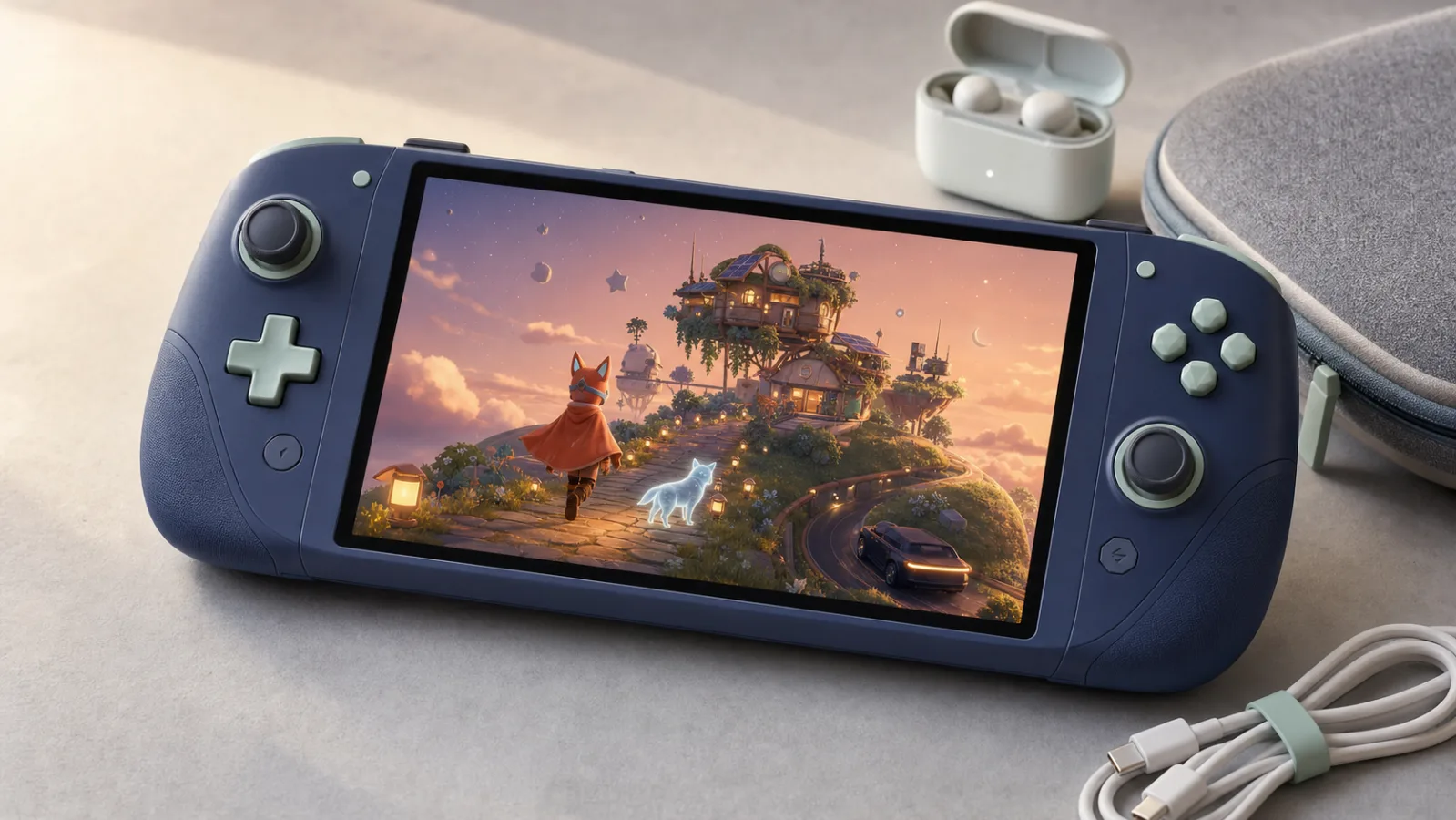
Handheld gaming is not one single hobby with one perfect device. It is a way of playing: fitting games around commutes, breaks, travel, quiet evenings on the sofa, and any moment when sitting in front of a television or desktop setup is not the ideal option. For a newcomer, that flexibility is the appeal. It can also make the first purchase feel surprisingly complicated. Some games are built for a dedicated portable system, some live on a phone, some are retro experiences with original handheld editions, and others are console or PC games that simply happen to work especially well in shorter sessions.
The most useful way to begin is not by chasing a huge library. Start by identifying how, where, and with whom you expect to play. A player who wants a calm solo routine needs something different from a household looking for active party games, and both differ from someone interested in preserving the feel of old-school NES-era challenges. The supplied games offer a good cross-section of these possibilities: cozy social worlds, story-led adventures, platformers, motion-driven music games, and demanding retro action.
This guide explains the major decisions that matter before you commit, then uses those games as practical examples of the kinds of handheld gaming experiences worth seeking out.
Start with your portable play style
Before comparing game names, decide which of these patterns best describes you. The answer will narrow the field more effectively than genre labels alone.
- The quick-session player: You want something satisfying in short windows of time. Arcade-style action, platforming stages, deliveries, minigames, and score-driven music play can all work well here.
- The cozy routine player: You want a game you can revisit regularly without pressure. Building, decorating, farming, community activities, and gentle exploration are natural fits.
- The story explorer: You value atmosphere, characters, and a clear sense of place. Adventure and role-playing games are likely to be your foundation.
- The social player: You want an excuse to play with family, friends, or an online community. Look closely at whether a game is explicitly cooperative or multiplayer rather than assuming it is.
- The retro-curious player: You enjoy older design conventions, direct controls, and the satisfaction of mastering a tough game through practice.
- The active party player: You want games that turn play into a group activity and get people moving rather than sitting still.
You can belong to more than one group, but choose a primary one for your first game. A focused first purchase teaches you what you actually enjoy on a smaller screen. It is better than buying several games that sound broadly appealing and discovering that none match the time and attention you have available.
Understand the main handheld routes
Dedicated Nintendo-style portable play
Nintendo Switch support is a useful signal for people who want a familiar portable-console approach. The game selection here includes Kirby Super Star, Just Dance 2017, Just Dance 2018, Just Dance 2019, and several upcoming games with Nintendo Switch or Nintendo Switch 2 platforms listed: Loftia, Haunted Paws, Kitsune: The Journey of Adashino, Petit Planet, and Petal Runner.
This route suits players who like physical controls, a console-first interface, and the option to move between a handheld screen and a shared screen when supported by their setup. It is especially attractive for platformers, adventures, and local social play. However, do not assume that every Switch-supported game has the same portable strengths. A fast platformer may be comfortable in a compact session, while a dance game is fundamentally better suited to a space where players can stand and move freely.
Mobile gaming on Android and iOS
Mobile gaming is the lowest-barrier entry point because many people already own the necessary screen. Petit Planet is listed for Android and iOS as well as PC and Nintendo Switch 2, making it the clearest example in this collection of a game designed around cross-platform possibilities. Its premise centers on building a home, sharing a planet with fuzzy neighbors, and exploring cosmic everyday life. That combination makes it a promising match for players who want a gentle, ongoing game rather than a single intense campaign.
The key mobile question is not whether a game can run on a phone; it is whether phone play suits your habits. Touch controls can be intuitive for menus, decoration, and casual interaction, while some people strongly prefer buttons for precision movement or action. Consider screen size, battery use, storage space, notifications, and whether you are comfortable treating your phone as a place to relax rather than another source of interruptions.
PC games that complement a portable routine
PC support appears throughout the selection, including Petit Planet, Loftia, Haunted Paws, Kitsune: The Journey of Adashino, Petal Runner, and Just Dance 2017. PC does not automatically mean handheld gaming, but it matters for beginners who want flexibility across devices or who already prefer PC as their main game platform. If you like a game's premise but want the comfort of a larger display, PC compatibility can be a useful complement to portable play.
Keep expectations practical. Cross-platform does not mean every version feels identical, and a game being available on PC does not establish that it is designed for a handheld PC. Treat the listed platforms as choices, then prioritize the version that fits your preferred controls and environment.
Retro and original hardware context
Retro handheld gaming is its own branch of the hobby. In this set, Knight Rider, Karnov, and John Elway's Quarterback are associated with older platforms including the Nintendo Entertainment System and Handheld Electronic LCD. These games represent a much more compact, immediate style of design, but they also reflect their era. They can be less forgiving, more limited in feedback, and less likely to ease a new player through their rules than a modern cozy adventure.
That is not a drawback if challenge and historical flavor are what you want. It simply means retro is best approached with the right mindset: play to learn patterns, celebrate incremental progress, and expect the controls and pacing to feel different from contemporary games.
Pick a first game by mood, not just genre
For cozy creativity: Petit Planet
Petit Planet is aimed at players who want home-building, community life, and discovery within a cosmic setting. It is described as an adventure, role-playing, and simulation game, with a free-to-play business model and Android, iOS, PC, and Nintendo Switch 2 platforms listed. For a newcomer, its strongest appeal is the potential to make play personal: build a home, get to know fuzzy neighbors, and settle into everyday activities rather than rushing toward a finish line.
It is best for the player who enjoys checking in regularly, customizing a space, and letting a game become part of a routine. Because it is listed with a future release date, treat it as one to watch rather than a game to plan around immediately. Free-to-play games also deserve an extra moment of consideration: decide in advance whether you want a no-spend casual experience or are comfortable evaluating optional purchases on their own merits.
For cooperative cozy play: Loftia
Loftia is built around a collaborative world in which players farm, craft, explore, decorate, and work toward a brighter, more sustainable future. Its multiplayer focus is central, not incidental. This makes it a strong fit for friends who want a shared long-term project and for players who find creative games more rewarding when they can show someone else what they have made.
For handheld beginners, the important question is social scheduling. A multiplayer world is most enjoyable when you either have a regular partner or are happy meeting new people. If you prefer complete independence, a solo-first adventure may be a better opening choice. Loftia is listed for Mac, Nintendo Switch, and PC, with a future release date, so it belongs on a forward-looking wishlist rather than an immediate starter-library recommendation.
For a friendly spooky duo: Haunted Paws
Haunted Paws combines a deliberately playful premise with horror-adventure tension. Two customizable puppies explore spooky environments, encounter evil creatures, and attempt to rescue their human friend from a haunted mansion. It is explicitly a cozy co-op horror adventure, making it a smart entry point for two players who want a shared game with personality without abandoning action entirely.
The game is listed for Nintendo Switch, Nintendo Switch 2, PC, PlayStation 4, PlayStation 5, and Xbox Series X|S. That broad platform range can help pairs find a version that suits their existing hardware. Its future release date means newcomers should view it as a promising co-op option to follow, not as a currently available purchase. If the horror element does not appeal, do not let the puppy theme mislead you; choose a warmer social game instead.
For a stylish narrative journey: Kitsune: The Journey of Adashino
Kitsune: The Journey of Adashino follows Kitsune, a fox girl traveling across Adashino Island with a Frog companion. Its Japanese-inspired island setting uses neon signs for color and light, while an unseen presence in the shadows adds a more ominous note. That contrast suggests a game for players who like atmosphere as much as action: the pleasure is likely to come from moving through a distinctive place and seeing how its mystery develops.
It is listed for Mac, Nintendo Switch, Nintendo Switch 2, and PC, with a future release date. For someone choosing between cozy games, this is the option to watch if you want a stronger sense of suspense and a defined travel narrative instead of a heavily social simulation loop.
For wholesome movement and short goals: Petal Runner
Petal Runner is an adventure RPG about Cali and Kira, aspiring Petal Runners who bike around Sapphire Valley. Its activities include deliveries, meeting new friends, and minigames, wrapped in a slice-of-life story about growing up and learning to let go. That structure sounds especially compatible with handheld habits: take on a delivery, explore a little, play a minigame, and leave with a clear sense that you accomplished something.
It is listed for Nintendo Switch 2 and PC, with a future release date. Keep it in mind if you want cheerful exploration and character-focused storytelling but do not necessarily want the ongoing responsibilities of a farm or building simulator.
Established starting points for a Nintendo-focused library
Kirby Super Star: the best all-around beginner pick
Among the established games in this set, Kirby Super Star is the most straightforward recommendation for a newcomer interested in classic Nintendo-style portable play. It contains multiple games and short subsections, giving players variety without requiring a single massive commitment. Kirby can float, inhale enemies and projectiles, spit them out, and copy certain enemies' abilities. The helper system is particularly welcoming because it adds a cooperative dimension to the adventure.
Its mix of action, adventure, and platforming makes it suitable for players who want responsive controls and colorful worlds but do not want to begin with a punishing retro action game. The listed Nintendo Switch, Wii, and Wii U platforms make it the obvious choice here for a player already in that ecosystem.
Just Dance 2017, 2018, and 2019: choose the soundtrack and setting that suit your group
The Just Dance games are not typical handheld commuting games, even when Nintendo Switch is among their listed platforms. They are movement-focused music games best treated as portable-friendly party software: easy to bring to a gathering, but most rewarding with room to stand, move, and laugh at missed routines.
Just Dance 2017 asks players to mimic on-screen dancers and scores accuracy. It supports motion controller systems on its console platforms and a smartphone through a companion mobile app, and its PC and current-generation console versions include Just Dance Machine. Just Dance 2018 brings a song list featuring tracks such as "24K Magic," "Despacito," "Shape of You," and "How Far I'll Go." Just Dance 2019 has 40 tracks, including "Havana," "Bang Bang Bang," and "No Tears Left To Cry," alongside personalized suggestions, a curated homepage, and eight choreographies developed with kids' development experts to encourage healthy movement.
For beginners, pick the installment whose included music and platform support best match the people likely to play. Do not buy one expecting a deep conventional campaign. Buy it to create an event.
How to approach retro games without frustration
Karnov, Knight Rider, and John Elway's Quarterback are valuable choices for players who want to explore older game styles, but they should not be judged by the accessibility standards of modern adventure games.
Karnov puts players in control of Jinborov Karnovski, a strongman seeking the Golden Acorn. He uses his strength and fireballs through side-scrolling action and platforming segments. This is a good fit for someone who wants a direct action challenge and enjoys repeating a difficult segment to improve.
Knight Rider uses a mission-based structure inspired by the television series, with players guiding KITT through driving, on-foot challenges, puzzle solving, and criminal encounters. It has the appeal of switching activities, but its 8-bit presentation and older design make it a choice for fans of the source material and retro experimentation rather than the easiest first game.
John Elway's Quarterback focuses on passing, avoiding interceptions, and scoring touchdowns. Its NES roots and Handheld Electronic LCD association make it best for football fans curious about a simpler historical approach to the sport. A new player should expect an arcade-like representation rather than the feature depth of a modern sports game.
Set yourself up for satisfying portable sessions
- Favor readable games at first. Clear character silhouettes, uncomplicated menus, and understandable goals reduce friction on a smaller display.
- Match controls to genre. Touch input can be natural for leisurely simulation tasks; platforming and action often benefit from dedicated buttons.
- Protect your comfort. Take breaks, avoid awkward wrist positions, and do not force long sessions just because a device is portable.
- Plan for interruption. Portable gaming often happens around real life. Games with short activities, flexible exploration, or clearly divided segments are easier to enjoy when you may need to stop.
- Choose co-op deliberately. A co-op game is only a good starter purchase if you have a partner or enjoy the social side of finding one.
- Do not confuse portability with suitability everywhere. A music game may travel well but need living-room space. A horror co-op adventure may be portable but still be best played with headphones and a friend.
A simple first-library plan
If you want one reliable established Nintendo-oriented starting point, begin with Kirby Super Star. It teaches the core joy of direct, readable, imaginative game design and offers enough variety to reveal what you like. Add a Just Dance entry only if you regularly play with others and have the room to move.
If mobile is your primary gaming space, watch Petit Planet for its cross-platform cosmic life-simulation approach. If you want a shared creative world, keep Loftia on your list. If you want a two-player spooky adventure, follow Haunted Paws. For story and atmosphere, choose between the neon-shadowed island journey of Kitsune: The Journey of Adashino and the sunny bicycle-led slice-of-life premise of Petal Runner when they become available.
Finally, make room for at least one game that is outside your normal comfort zone. Try Karnov if you want old-school action, Knight Rider if its mix of driving and missions appeals, or John Elway's Quarterback if you want to see how football games once approached the quarterback role. Handheld gaming becomes more rewarding when your library includes both a dependable favorite and a small curiosity.
The best handheld setup is the one you actually use. Choose a platform that fits your existing life, start with a game designed around your preferred mood, and let your habits--not marketing or a giant backlog--tell you what to play next.
Community
Discussion
Start the conversation.
No comments have been posted yet.