
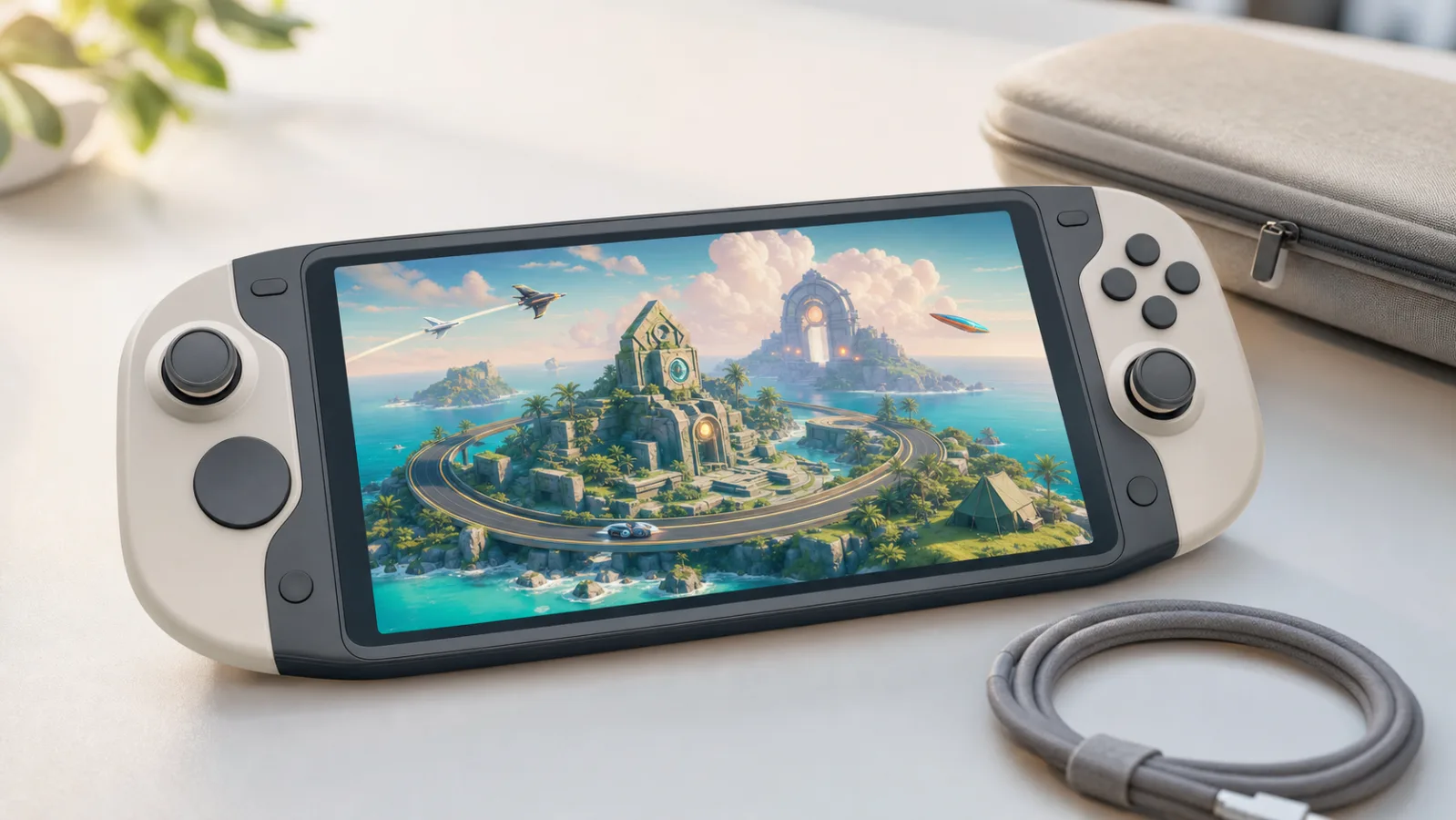
Handheld gaming is not one single hobby. It is a flexible way to play: a few minutes between commitments, a focused evening on the sofa, a co-op session with friends, or a long-running challenge that lives in a pocket or bag. That flexibility is its greatest strength, but it can make choosing where to start feel surprisingly complicated. A newcomer can encounter modern hybrid hardware, phones and tablets, older dedicated handhelds, portable-friendly console versions, and a huge range of game styles that demand very different amounts of attention.
The simplest way to begin is not to chase a giant library. Choose a device you will genuinely use, then select two or three games that serve different moods. A short puzzle game can fit a quiet commute. An arcade shooter can provide immediate intensity. A racing game can become a social option. A deeper adventure can give your portable library a sense of place and progress. The games in this guide show how broad handheld gaming can be, from old-school action to thoughtful logic puzzles and colorful multiplayer racing.
Start with your play habits, not the hardware
Before comparing platforms, decide what a normal gaming session looks like for you. Someone with ten-minute windows needs a different game than someone who enjoys playing for an uninterrupted hour. Someone sharing a device or regularly meeting friends may value local multiplayer, while a solo player may care more about an engaging campaign, repeatable stages, or the ability to experiment at their own pace.
- For quick sessions: Prioritize arcade action, racing, or self-contained puzzles. These genres tend to give you an immediate goal and a natural stopping point.
- For relaxed, deliberate play: Look for exploration and puzzle adventures. They work well when you want to make progress without needing constant rapid reactions.
- For skill-building: Vertical shooters and classic action games reward repeated practice. They are ideal if you like learning patterns, improving movement, and returning with a clearer plan.
- For shared play: Choose games with clear local multiplayer support or approachable competition. A familiar theme and simple objective can help bring in players with different experience levels.
- For long-term variety: Favor games with multiple routes, unlockables, procedural elements, extra challenges, or different characters and tools.
It is also worth being honest about controls. Touch input can be perfectly natural for some puzzle games, but precise action games often benefit from physical buttons. A hybrid system can be appealing because it supports both portable and television play, while a phone or tablet is the most convenient option when you already carry one. Neither route is universally better. The right platform is the one that makes starting a game easy rather than turning every session into setup time.
Understand the main routes into handheld gaming
Modern portable and hybrid systems
A modern dedicated portable or hybrid system is often the most straightforward beginner route. It offers physical controls, a screen designed around games, and access to versions built for both portable and home use. Nintendo Switch is particularly relevant to this guide, with games including Ittle Dew, Ikaruga, Human Resource Machine, Ice Cream Surfer, Hive Jump, and Hello Kitty Kruisers with Sanrio Friends listed for the platform.
This route suits players who want consistent controls and a library that can include both contemporary indie games and older-style experiences. It is especially useful if your tastes are still forming: one device can hold a thoughtful programming puzzle game, a demanding arcade shooter, a colorful racer, and a co-op platform shooter without forcing you to commit to one genre.
Phone and tablet gaming
Mobile gaming is the lowest-friction starting point because Android and iOS devices are already part of many people's daily routine. From the supplied games, Ittle Dew, Ikaruga, I Have No Mouth, and I Must Scream, and Human Resource Machine are listed across Android and iOS. The upcoming Warhammer Survivors is also listed for both mobile platforms.
For beginners, mobile works best when you embrace its strengths: short play windows, simple access, and games where thinking matters as much as button precision. A touch screen can be especially comfortable for point-and-click adventures and logic puzzles. For faster arcade games, consider whether you enjoy touch controls before making that genre your first purchase. Portable convenience is valuable only when the control method feels good to you.
Retro and legacy handheld play
Older handheld gaming has a different appeal. It often emphasizes immediate rules, concise stages, striking limitations, and replay through mastery. The supplied list includes games associated with Handheld Electronic LCD and Tiger Game.com, such as Indy 500, plus a Handheld Electronic LCD version of Home Alone 2: Lost in New York and Heavy Barrel. Home Alone 2 is also listed for Nintendo Game Boy.
Retro play is best approached with curiosity rather than an expectation that every older game will feel modern. Older designs may be more demanding, more direct, and less concerned with tutorials or convenience. That can be exciting: a small game with a focused objective can be an excellent way to understand the roots of portable design. But it also means that newcomers should choose games based on the experience they want, not simply the age or collectability of a platform.
Build a first handheld library with purpose
Your first three games should not all do the same job. A practical starter library includes one game you can open instantly, one game you can learn over time, and one game that offers a different pace. This approach prevents the common mistake of buying several similar games and discovering that none fit your actual schedule.
Start with exploration and flexible puzzles: Ittle Dew
Ittle Dew is an excellent starting point for players who want an adventure game without being locked into one narrow path. It follows Ittle Dew and Tippsie after they crash on a strange island filled with loot, secrets, mysterious inhabitants, puzzles, and shortcuts. Its core mix of exploration, inventive tool combinations, and classic adventure structure makes it a particularly useful entry point for people who want to think without playing under relentless pressure.
The important feature for a new portable player is flexibility. The island can be explored at your own pace, and the game's approach to progression also welcomes speedrunners. That means it can support different relationships with the same game: a first-time player can slow down, explore, and solve; a returning player can look for smarter routes and shortcuts. On the handheld side, it is listed for Android, iOS, and Nintendo Switch, providing options for both touch-oriented and button-oriented players.
Choose Ittle Dew if you like uncovering secrets, prefer playful problem-solving to pure reaction speed, and want a game that may reward both casual exploration and more efficient repeat runs.
Learn logic through play: Human Resource Machine
Human Resource Machine turns programming concepts into office-themed puzzle challenges. Each level assigns a new job, and your role is to program a small worker to automate it. Completing the task earns promotion and leads into another year in the office. The premise is light enough to make abstract logic approachable, but the challenge has depth: experienced players can pursue additional objectives beyond simply finishing a level.
This is a strong first puzzle game because it teaches by asking you to solve visible problems. You are not required to arrive with technical knowledge. Instead, you gradually learn how instructions interact, how to break a task into steps, and how to improve a working solution. It is less about reflexes than patient experimentation, making it well suited to small, quiet handheld sessions. It is listed for Android, iOS, and Nintendo Switch, among other platforms.
Choose it if you enjoy the satisfaction of making a messy process cleaner, or if you have been curious about programming but would rather encounter its logic as a game than as a formal lesson.
Try a precision classic: Ikaruga
Ikaruga represents the other end of the portable spectrum: concentrated arcade shooting that asks for attention and practice. The story centers on Shinra, the surviving pilot of the freedom federation Tenkaku, who is entrusted with the Ikaruga fighter after the island nation of Horai uses a mysterious power to conquer other nations. The fighter's defining ability is its integration of two energy polarities, allowing the pilot to switch between them.
For a newcomer, the key is to set expectations correctly. This is not necessarily a game to conquer in one casual sitting. It is a game to revisit. Vertical shooters become rewarding when you treat early failures as information: watch enemy placement, recognize the rhythm of attacks, and make one improvement at a time. Portable play can make that cycle inviting because you can practice a small section whenever you have a focused window.
Ikaruga is listed for Android and Nintendo Switch, as well as several console and arcade platforms. Choose it if you want a demanding skill game, enjoy replaying stages for improvement, and appreciate the satisfaction of learning a difficult system.
Pick colorful arcade energy: Ice Cream Surfer
Ice Cream Surfer is an arcade shooter adventure with a deliberately playful premise: the Ice Cream Surfer and four super-tasty friends fight evil Broccoli and an army of vegetables across the Gourmet Universe. The journey covers six worlds, with unique enemies and a giant final boss in each, leading toward the No-Flavor Zone. Its 16-bit-inspired pixel visuals and arcade-oriented soundtrack place it firmly in the tradition of bright, direct action games.
This is a good choice for players who want a clear arcade campaign rather than a huge open-ended commitment. Worlds, enemy varieties, and bosses give it a clear structure, while its unusual theme keeps the mood lighter than many shooters. It is listed for Nintendo Switch and PlayStation Vita, among other platforms, so it can appeal to players interested in portable versions on either a modern hybrid system or a dedicated handheld format.
Choose a racer for friends and family: Hello Kitty Kruisers with Sanrio Friends
Hello Kitty Kruisers with Sanrio Friends is a 3-D racing game built around Hello Kitty and other Sanrio characters. Its courses span land, air, and water, giving races more variety than a single-track format. You can race alone or compete with up to three friends, while Adventure Mode tests racing skills and unlockable outfits and vehicles offer additional goals.
This is a particularly sensible starter pick when you expect to share your system. Racing is easy to explain: reach the finish first, learn the course, and try again. The Sanrio setting can make the game welcoming to players who do not normally identify as racing-game fans, while unlockables provide a reason to continue after the first few races. It is listed for Nintendo Switch and Nintendo Wii U.
Bring a group: Hive Jump
Hive Jump offers a more combative co-op option. Set in the 24th century, it casts players as JUMPERS fighting through alien hives and planets against an enemy that outnumbers humanity a million to one. The game combines run-and-gun platforming with procedurally generated environments. Up to four players can team up locally or online, fighting enemies, avoiding traps, gathering treasure and lost relics, and eventually facing alien bosses.
For beginners, its greatest advantage is that a shared goal can make a difficult game easier to approach. A group can learn encounters together, celebrate a close escape, and return for another run with new layouts. Procedural generation also means that the experience is not only about memorizing a fixed route. Choose Hive Jump if your handheld gaming will include regular co-op sessions and you want action with a changing structure. It is listed for Nintendo Switch.
Approach classic action with the right mindset
Ikari Warriors and Heavy Barrel are useful reminders that portable-friendly action has long been built around forward momentum, powerful pickups, and endurance. Ikari Warriors is a vertically scrolling game in which one or two players fight through jungles, rivers, and ruins with machine guns, grenades, rocket launchers, and other power-ups while facing soldiers, tanks, helicopters, and obstacles. Heavy Barrel similarly centers on a commando infiltrating an enemy base in search of a powerful weapon, with intense combat and cooperative play as major features.
These games are for players who want direct arcade-style action and are comfortable with a challenge. Do not judge yourself by an early defeat. Learn what the game gives you: weapon pickups, health resources, positioning opportunities, and the advantages of playing alongside someone else. Both are listed in forms connected to legacy systems, while Ikari Warriors is also listed for Nintendo Switch, PlayStation Portable, PlayStation 3, and PlayStation 4.
Home Alone 2: Lost in New York offers a different retro route. The game places Kevin in New York City locations loosely based on the film, including Central Park, an abandoned toy store, and the Plaza Hotel. Its eight levels involve avoiding Harry and Marv through traps, items, and platforming challenges. It is listed for Nintendo Game Boy alongside other older platforms. It is best for players who enjoy a film-based 8-bit adventure and want to see how a familiar story was adapted into a compact action-platform game.
Know which games need a content check
Genre labels alone do not communicate tone. I Have No Mouth, and I Must Scream is a dark point-and-click puzzle adventure based on Harlan Ellison's short-story collection. In its premise, AM holds the last five humans prisoner and subjects them to virtual adventures shaped by their pasts, fears, and weaknesses. That makes it a very different recommendation from colorful arcade shooters or Sanrio racing.
It can be a good fit for an adult player seeking a grim, narrative-driven puzzle experience, especially on a platform where point-and-click interaction feels comfortable. It is listed for Android, iOS, Nintendo Switch, PlayStation, Xbox, PC, and other systems. However, newcomers should choose it for its unsettling themes and story-focused atmosphere, not as a general all-ages starter game.
What about Warhammer Survivors?
Warhammer Survivors is listed as a fast-paced roguelite survivors game set across the Warhammer 40,000 and Warhammer: Age of Sigmar universes. Its described loop involves controlling characters from both settings, collecting and evolving iconic weapons, and surviving endless enemy swarms in bullet-hell combat. It is listed for Android, iOS, Nintendo Switch, Nintendo Switch 2, PC, PlayStation 5, Xbox One, and Xbox Series X|S, with a listed release date of December 31, 2026.
Because that listed date is still ahead, treat it as a title to watch rather than the foundation of a starter library. Its format sounds suited to players who enjoy repeated runs, escalating builds, and crowded action, but a practical beginner library should be built around games already established in the supplied platform list.
Final buying and playing checklist
- Choose your preferred session length. Buy for the time you have, not the time you imagine having.
- Pick controls that suit the genre. For precision-heavy shooters and platform action, physical controls may be your priority. For puzzles and point-and-click adventures, touch input may be a natural fit.
- Start with variety. A strong first trio could be Ittle Dew for exploration, Human Resource Machine for logic, and Hello Kitty Kruisers with Sanrio Friends or Ikaruga for immediate action, depending on whether you prefer social racing or solo mastery.
- Use difficulty as a signal, not a verdict. In arcade games, repeated attempts are often the intended path to improvement.
- Match the audience to the tone. Bright, playful games and dark narrative adventures belong in very different kinds of portable libraries.
- Check the listed platform before deciding. A game can be ideal in genre but irrelevant if it is not on the device you plan to use.
The best handheld setup is the one that gives you a reason to play today. Start small, choose games that fit distinct moods, and allow your preferences to emerge through actual sessions. Whether you end up exploring an island in Ittle Dew, optimizing office jobs in Human Resource Machine, switching polarities in Ikaruga, or racing Sanrio characters with friends, handheld gaming rewards a library built around your real life rather than a checklist of supposedly essential games.
Community
Discussion
Start the conversation.
No comments have been posted yet.