

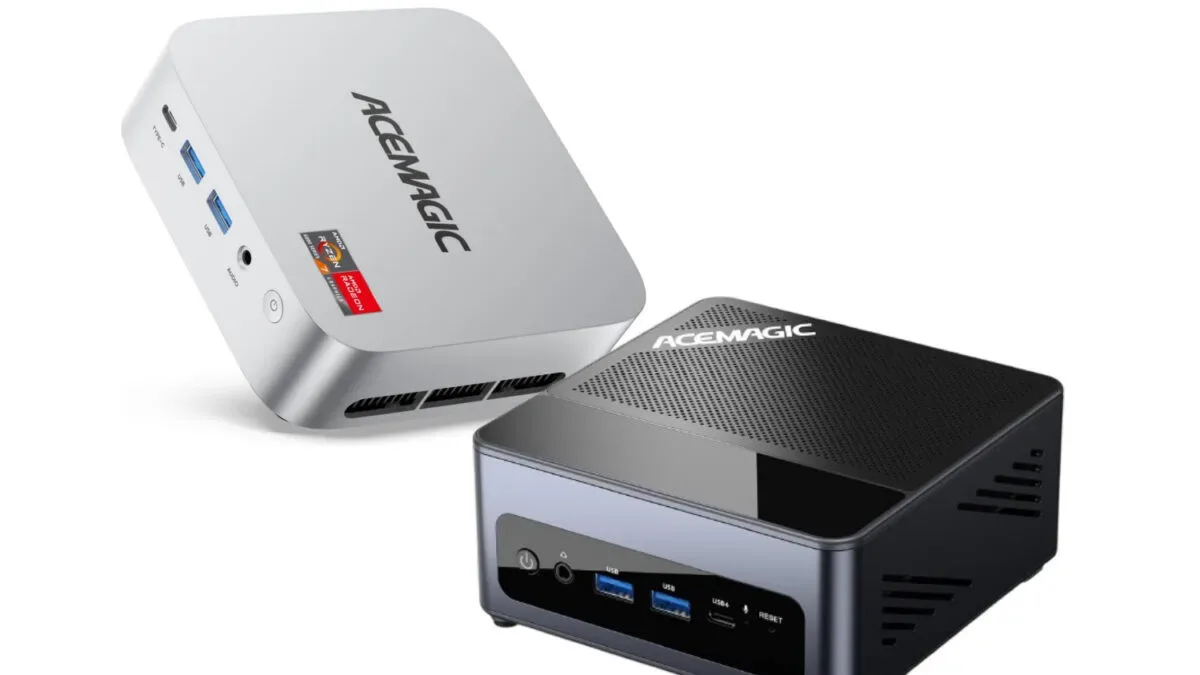
Mini PCs continue to occupy an interesting space for PC players: they are far smaller than a conventional desktop tower, can fit cleanly into a living-room setup or crowded workspace, and increasingly offer enough horsepower for everyday gaming and creative work. ACEMAGIC has discounted two of its compact Windows machines for Black Friday, targeting two very different performance tiers.
The more affordable option is the ACEMAGIC M1 mini gaming PC, configured with an AMD Ryzen 7 7735HS processor, 24GB of RAM, and a 512GB SSD. It is listed at $426 after using the checkout code BL0H8F3B, down from $470. At the other end of the range, the ACEMAGIC F5A Top AI mini PC with AMD's Ryzen AI 9 HX 470, 32GB of memory, and a 1TB SSD is discounted to $1,200 from $1,500.
Those figures represent a modest $44 reduction on the M1 and a much more substantial $300 reduction on the F5A. The promotions also operate on different schedules. The M1 code is stated to remain valid through December 31, while the F5A's direct 20% markdown is scheduled to end on November 30. As with many seasonal hardware offers, availability may change before those dates if inventory is exhausted.
ACEMAGIC M1: the value-focused compact PC
The M1 is the simpler proposition of the two. Its AMD Ryzen 7 7735HS is an eight-core mobile processor built on AMD's Zen 3+ architecture. While it is not a newly introduced chip, that does not make it irrelevant in a compact desktop. Mobile processors are common in mini PCs because they balance performance, heat output, and power draw more effectively than many full-size desktop parts.
For useful background on this topic, read October Game Spending Fell 14% as GTA 6 Fever Reshaped the Market.
For $426 after the promotional code, the notable part of this M1 configuration is arguably its 24GB of RAM. That is an unusual capacity compared with more common 16GB and 32GB configurations, but it can be useful for people who leave browsers, chat clients, launchers, office applications, and media tools open alongside a game. It should also give the system more breathing room for lightweight video work, photo editing, and general multitasking than an entry-level machine with less memory.
The included 512GB SSD is enough to get started, but prospective players should consider their storage needs realistically. Modern PC games can be exceptionally large, and a 512GB drive will fill faster than it once did after Windows, applications, updates, and several major games are installed. The capacity is better suited to a focused game library or a general-use PC than to a machine intended to permanently hold a huge collection of current releases.
Display connectivity is another highlight on paper. The M1 supports output to three 4K displays through HDMI, DisplayPort, and USB-C with DisplayPort 1.4 support. That does not mean every use case will need three screens, but it does make the compact system potentially appealing as a desk PC. A player could use one monitor for a game, another for guides or voice chat, and a third for music, capture tools, or work applications. For non-gaming use, the same flexibility suits a multi-monitor productivity setup.
For another perspective on this story, read ACEMAGIC M1 and F5A Mini PCs Get Black Friday Price Cuts.
It is important, however, to distinguish display-output support from gaming-performance expectations. Being able to connect a 4K panel is not the same thing as promising that every game will run well at 4K. The M1's appeal is its compact design and balanced everyday specification, rather than the kind of dedicated graphics hardware usually required for demanding high-resolution PC gaming.
F5A targets heavier workloads and 1080p gaming
The F5A occupies a more premium category. Its AMD Ryzen AI 9 HX 470 processor has 12 cores and includes AMD's XDNA 2 neural processing unit, or NPU. ACEMAGIC lists the NPU at 55 TOPS, with total performance across the CPU, GPU, and NPU reaching 86 TOPS. TOPS, short for trillions of operations per second, is a metric commonly used to describe AI-oriented processing throughput.
For users interested in local AI features or applications designed to take advantage of an NPU, that dedicated component is a meaningful difference from a more conventional mini PC. An NPU is designed to handle appropriate AI tasks more efficiently than routing everything through the CPU or integrated graphics. Its practical benefit will still depend on the software a buyer uses and whether that software supports the relevant hardware acceleration.
The F5A also steps up to 32GB of RAM and a 1TB SSD. That combination makes more sense for the machine's positioning. The extra memory is useful for demanding multitasking, larger editing projects, development work, and workloads involving AI tools. Meanwhile, the 1TB drive offers a more comfortable baseline for a player who wants a broader installed library without immediately reaching for external storage.
Graphics come from Radeon 890M integrated graphics with 16 compute units. ACEMAGIC describes this as comparable to GTX 1650-class desktop graphics and positions the system for 1080p gaming without a discrete GPU. That is a more encouraging starting point than the M1 for buyers whose priority is games, though settings, frame-rate targets, game engines, driver revisions, and upscaling support will all influence actual results.
Older, esports-focused, or less graphically intensive games are generally a more natural fit for an integrated graphics system than the most demanding new releases. Players shopping for a small-form-factor PC should approach it with clear expectations: the F5A may be a capable 1080p machine, but it is not being presented as a replacement for a modern gaming tower with a powerful standalone graphics card. Reducing settings or using performance-oriented options may remain necessary in more intensive titles.
Mini-PC advantages come with trade-offs
Both systems reflect the core appeal of the mini-PC category. Their small footprint can make them easier to place beside a television, beneath a monitor, or in a shared work area where a traditional case would be inconvenient. They also offer an alternative for buyers who do not want to assemble components themselves or accommodate a large desktop chassis.
That compact approach is especially useful for players building a low-clutter entertainment setup. A mini PC can be connected to a TV, paired with a controller, and used for a mix of games, streaming, browsing, and emulation where appropriate. On a desk, the same device can become a practical secondary computer or a main workstation for users whose tasks do not demand a dedicated graphics card.
At the same time, compact PCs are not identical to easily upgradeable towers. Buyers should check the manufacturer's specifications and documentation for memory and storage expansion options before purchasing, rather than assuming that every component can be replaced later. Cooling behavior, noise under sustained load, port placement, wireless connectivity, warranty terms, and the exact configuration sold are also sensible points to verify.
The F5A's price deserves particular consideration. Even after a $300 reduction, $1,200 is a significant investment for a system using integrated graphics. Its value is most straightforward for someone who specifically wants the Ryzen AI 9 HX 470 platform, 32GB of memory, 1TB of storage, compact dimensions, and AI-focused hardware in one prebuilt package. Buyers focused almost exclusively on conventional gaming performance may want to compare the cost with larger desktops that include discrete graphics, accepting that those alternatives will take up more room.
Which deal fits which buyer?
The M1 is the more approachable choice for shoppers who want a compact Windows 11 Pro computer for daily use, multitasking, lighter creative tasks, and less demanding PC games. The discount code brings its price to $426, and the 24GB memory configuration helps it stand apart from many basic mini PCs. It is best viewed as an all-purpose small desktop with some gaming potential rather than a machine built around high-end visual settings.
The F5A is aimed at buyers who need more headroom. Its 12-core Ryzen AI processor, XDNA 2 NPU, Radeon 890M graphics, 32GB of RAM, and 1TB SSD make it the more suitable option for heavier productivity use, AI-oriented workflows, and 1080p gaming ambitions. The 20% Black Friday reduction is meaningful in dollar terms, although the final price still places it in a premium mini-PC bracket.
Before completing either purchase, shoppers should confirm that the listed configuration, price, and promotion are still active at checkout. The M1 requires entering BL0H8F3B to reach its stated $426 price, while the F5A's markdown is presented as a direct discount. With the M1 code scheduled through December 31 and the F5A reduction ending November 30, the higher-end model has the shorter stated window.
For PC players who value a small footprint as much as raw performance, these discounts create two distinct paths into ACEMAGIC's mini-PC lineup. The M1 emphasizes accessible pricing and everyday versatility. The F5A costs far more, but brings newer AI hardware, increased memory and storage, and a stronger integrated graphics solution for users who need a more capable compact system.
Community
Discussion
Start the conversation.
No comments have been posted yet.