

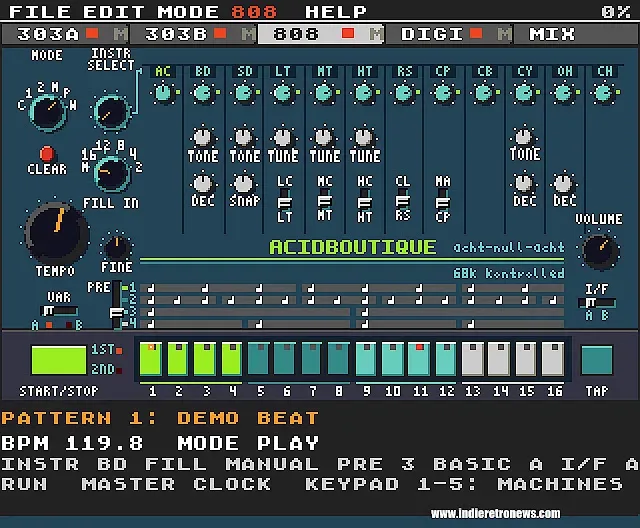
The Commodore Amiga remains one of the most creatively celebrated home-computer platforms of its era, remembered not only for games but for its unusually strong audiovisual capabilities. A new piece of software called AcidBoutique is leaning firmly into that legacy. Created by solo developer wintermute303, AcidBoutique is a music-production tool designed for the Commodore Amiga that combines the character of two landmark electronic-music machines: the Roland TB-303 bassline synthesiser and TR-808 drum machine.
Its premise is particularly striking because it is intended to run on an original Amiga 500 with 1 MB of RAM or more. Rather than treating the Amiga as a modern computer in a vintage case, the project is built around the limitations and appeal of the original hardware. The software runs on the machine's Motorola 68000 processor and aims to put a compact acid and electro-oriented studio setup onto a computer now roughly four decades old.
For retro-computing enthusiasts, music makers, demo-scene fans, and anyone interested in the broader creative uses of classic machines, AcidBoutique is an intriguing reminder that an old platform can still receive ambitious new tools. It also sits at an interesting intersection: the software is not a game, but it belongs to the same ongoing preservation-and-development culture that keeps legacy gaming computers active long after their commercial lifetimes.
Two foundational electronic-music machines in one Amiga tool
The TB-303 and TR-808 are among the most recognisable pieces of hardware in electronic music. The TB-303's squelching, sliding bass sound became inseparable from acid house and subsequently appeared across techno, trance, electro, and many other styles. The TR-808, meanwhile, helped define the sound of countless records with its distinctive kick, snare, clap, hats, toms, and percussion voices.
For useful background on this topic, read Mega Man Legends 'New Media' Listing Briefly Appears, Sparking Remaster Speculation.
AcidBoutique is built around those two identities. Its bassline side is meant to reproduce the TB-303 experience, including the performance details that matter when programming acid patterns. That includes the instrument's characteristic slides and accents, features that can dramatically change a sequence's feel even when the notes themselves remain simple. The drum side focuses on the TR-808's classic palette and sequencing appeal, pairing rhythmic programming with the bassline component in a form that is practical for a period Amiga setup.
That combination makes sense for the hardware. The Amiga has long had a reputation as a capable music machine, aided by its dedicated audio hardware and the vibrant tracker culture that grew around the platform. Numerous musicians, hobbyists, and scene creators used Amiga systems for composition, sample playback, game audio, and audiovisual productions. AcidBoutique takes a different route from a conventional tracker, concentrating on emulating the workflow and behavior of specific electronic instruments.
More than a loose approximation
The developer describes AcidBoutique as the result of reverse-engineering work rather than a broad attempt to imitate the sound of the original units from memory. The key claim is that the software runs the genuine logic of the original hardware in real time on the Amiga's Motorola 68000 CPU.
That distinction is important to users who care about the small quirks that make vintage instruments feel alive. In electronic-music emulation, it is not always enough to approximate the basic waveform or provide a set of familiar drum samples. The way notes transition, how an accent influences a phrase, the response of a slide, and the specific behavior of a drum voice can all shape the end result. AcidBoutique's purpose is to retain those behavioral details on a machine with far less processing power and memory than even entry-level modern devices.
Running that logic live on an Amiga 500 is also part of the project's appeal. The platform's Motorola 68000 processor powered an enormous range of 16-bit-era games and creative software, but it was never designed with today's software expectations in mind. Projects like this draw attention to both the efficiency of period-oriented development and the ongoing curiosity surrounding the Amiga's technical limits.
There is a strong historical symmetry to the idea, too. The Amiga and these electronic instruments all occupy important places in late-20th-century creative culture. They emerged in overlapping eras, reached audiences through very different communities, and have become enduring reference points for artists, collectors, musicians, and technologists. AcidBoutique brings those histories together in a hands-on application rather than merely presenting them as nostalgic references.
Designed for original Amiga hardware
AcidBoutique's stated baseline is an Amiga 500 with at least 1 MB RAM. That makes the project especially relevant to users maintaining original systems, rather than limiting it to modern emulation environments or heavily expanded later Amiga configurations. The requirement also reinforces the developer's focus on making the experience feel appropriate to the machine.
Classic-hardware software often has to balance authenticity against usability. A tool can be technically impressive yet require rare expansions, complex external setups, or a level of maintenance that limits the number of people able to use it. By targeting a comparatively modest configuration, AcidBoutique potentially speaks to a wider portion of the active Amiga community, including owners of more standard A500-era machines.
Of course, a music workstation needs more than sound generation to become genuinely useful. Pattern entry, timing, editing, arrangement, and the overall speed of experimentation all matter to a musician. The available details position AcidBoutique as a compact production environment intended to make bassline and drum programming accessible on the Amiga itself. Its attraction is therefore not just the prospect of hearing familiar instrument behavior, but of interacting with it through a dedicated vintage-computing workflow.
That workflow may be particularly appealing to people who enjoy constraints. Modern digital audio software offers nearly unlimited tracks, plug-ins, undo histories, automation options, and libraries. An Amiga-based tool built around a focused pair of instruments offers the opposite philosophy: learn the machine, program patterns deliberately, and turn limitations into a creative identity. For acid, electro, industrial, and retro-styled electronic projects, that narrowed focus can be a strength rather than a compromise.
Users must provide their own ROMs
There is one essential requirement for prospective AcidBoutique users: they must supply their own original 303 and 808 ROMs. The software does not include those ROM files because of copyright restrictions. Instructions for getting the tool working with compatible ROMs are included in its manual.
This is a significant detail for anyone considering the project. The application's approach depends on original hardware logic, but the associated ROM material remains protected. As a result, AcidBoutique is not presented as an all-in-one package containing every component necessary for immediate use. Users need to ensure they obtain and use ROMs legitimately before expecting the full intended functionality.
The requirement is also a familiar reality in preservation-focused software circles. Emulators, FPGA recreations, and hardware-accurate tools can face legal and practical boundaries around firmware, BIOS files, arcade boards, and instrument ROMs. A program may be technically capable of recreating a device's operation, while users are still responsible for the copyrighted material required to activate that recreation. In AcidBoutique's case, the manual is said to provide the relevant setup guidance.
A spare-time project with room to grow
wintermute303 developed AcidBoutique in spare time and used AI as part of the process. That places the release among a growing wave of independent retro projects created outside conventional commercial-development pipelines. The Amiga community continues to benefit from that kind of work, whether it takes the form of new games, utilities, hardware upgrades, ports, demos, or specialist creative applications.
The tool is being offered at a low price, described as roughly equivalent to a cup of coffee. The stated aim is to make the software accessible to the community while allowing support from interested users to contribute toward future development and updates.
That model feels well suited to a niche platform. Modern Amiga development is rarely about reaching a mass audience, but small purchases and sustained enthusiasm can help determine whether an experimental tool receives refinement after its initial release. For AcidBoutique, future updates could be especially meaningful because music software tends to evolve through usability improvements as much as new headline features.
Why AcidBoutique matters to the retro community
AcidBoutique is not trying to transform an Amiga into a general-purpose modern music-production PC. Its value lies in its specificity. It brings together a classic computer, two deeply influential electronic instruments, hardware-conscious coding, and a constrained creative workflow. That is a compelling recipe for enthusiasts who appreciate systems with clear personalities.
It also broadens the picture of what retro platforms are for in 2026. The continued life of the Amiga is not limited to replaying old games or collecting original releases. New software can give the system fresh reasons to be switched on, and creative tools can be just as important to that process as new games. In this instance, the result is a miniature electronic-music environment whose identity depends on the quirks, capabilities, and limitations of the original machine.
For Amiga owners with an interest in acid basslines, 808-driven rhythms, or historically minded music technology, AcidBoutique offers an unusual proposition: a chance to build tracks on period hardware while using recreated original-instrument behavior in real time. It is a small-scale release with a very particular audience, but that audience is precisely why it stands out.
Community
Discussion
Start the conversation.
No comments have been posted yet.