

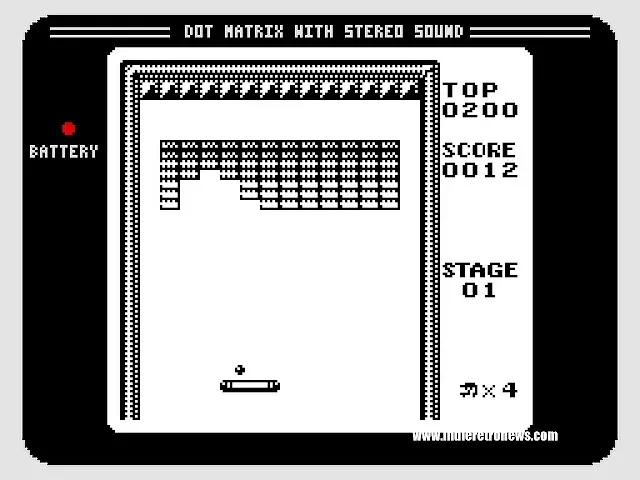
Alleyway ZX is a newly released unofficial conversion that brings the familiar 1989 handheld block-breaking game to the ZX Spectrum. Created by Kirby2000, the project is designed for both the Spectrum 48K and 128K models, adapting the original's compact paddle-and-ball action for one of Britain's most enduring home-computer formats.
The conversion keeps the core premise wonderfully direct. Players move a paddle along the bottom of the screen, returning a bouncing ball toward formations of blocks above. Clearing those formations opens the way to the next challenge, while missed returns cost valuable chances to continue. It is a formula that predates countless brick-breaking games, but its speed, strict positioning demands, and steadily tougher arrangements have always given it an immediate arcade-like appeal.
Kirby2000's Spectrum version aims to preserve the identity of the 1989 original rather than radically redesign it. That includes its stage structure, ball behavior, visual layouts, and recognizable opening presentation. For retro players interested in seeing how a handheld-era game translates to the ZX Spectrum's very different hardware, Alleyway ZX offers a focused conversion built around authenticity.
A simple idea with escalating pressure
Block-breaking games are easy to understand but often difficult to master, and Alleyway ZX leans into that contrast. At the outset, success is about keeping the ball in play and finding reliable angles through the first block patterns. As the game moves forward, however, the walls become more demanding. Players must react to changing formations, recover quickly from awkward rebounds, and anticipate where the ball will travel instead of only chasing its present position.
For useful background on this topic, read Terry's Terraforming Launches October 22 for Meta Quest 3 and 3S.
The full game contains 32 stages. Of those, 24 are standard levels, while the remaining eight are timed bonus rounds. This structure gives the experience more variety than a straightforward sequence of static brick walls. Standard stages are the main test of endurance and precision; the bonus sections add urgency, challenging players to clear as much as possible before time expires.
There are also several forms of block-wall behavior. Some stages use normal stationary formations, while others introduce scrolling or advancing walls. These shifting layouts raise the tension considerably. A stationary arrangement lets a player gradually learn the useful angles and safest returns, but a moving or advancing formation changes the board state and limits the time available to respond. The result is a progression that becomes increasingly less forgiving as players approach the ending.
Completing the stages leads to a final victory sequence, giving the game a clear finish rather than an endless score-chasing loop. That makes Alleyway ZX especially suited to players who enjoy compact retro games with a defined route to completion, even if mastering every stage and maximizing bonus-round performance provides its own replay incentive.
Designed around 50 Hz Spectrum play
One of the conversion's stated technical goals is smooth 50 Hz gameplay. For this kind of game, consistent motion is not merely decorative. The paddle must be placed accurately beneath a fast-moving ball, and even small inconsistencies in responsiveness or animation can make a precision-focused game feel unreliable. A 50 Hz presentation is therefore an important part of making the Spectrum adaptation feel quick and controlled.
The project also uses flicker-free sprites. On the ZX Spectrum, where display and colour limitations can create challenges for fast-moving objects, clarity is particularly valuable. The ball, paddle, and active playfield all need to remain readable at a glance. Reducing distracting sprite flicker helps the player track the action, particularly during later stages when the ball can rebound rapidly through remaining blocks.
Faithful ball physics are another notable part of the conversion's approach. Brick-breakers live or die on the relationship between paddle contact, rebound direction, and player expectation. A ball that behaves unpredictably can turn difficulty into frustration. By seeking to reproduce the original game's physics, Alleyway ZX is intended to retain the timing and trajectory management that defined the handheld release.
Stage layouts have likewise been recreated with fidelity in mind. This is significant because level design supplies much of the game's personality. Different arrangements influence the routes the ball can take, determine which blocks are easiest or hardest to reach, and shape how quickly a player can open space in the wall. Preserving those designs means the Spectrum version is not simply borrowing the concept; it is carrying over the specific progression of the 1989 game.
48K and 128K versions have distinct audio strengths
Alleyway ZX supports both major Spectrum memory configurations, with audio tailored to each one. On ZX Spectrum 128K systems, the game provides AY music and sound effects. The AY sound hardware gives the 128K version a fuller sonic palette, allowing its music and gameplay cues to have greater presence during play.
For ZX Spectrum 48K users, the conversion instead uses classic beeper music and effects. This is a fitting choice for the machine's earlier configuration and ensures that the game is not limited to 128K hardware. Beeper audio is a defining part of the 48K Spectrum experience, and its inclusion means players can enjoy an appropriately period-flavoured version without needing the expanded audio capabilities of later models.
The split is more than a technical footnote. It reflects a thoughtful attempt to make the same game feel at home across the Spectrum family. Players with 128K hardware can hear the benefits of AY music and effects, while 48K owners receive an audio presentation designed around the hardware they actually use. In either configuration, sound remains important: it reinforces contacts with the ball, destroyed blocks, and the momentum of a game where visual attention is locked tightly on the playfield.
Keyboard and classic joystick support
Control flexibility is another practical strength. Alleyway ZX supports keyboard input as well as Kempston and Sinclair joysticks. That compatibility matters for a Spectrum release, where players' preferred setups can vary enormously between original hardware, refurbished systems, and modern emulation or FPGA arrangements.
Keyboard controls offer an accessible baseline for anyone loading the game without a joystick attached. Meanwhile, support for Kempston and Sinclair standards gives players the option to use the controllers most closely associated with the platform. For a paddle-based game, a joystick can be a particularly natural fit, since the central action is built around quick left-and-right movement and steady positioning.
Having multiple input methods also makes the conversion more approachable for different kinds of retro users. Some players seek the original hardware experience, complete with a period joystick. Others may be experimenting with Spectrum software through a modern setup and prefer keys. The game accommodates both without treating one configuration as the only valid way to play.
A respectful crossover between two retro formats
The original 1989 game was made for a handheld environment, where its uncluttered rules and short, intense stages suited portable play. Bringing that design to the ZX Spectrum creates an interesting meeting point between two distinct strands of retro gaming history. One comes from the early handheld market, built around focused action and immediate readability. The other comes from the home-computer scene, where technical adaptation, machine-specific sound, and control compatibility are part of the charm.
Alleyway ZX does not appear to be trying to reinvent its inspiration. Instead, it concentrates on delivering the recognizable block-breaking experience on Spectrum 48K and 128K hardware while accounting for what those machines do best. Smooth 50 Hz movement, flicker-free sprites, recreated stages and physics, hardware-appropriate audio, and broad control support all point toward a conversion made for players who value a faithful result.
For ZX Spectrum fans, it is another example of the continued enthusiasm surrounding new software for classic systems. For players who remember the original handheld game, it offers a chance to tackle its 32-stage campaign through a new retro lens. And for anyone simply in the mood for a demanding paddle-and-ball challenge, Alleyway ZX delivers the enduring pleasure of turning one well-aimed rebound into a cascade of shattered blocks.
Community
Discussion
Start the conversation.
No comments have been posted yet.