

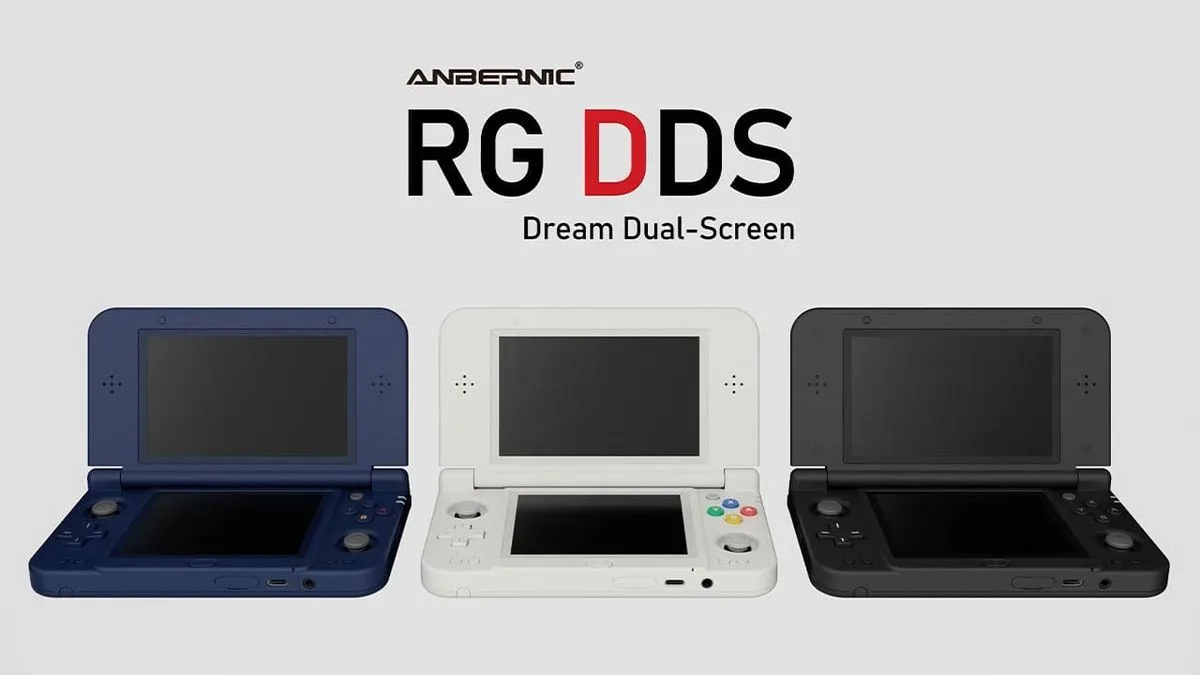
Anbernic has unveiled the RG DDS, a new dual-screen handheld whose design leaves little doubt about the hardware that inspired it. Short for Dream Dual Screen, the clamshell device closely follows the visual language, controls and general proportions of Nintendo's New 3DS family, but removes the stereoscopic 3D functionality that distinguished Nintendo's system.
The result is an unusually direct homage: a portable with two stacked displays, a touch-friendly lower screen, an integrated stylus, familiar face-button placement and colour options that appear intended to evoke New Nintendo 3DS models. It is also positioned as a considerably more powerful modern handheld rather than a period recreation, with Anbernic revealing that the system uses Qualcomm's Snapdragon G2 Gen 2 chipset.
Anbernic has not yet confirmed a release date or price for the RG DDS. Important practical details, including software support, storage configurations, battery capacity, display specifications and the precise function of one conspicuous extra button, remain unknown. Still, the announcement offers a clear look at the company's direction: a dedicated dual-screen machine built around the physical habits players developed with DS and 3DS hardware.
Embedded X/Twitter post
A Familiar Clamshell, With One Major Feature Missing
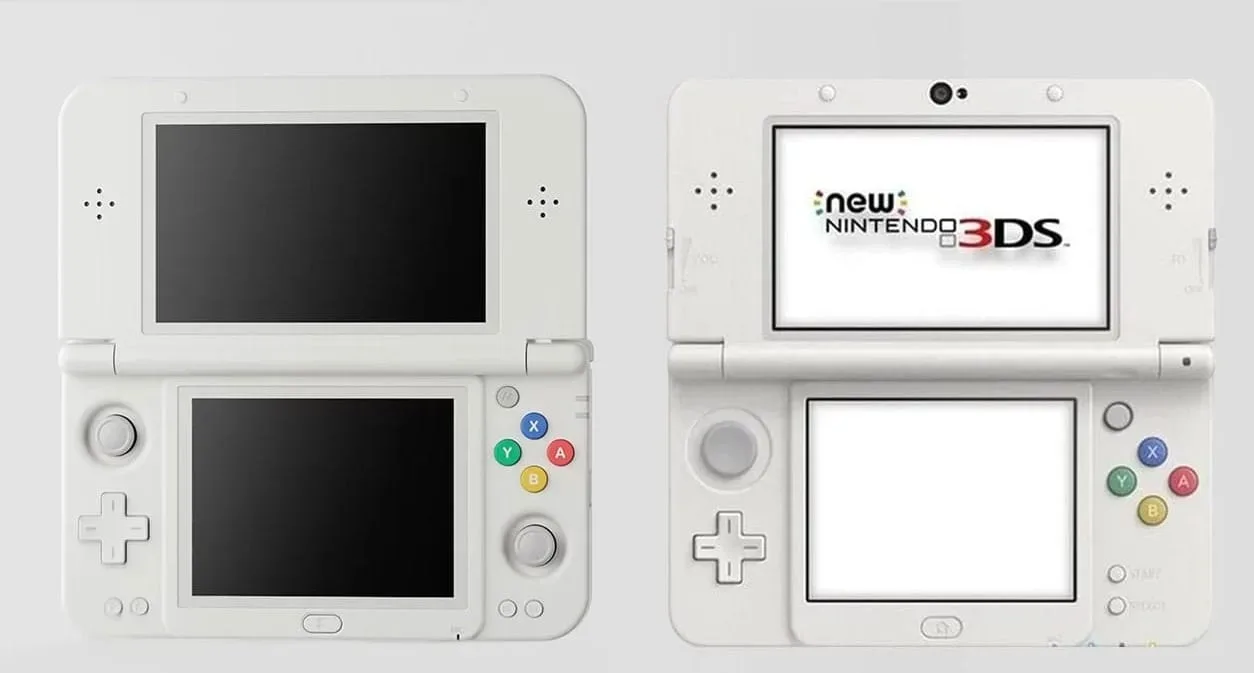
The most immediate talking point is the RG DDS exterior. Its silhouette is extremely close to the New Nintendo 3DS, from the folding body and screen arrangement to the speaker grilles, button layout and overall form factor. The white version shown by Anbernic even uses face buttons that strongly resemble those seen on the white New 3DS.
For useful background on this topic, read Yoshi Enters Pokémon Emerald in Yoshi's Eggcellent Adventure ROM Hack.
For players who spent years navigating menus and games on Nintendo's dual-screen systems, that resemblance could be more than cosmetic. A clamshell shape changes the way a handheld sits in the hands, protects the displays during travel, and naturally accommodates games designed around a vertical two-screen presentation. The stylus also stores in the bottom of the unit, continuing another essential part of the DS-era formula.
There is one substantial difference from the New 3DS: the DDS does not include a glasses-free 3D display. That means it cannot replicate one of the 3DS's original headline features. For many players, this may be a reasonable compromise; the 3D effect was memorable, but it was not universally used or preferred. Nonetheless, anyone seeking a literal replacement for the New 3DS experience should keep that omission firmly in mind.
The controls do not reproduce Nintendo's hardware exactly. Anbernic has placed an additional thumbstick on the right side beneath the face buttons. That gives the device a more contemporary control setup than the original 3DS line and could be important for software that benefits from dual analogue input. It also reinforces that the DDS is not simply trying to recreate a 2015 handheld internally.
Snapdragon G2 Gen 2 Brings Modern Hardware Ambitions
Anbernic has identified the Qualcomm Snapdragon G2 Gen 2 as the processor inside the RG DDS. It is a mid-range gaming-oriented mobile chipset, and its inclusion suggests the handheld is intended to reach beyond lightweight retro systems. The announced silicon has been compared in broad positioning with hardware expected in devices such as the AYN Thor, though real-world performance will ultimately depend on cooling, memory, software optimisation and the final operating system configuration.
On paper, the chip gives the DDS potential to handle the kind of workloads that make a dual-screen form factor particularly appealing. Nintendo DS and Nintendo 3DS software are obvious targets conceptually, because their original designs were built around two displays and touch input. A device with an upper and lower screen can avoid the awkward screen stacking, swapping and resizing compromises often required on single-display handhelds.
That said, Anbernic has not published a complete compatibility list or made specific performance guarantees for individual games. It would be premature to treat the announcement as confirmation of flawless support for every DS or 3DS title. Emulation performance varies by game and by software solution, while touch controls, screen resolutions, aspect ratios and system-level features can all affect the final experience.
There is also speculation that the available power could extend to more demanding systems, potentially including less intensive Nintendo Switch software. At this stage, that remains an expectation rather than a confirmed capability. Players interested in the DDS for anything beyond its dual-screen premise should wait for independent testing and fuller technical information.
Screen Proportions Matter More Than Raw Size
Anbernic says the DDS uses the same display aspect ratio as the New 3DS. That choice is significant because the relationship between the two screens is central to the feel of DS and 3DS software. Correctly proportioned displays can make menu layouts, maps, inventories, touch prompts and split-screen gameplay feel much closer to their original presentation than a generic widescreen panel can.
The displays are reportedly smaller than those on the Retroid Pocket Lite. Bigger screens are not automatically better for this particular idea, however. A closer match to the physical scale and aspect ratio of the original hardware may be more attractive to players prioritising authenticity, portability and a handheld that feels purpose-built for vertically arranged content.
Anbernic has not yet detailed panel resolution, brightness, refresh rate, colour performance or whether the two displays have differing specifications. Those details will be crucial. A dual-screen device lives or dies not only by horsepower, but by how consistently both panels behave and how naturally they work together during extended play.
An Interface Built for the Bottom Screen
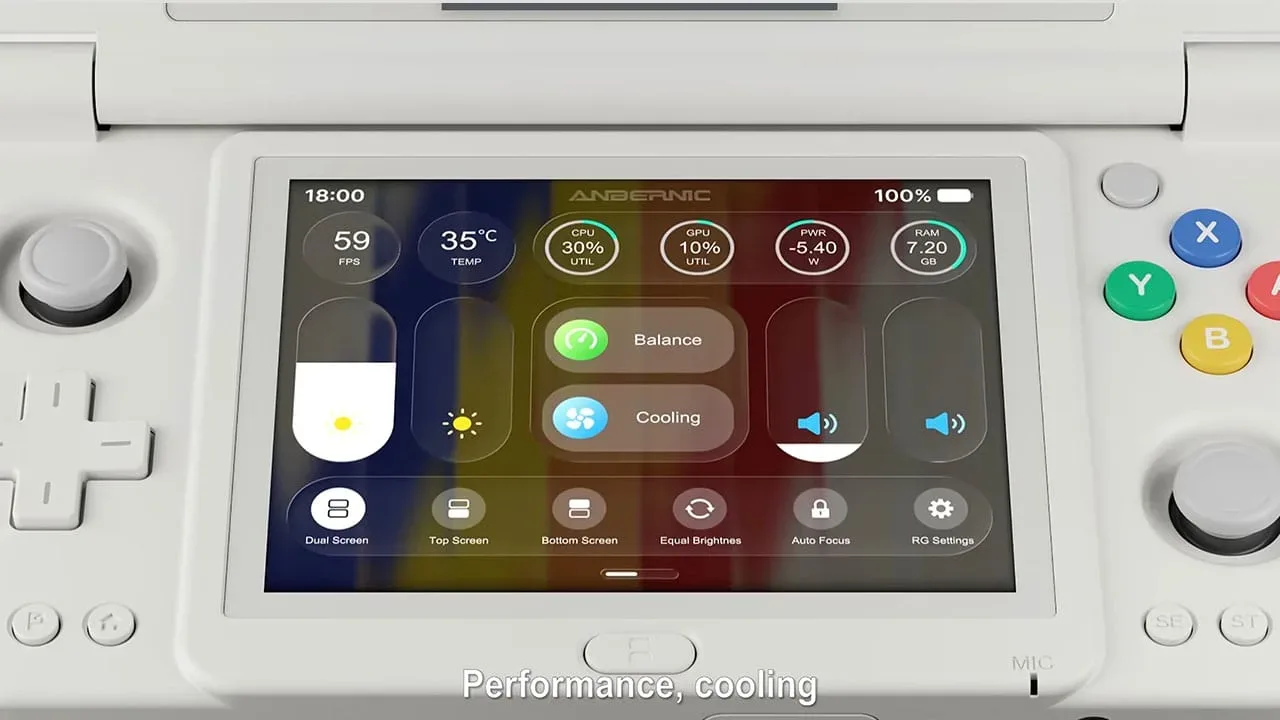
Promotional material shows a bottom-screen interface with numerous adjustable parameters and controls. The menu presentation has a distinctly DS-like structure while also incorporating a cleaner, more contemporary visual style. It appears designed to let users access system options without obscuring the primary display, a practical advantage of retaining a dedicated second screen.
The extent of those controls is not yet fully explained, but the demonstrated layout suggests a dense settings environment. This could be useful for adjusting performance profiles, display options, controller mappings or other device-level settings while a game remains visible above. Whether that interface proves approachable will depend on the final software design; extensive customization can be welcome, but only if it does not become a barrier to quickly launching and playing games.
The included extendable stylus is another important piece of the package. It makes the lower screen more than a supplementary information panel and opens the door to touch-based navigation that buttons alone cannot reproduce. It also means the DDS can preserve one of the most distinctive tactile elements associated with DS and 3DS play.
The Mystery of the AI Button
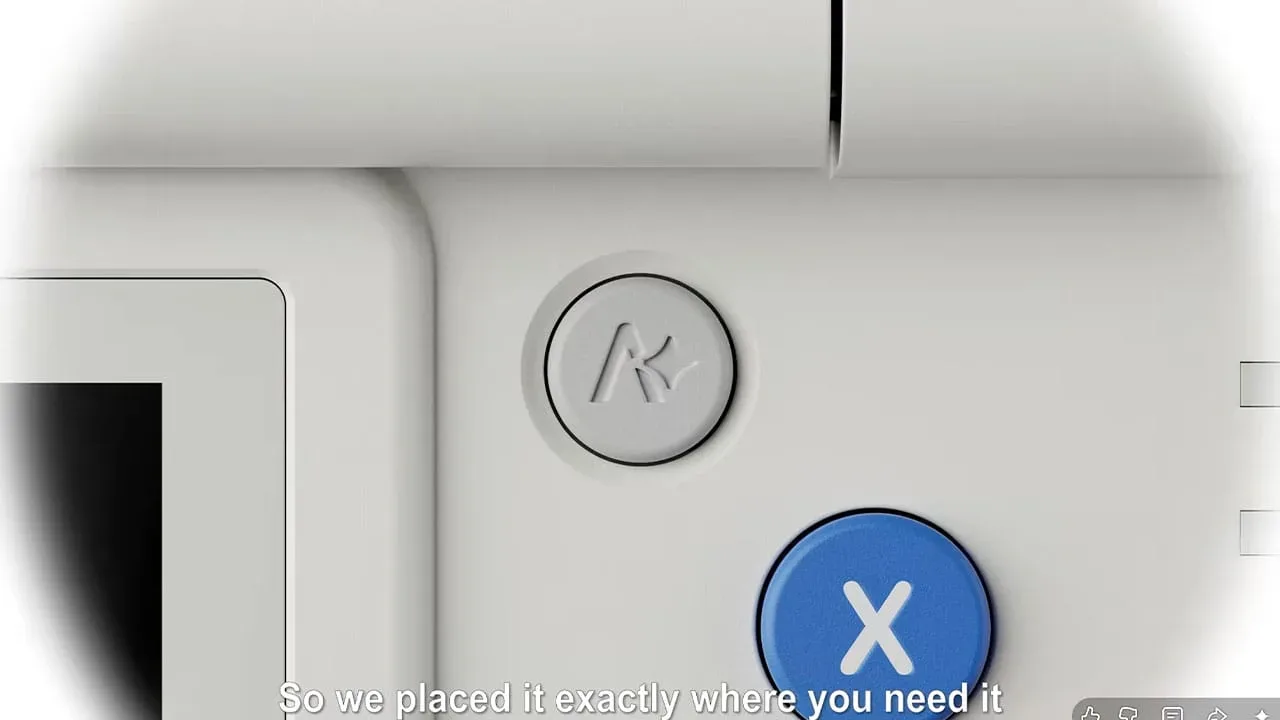
One unexpected hardware addition sits above the X button: a dedicated AI button. Anbernic has shown the control but has not explained what it does. That absence of detail makes it impossible to say whether the feature is intended for game help, system assistance, content generation, search functions, translation, accessibility tools or something else entirely.
The placement is notable because it gives the feature a physical shortcut rather than burying it inside a settings menu. For some users, an on-device assistant that can quickly explain a menu, offer hints or assist with configuration could be useful. Others may see it as an unnecessary addition to a layout already built around nostalgia for a simpler era of handheld design.
Until Anbernic clarifies the feature, it is best viewed as a curiosity rather than a reason to choose the DDS. Its value will depend entirely on what it can do, whether it requires an internet connection, how easily it can be disabled or reassigned, and whether it interferes with normal play.
What Is Still Unknown
The RG DDS announcement establishes the central concept but leaves several buying questions unanswered. There is no confirmed launch window, retail price, battery estimate or full specification sheet. Anbernic has also not detailed regional availability, the operating system, wireless features, ports, RAM, storage, display resolution or bundled accessories beyond the visible stylus.
- Confirmed so far: a New 3DS-inspired dual-screen clamshell design, New 3DS-like display proportions, a Snapdragon G2 Gen 2 chipset, a stylus, a right-side second thumbstick and an AI-labelled button.
- Not confirmed: price, release date, battery life, screen resolution, complete specifications, game compatibility and the function of the AI button.
- Worth watching: how the system handles dual-screen software, how polished its interface is, and whether its modern hardware delivers consistent performance across the software people expect to use on it.
The DDS is a striking announcement because few handheld makers have committed so directly to the old dual-screen clamshell concept. Its appearance will inevitably invite comparison with the New Nintendo 3DS, but its success will depend on whether Anbernic can turn that familiar shape into a polished modern device rather than merely a visually persuasive imitation. Until pricing, availability and deeper specifications arrive, the RG DDS remains one of the more intriguing--if still incomplete--handheld reveals in Anbernic's lineup.
Community
Discussion
Start the conversation.
No comments have been posted yet.