

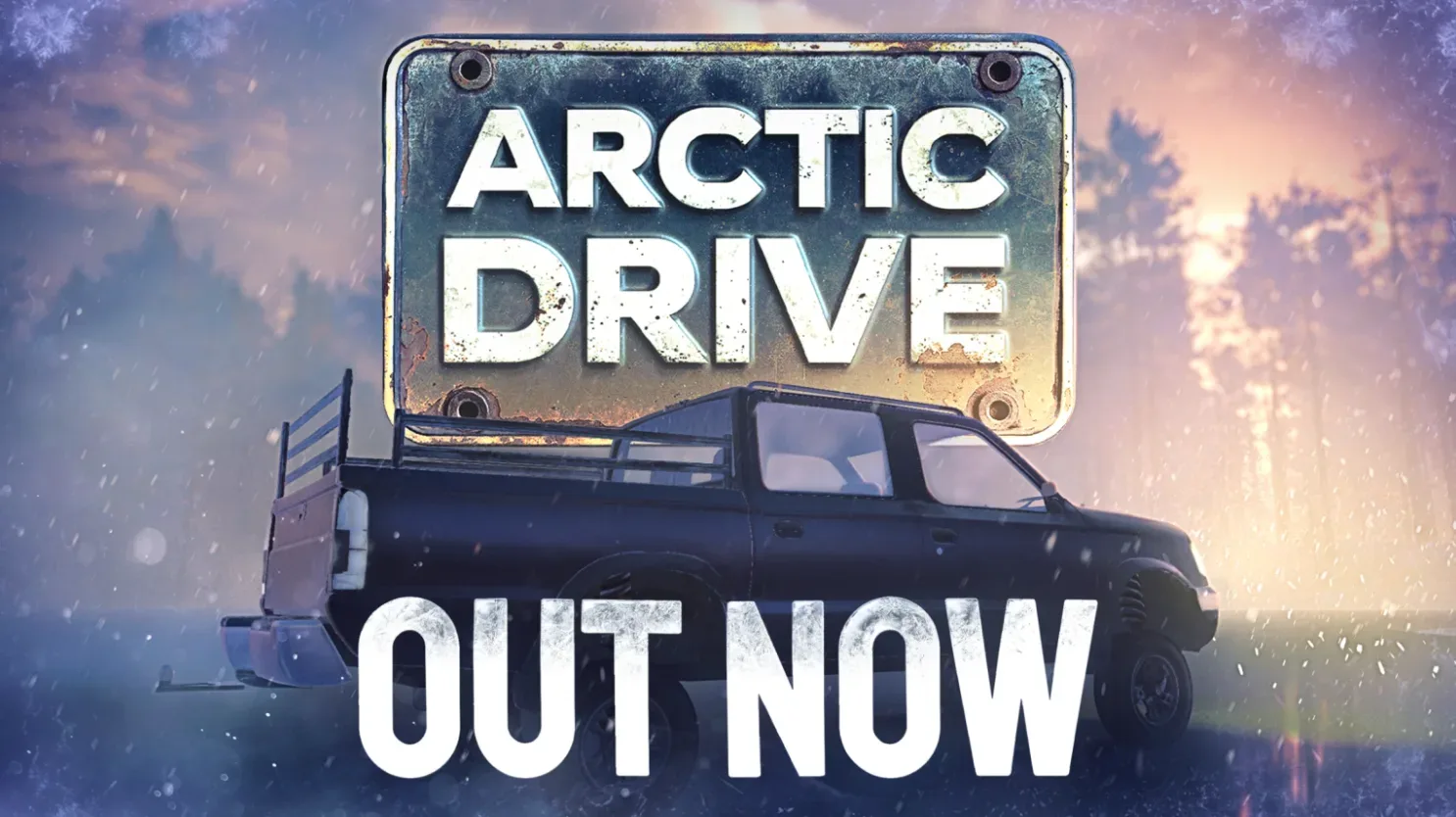
Arctic Drive entered Early Access on November 25, 2026, arriving on PC through Steam and on Xbox Series X|S. The vehicle-focused survival game drops players into a hostile frozen landscape where staying alive depends not only on what they can carry, craft, or scavenge, but also on whether their car can keep moving.
The Early Access build supports up to four players in co-op. Players can choose between a structured Scenario mode centered on a character named Brian and his journey through the Arctic, or a more open Sandbox mode built around exploration, looting, survival, and pushing farther along the road. Both approaches put the vehicle at the center of the experience: it is transportation, shelter, storage, and a vital piece of equipment that needs constant attention.
That focus gives Arctic Drive a distinct survival-game hook. Rather than simply travelling on foot between abandoned locations, players are expected to make decisions around the condition and usefulness of their vehicle. The farther north they travel, the more important those decisions become as severe weather, changing roads, and the demand for supplies put pressure on every journey.
A survival game where the car comes first
Arctic Drive frames the car as the player's lifeline in an unforgiving region. A trip into the unknown is not just about picking a destination and driving there. Players must search points of interest for useful parts and resources, maintain their ride against the cold, and work out which finds are worth bringing along for the next stretch of road.
For useful background on this topic, read Golden Cat Awards 2026 nominees Announced as Verified-Play Voting Opens.
Salvaged vehicle components can be bolted onto the car, allowing players to adapt and improve their transport as they progress. Used equipment can also be broken down at workbenches, converting old gear into crafting materials. Those materials can then be used to create consumables and repair parts, establishing a loop that connects exploration with vehicle upkeep and longer-term survival.
The game also lets players trade up to better vehicles. That suggests the starting car is not intended to be a permanent solution for the whole expedition. Instead, the journey north is expected to involve reassessing the group's needs, discovering upgrades, and finding rides more suitable for the increasingly difficult conditions ahead.
It is a setup that makes resource management feel tied directly to movement. A poor decision about repairs, supplies, or scavenged parts could limit how far a group can travel. Conversely, an effective upgrade or a well-stocked vehicle can give players a better chance when they encounter worsening snow and more demanding terrain.
For another perspective on this story, read Arctic Drive Enters Early Access on Steam and Xbox Series X|S.
Scenario mode gives Brian's expedition a direction
For players looking for more than a purely self-directed survival session, Arctic Drive's Scenario mode follows Brian on a journey through the Arctic. These scenarios are described as goal-driven runs, providing objectives that can guide the experience through the game's snowy environments and survival systems.
That structure could make Scenario mode a useful entry point for newcomers learning the game's core routines: searching locations, collecting supplies, maintaining a car, crafting necessities, and choosing when it is safe to continue. Goals also offer a sense of purpose that can be particularly important in a survival game, where open-ended mechanics can otherwise leave players to create their own direction.
Scenario mode's presence does not mean Arctic Drive is solely a linear adventure. Its design still leans on the uncertainty of the road, resource hunting, and an Arctic environment that can complicate a planned route. Objectives may set the destination, but staying alive long enough to reach it remains the central challenge.
Sandbox mode leaves room for the unexpected
Sandbox mode is the alternative for players who want to concentrate on open exploration and survival without the same scenario-led framework. Here, the appeal is the journey itself: head out, investigate points of interest, gather what is useful, and try to build enough momentum to continue deeper into the north.
Looting and scavenging are essential parts of this format. Supplies and components found along the route can support immediate needs or become the basis for later crafting. Because gear can be scrapped for materials, an item that is no longer useful in its original form may still have value at a workbench. That approach should reward careful use of inventory rather than treating every worn or outdated object as simple clutter.
The ability to swap or improve vehicles adds another layer to Sandbox runs. Players are not only measuring their own preparedness; they are measuring whether their current car remains capable of handling the route ahead. Finding a better option may be as important as finding food, repair items, or other essential survival resources.
Weather and changing terrain raise the stakes
The Arctic setting is designed to be more than a backdrop. Arctic Drive includes dynamic snowstorms and weather systems that affect progression. Players cannot assume the route will remain stable simply because they have successfully travelled it before. Conditions can change, forcing groups to react to the environment while preserving their supplies and keeping their vehicle operational.
Roads and biomes also change as players push north. That progression gives the expedition a growing sense of escalation: reaching a new area should mean encountering different surroundings and, potentially, a new set of practical concerns. The farther the drive goes, the less likely early-game habits are to be enough on their own.
This changing-world approach fits the game's central idea of a road trip through extreme conditions. Arctic Drive is not just asking whether players can survive in the wilderness. It is asking whether they can sustain an expedition over distance, through weather that may interrupt plans and landscapes that become more threatening as the journey continues.
Four-player co-op brings a convoy mentality
Early Access supports groups of up to four players, letting friends tackle the Arctic together. Co-op naturally complements the game's survival loop, since a team can divide attention between driving, searching locations, carrying equipment, crafting at workbenches, and looking after the vehicle.
Just as importantly, co-op can make the game's road-focused structure feel more like a shared expedition. One player might prioritize keeping an eye on needed repairs while another searches a point of interest for components, with others managing supplies or deciding which direction to take. The game's systems appear built to generate those moments of group planning, particularly when the weather turns or a vehicle upgrade demands a difficult choice.
There is still likely to be pressure in a larger group. More players can mean more hands available for scavenging, but it can also mean more people relying on the same reserves and transport. Arctic Drive's survival tension should therefore come not only from the cold landscape, but from the practical challenge of coordinating a team around a limited mobile base.
A substantial start for Early Access
Arctic Drive arrives in Early Access after attracting nearly 200,000 wishlists. More than 100,000 players also tried its demo before launch, giving the development team a sizable group familiar with the game's blend of driving, survival, and scavenging.
The developers expect the Early Access period to last less than a year. During that time, player feedback and suggestions will be collected through the Steam Forums and the game's Discord community. A roadmap has also been outlined, pointing toward additional content and further updates as development continues.
That community-driven period is especially relevant for a systems-heavy game such as Arctic Drive. Vehicle upgrades, scavenging rewards, crafting materials, weather effects, and the balance between Scenario and Sandbox play can all benefit from feedback once players begin taking different approaches to the Arctic. Early Access gives the team room to adjust those interconnected systems while continuing to expand the experience.
What players can expect now
- Vehicle-centered survival across a dangerous Arctic landscape.
- Online co-op for up to four players.
- Scenario mode following Brian's Arctic journey through objective-led runs.
- Sandbox mode for freeform exploration, looting, and survival.
- Scavenging at points of interest for supplies, parts, and better vehicles.
- Crafting and repairs using materials recovered from scrapped equipment.
- Dynamic snowstorms and weather that influence progression.
- New roads and biomes as players travel deeper north.
Arctic Drive is available now in Early Access on Steam for PC and Xbox Series X|S. Its opening version already presents a clear premise: the cold is dangerous, the road is unpredictable, and the car carrying players through it all may be the most important resource they have.
Community
Discussion
Start the conversation.
No comments have been posted yet.