

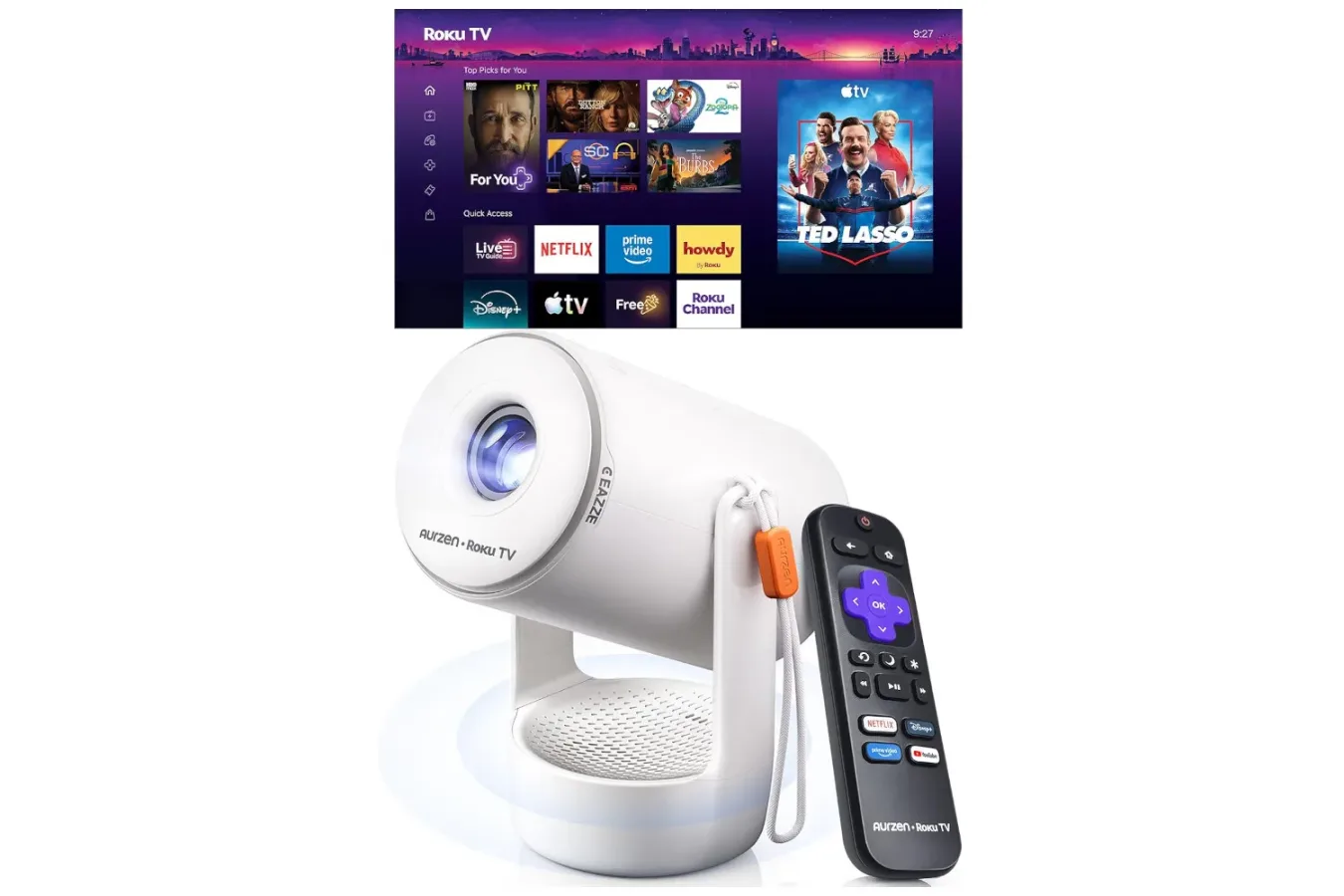
A large television can transform game nights, movie marathons and streaming sessions, but it is not always the most flexible way to get a big image. A portable projector offers a different proposition: rather than dedicating a wall and a room to one fixed screen, it can move between bedrooms, living rooms, outdoor spaces and temporary setups. The Aurzen Roku TV E1R Portable Mini Projector is currently positioned as an especially inexpensive option for that idea, with its price reduced to $90.
The Aurzen E1R normally costs $140, making the current price a 36% discount. At less than $100, it is notable not simply as a compact projector, but as one with Roku TV built in. That means users are not required to attach a separate streaming stick just to access the Roku app ecosystem and its collection of live channels. For anyone building an occasional entertainment or gaming screen without investing in a full television, the combination is the central appeal.
A portable path to a larger screen
The primary function of the E1R is straightforward: it can turn a suitable wall or projection surface into a much larger display than a typical monitor, tablet or handheld screen. Aurzen's unit projects at 720p resolution. That is below the 1080p and 4K standards increasingly common on televisions and premium projectors, so buyers should approach it with the appropriate expectation. It is not presented as a replacement for a high-end home theater display.
Still, resolution is only one part of where a projector can fit. A 720p image can be suitable for casual shows, movies, music videos, retro games and social sessions where the priority is scale, portability or simply putting something on in a different room. It may also be a practical companion for a temporary screen during a gathering, especially when a conventional television is unavailable or inconvenient to move.
For useful background on this topic, read Nintendo GameCube at 25: The Purple Box That Made Play Feel Special.
The device is designed to be easy to reposition. Its rotation is a key part of that pitch, allowing users to adjust the projector toward different surfaces and seek a workable angle without rebuilding the entire setup. It also supports multiple standing arrangements and can work with different mounts. Those details matter more than they might seem on paper: a small projector is most useful when it can adapt to a bedside table one evening, a shelf the next, or a more deliberate mounted arrangement later on.
Aurzen also highlights the projector's brightness as a strength, intended to broaden the range of spots and circumstances where it can be used. As with any projector, room lighting and the surface used for projection will remain important considerations. A darker environment generally makes it easier to get the kind of image viewers expect from projected video, while the color and texture of the wall can affect the final result.
Roku TV is the feature that separates it from a basic projector
Many affordable mini projectors are essentially displays that depend on another device for content. That can be perfectly adequate for a PC, console, phone or media streamer, but it adds cables, accessories and another interface to navigate. The E1R takes a more self-contained approach through its Roku TV integration.
With Roku TV included, the projector can provide access to Roku's familiar lineup of streaming apps. The platform also includes free live channels, which can be useful when a viewer does not have a specific film, series or stream in mind. It creates a lower-effort use case for the projector: set it up, open Roku's interface and browse rather than connecting a separate player first.
For gaming audiences, built-in Roku should be viewed as a convenience for downtime rather than as a substitute for a console or gaming PC. The supplied information does not establish advanced gaming-specific display features, refresh-rate specifications or latency performance, so prospective buyers should not assume those capabilities. What it does establish is that the E1R has multiple connectivity options, potentially giving it a role alongside other hardware while retaining its own streaming functions.
That distinction is useful. A player might use a console, PC or handheld in a more permanent setup for demanding competitive games, then use a portable projector for party games, older titles, co-op sessions or watching a show after playing. The projector's value is less about winning a specification race and more about giving people another screen option that is easy to relocate.
Where it could fit into a gaming setup
A portable projector has some immediately obvious gaming uses, though not every game or environment will be equally well suited. Slower-paced games, local multiplayer titles and retro collections can benefit from the novelty of a large projected image. So can a living-room session where several people need to see the screen at once. A projector can also make a spare room, garage or temporary gathering space feel more purposeful without requiring the purchase and installation of a large television.
- Local multiplayer: A larger image can make it easier for a room full of people to follow shared action.
- Retro and casual games: Older games and less visually demanding experiences may be a natural match for a 720p portable display.
- Handheld companion screen: Players who use a handheld capable of video output may appreciate the possibility of moving from a personal screen to a shared display, where supported by their hardware and accessories.
- PC and console connectivity: The projector has multiple connection methods, offering flexibility for devices beyond its internal Roku interface.
- Post-game streaming: Built-in Roku provides a direct route to streaming apps and free live channels without a separate streaming stick.
There are practical limits worth remembering. Projection works best when there is enough room to create the desired image size, a surface that gives a clean picture, and lighting conditions that do not overwhelm it. Players who primarily play fast, competitive games may also prefer to research display responsiveness before making a purchase decision, because that information is not detailed here. In short, this is best understood as a flexible entertainment device first, with gaming possibilities that depend on the user's expectations and setup.
Audio and connections add to the all-in-one approach
The E1R also includes built-in sound, described as impressive for a compact unit. Integrated speakers make sense for the projector's portable purpose: the fewer separate pieces that need to be carried and connected, the easier it is to take the display from one spot to another. That could be enough for casual viewing, background music or an impromptu video session.
However, people planning a bigger outdoor movie evening or a louder multiplayer gathering may still want to consider their audio needs. The available details confirm multiple ways to connect devices, but they do not specify every supported audio configuration or connection standard. Buyers with a particular speaker system, console setup or mounting plan should check the product listing's technical details before committing.
That same advice applies to any projector purchase. The headline deal is compelling, but the best buying decision depends on the intended use. Someone who wants maximum sharpness for a dedicated cinema room may be better served by a more expensive 1080p or 4K model. Someone who wants a compact device capable of streaming Roku content and creating a big image on demand is closer to the E1R's intended audience.
The $90 price is the real draw
At its regular $140 price, the Aurzen Roku TV E1R already sits in the lower-cost portable projector category. At $90, it becomes a more accessible impulse purchase for viewers who are curious about projectors but do not want to spend heavily on a first unit. The discount reduces the risk of experimenting with an extra screen for occasional movies, casual gaming, streaming or outdoor use.
It is also worth treating the sale price as temporary. Retail discounts can change without much warning, and there is no indication that the $90 listing will remain available for a set period. Anyone interested should verify the current price and the product's listed specifications before checking out.
The Aurzen E1R is not trying to be a top-tier home theater projector. Its proposition is much simpler: a compact projector with 720p output, adjustable rotation, mounting flexibility, built-in audio, multiple connection options and a Roku TV experience in one device. With the current reduction from $140 to $90, that package could make sense for people looking to make almost any suitable wall feel like a bigger entertainment screen.
Community
Discussion
Start the conversation.
No comments have been posted yet.