

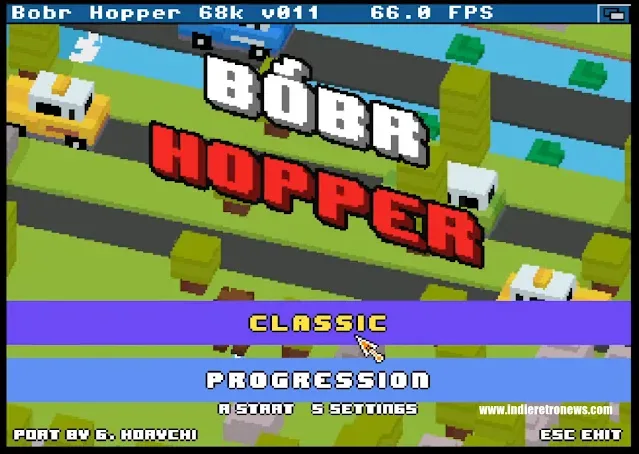
Bóbr Hopper is bringing a familiar arcade challenge to classic Commodore Amiga hardware: get across safely, avoid moving hazards, and see how far you can go before one bad step ends the run. Developed by angree as a native AmigaOS port, the game puts players in control of either a beaver or a chicken as they navigate roads, rivers, and railway tracks packed with dangers.
The premise deliberately channels the enduring appeal of arcade crossing games. It is immediately understandable, but survival depends on timing, awareness, and fast decisions. A player may need to slip past traffic one moment, judge a safe route over water the next, then react to an approaching train before continuing onward. That straightforward structure makes it well suited to score chasing, while Bóbr Hopper also expands beyond an endless format with structured progression.
What makes this version especially notable is its technical foundation. Although its gameplay logic follows angree's prior handheld retro releases, the AmigaOS engine itself was created from scratch for the platform. The project is designed to perform smoothly on a stock 68020-based Amiga without needing a floating point unit, using fixed-point techniques and pre-rendered assets to work within the constraints of the era's hardware.
Two Ways to Cross the Course
Bóbr Hopper offers two main ways to play. The first is a classic endless mode built around chasing a higher score. This is the most direct expression of the game's arcade inspiration: keep moving, survive the hazards, and attempt to extend the run farther than before. It is a format where each failed attempt can encourage another quick try, especially as players become more familiar with the movement patterns and hazards.
For useful background on this topic, read Gabe Newell's Old MMO Lesson on Player "Hacking" Is Finding New Life.
The second route is a multi-level progression mode. This includes a dedicated career structure and a ranking system, giving players goals beyond simply posting a better high score. Rather than treating every run as an isolated attempt, the career path provides a more guided framework for working through the game's content and earning ranks along the way.
The inclusion of both approaches is important for a game based on such a concise core idea. Endless play supports the traditional arcade loop, where mastering movement and reacting under pressure are the entire focus. A level-based career, meanwhile, can give that loop a sense of advancement. Players who want immediate replayability have the high-score mode, while those looking for a sequence of objectives can pursue the progression route.
Language support is available in both English and Polish. That bilingual presentation also reflects the project's identity as a homebrew-style release built around a very specific classic platform while remaining accessible to a broader audience.
A Familiar Formula, Rebuilt for AmigaOS
The basic game design is not angree's first use of this particular concept. Bóbr Hopper's core logic is described as a direct, line-for-line replication of earlier versions made for handheld retro devices including the SF2000, GB300, and R36S. Those systems are associated with low-cost portable retro gaming and offer a very different environment from a Commodore Amiga setup.
However, the Amiga edition is not simply a matter of transferring the existing program to another device. Its engine was built specifically for AmigaOS, with the goal of getting strong performance from classic hardware. That distinction matters in retro development. Reusing rules, movement behavior, and stage logic can preserve the feel of an established game, but the rendering approach, memory use, and data handling still need to suit the target machine.
For Bóbr Hopper, that means the gameplay may be consistent with the handheld editions, but the technical work under the surface is tailored to Amiga architecture. The result is a native AmigaOS project rather than an off-the-shelf emulated or generic implementation.
Fixed-Point Math Instead of an FPU Requirement
One of the clearest design decisions behind Bóbr Hopper is its use of 16.16 fixed-point math. In practical terms, fixed-point calculations provide a way to handle positions and movement with fractional precision while avoiding a dependency on floating-point hardware. This is particularly useful when targeting systems that may not include a mathematical floating point unit.
The game is intended to run on a stock 68020 processor without requiring an FPU. For Amiga enthusiasts, that target is significant because it prioritizes compatibility with a broad range of suitably equipped classic machines instead of reserving the experience for more extensively upgraded configurations.
Bóbr Hopper also uses a rigid orthographic camera arrangement. Objects retain the same size on screen regardless of their position in the game world. That differs from a perspective-driven presentation, where elements farther away appear smaller and calculations often become more demanding. A fixed orthographic viewpoint fits the arcade-style crossing concept well, keeping the action easy to read while helping the engine maintain a predictable rendering workload.
The combination of fixed-point math and an orthographic camera is a purposeful match for the project's goals. It supports responsive-looking movement and a clear view of traffic, water hazards, obstacles, and the playable character, without requiring the kind of processing features the game is intentionally avoiding.
Pre-Rendered Sprites Keep the Action Moving
Rather than asking the Amiga to build every visual element from complex calculations during play, Bóbr Hopper takes a pre-rendered approach. Visual assets are prepared offline, then stored as individual sprites. During gameplay, the system can draw those prepared components in sequence, from the background toward the foreground.
This workflow is designed to make efficient use of the hardware. Pre-baking assets shifts much of the intensive art-generation work outside of the live game. The Amiga then concentrates on selecting, loading, ordering, and displaying sprites as the player moves across the course.
There is substantial animation coverage for the protagonists. The beaver or chicken hero has 11 distinct poses and 12 directional angles. That set is intended to account for the many states needed in a game where movement is the focal point, including stretching, squashing, collisions, and other transitional actions. The obstacle art also receives directional treatment, with cars, trees, and rocks using four-directional renders.
Such asset variety can help the game communicate motion and impact clearly. In a crossing game, it is important that a player can quickly read where a car is headed, whether a character is moving or has collided with something, and how environmental objects are positioned in relation to the route ahead. The different render angles are therefore more than decorative detail; they contribute to legibility in fast arcade play.
Dynamic Log Clipping Adds a Small but Ambitious Detail
One particularly interesting technical detail involves the logs used in water sections. They are not simply flat, pre-cut images placed on top of the river. Instead, they are dynamically clipped at the water line in real time.
That may sound like a small visual touch, but it demonstrates the balance Bóbr Hopper is attempting to strike. The project relies on pre-rendering where that makes sense for speed, yet it still performs selective real-time work for effects that improve how objects sit within the scene. A log interacting visually with the waterline can make the environment feel more cohesive than a collection of completely separate flat layers.
It also illustrates why a platform-specific engine remains valuable even when the underlying game logic already exists elsewhere. The developer can choose exactly which visual operations deserve runtime attention and which should be handled ahead of time as prepared sprite data.
Two Graphics Sets for Different Amiga Setups
To support different display preferences and hardware arrangements, Bóbr Hopper includes two graphical sets. The low-resolution option runs at 320x240 and occupies 1.6 MB, while the high-resolution set runs at 640x480 and uses 6.4 MB.
The engine loads only the graphics data it needs for the selected presentation. This is a practical memory-management choice, especially on vintage hardware where loading unnecessary assets could affect responsiveness or reduce compatibility. Players using the lower-resolution option are not required to carry the larger high-resolution asset set in memory, while those choosing the sharper presentation have an option designed for that setup.
Offering both resolutions reinforces the project's broader technical philosophy. Bóbr Hopper is not trying to treat all Amiga systems as identical. Instead, it acknowledges that users may have different configurations and gives the engine a way to adapt its asset requirements accordingly.
A Carefully Considered Retro Project
Bóbr Hopper combines an easy-to-recognize arcade premise with an unusually detailed look at how a modern homebrew project can be shaped around vintage technology. Its roads, rivers, and train tracks provide the immediate challenge, while the beaver and chicken characters offer two playful faces for the journey across them.
Behind that simple setup is a focused set of engineering choices: fixed-point rather than floating-point calculations, an orthographic camera, offline-prepared sprites, controlled layering, dynamic clipping for logs, and selectable graphics sets. None of those decisions changes the central goal of crossing safely, but together they are meant to make that goal work effectively on native AmigaOS.
For players interested in new software on classic Commodore hardware, Bóbr Hopper stands out as both an arcade-style score chaser and a technical showcase of what careful optimization can achieve on a 68020-based Amiga. With endless runs, career progression, bilingual support, and dedicated platform work, it offers more than a simple retro throwback: it is a new take on a durable arcade idea, constructed specifically for an old-school computer environment.
Community
Discussion
Start the conversation.
No comments have been posted yet.