

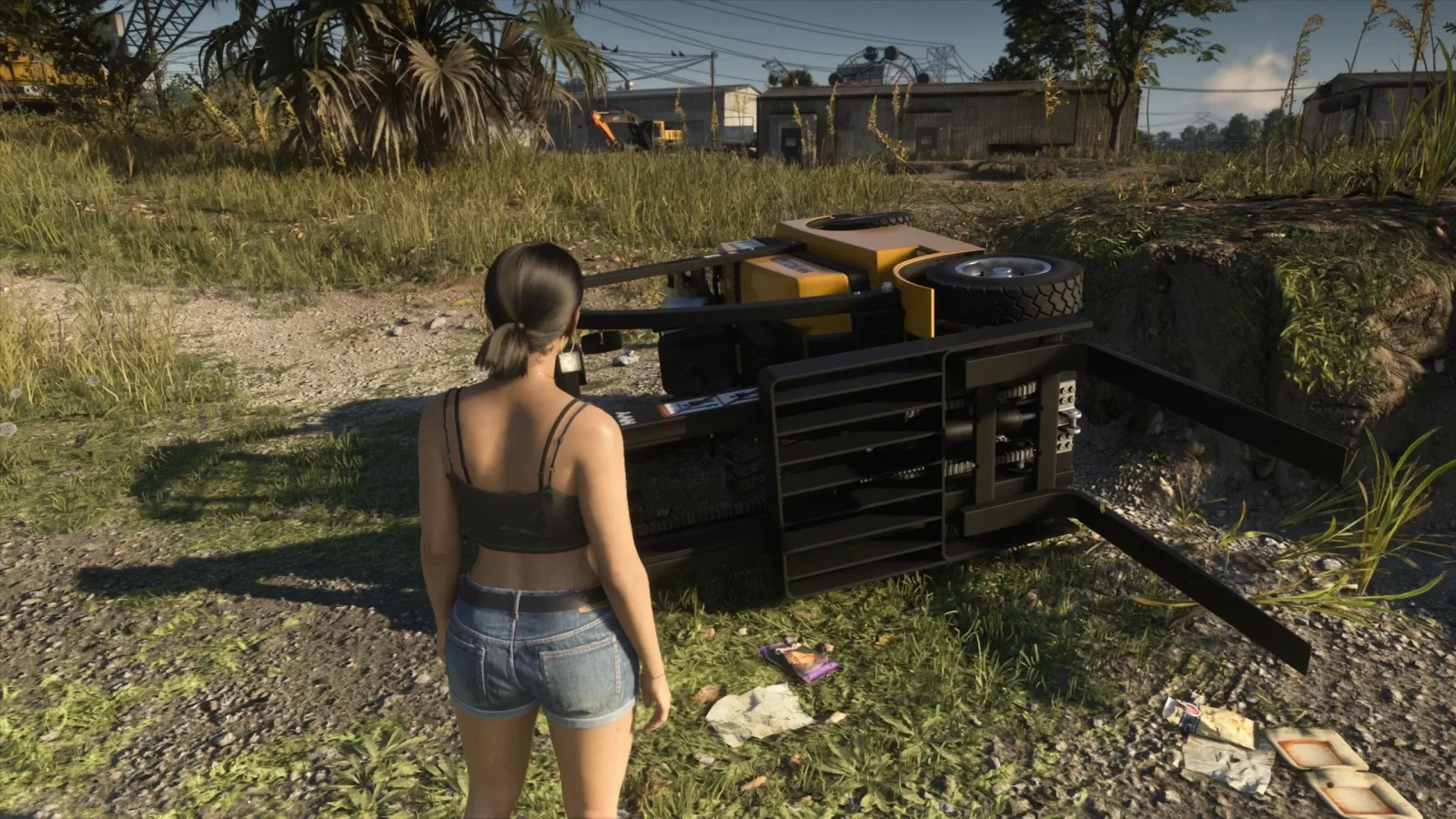
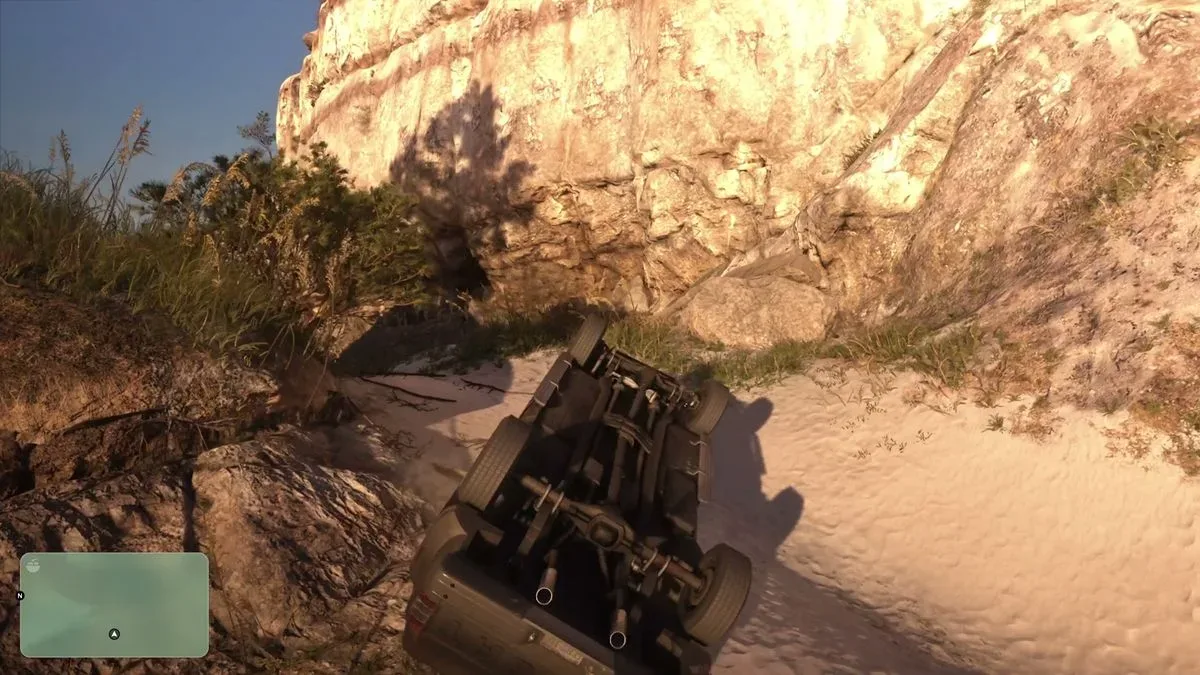
Crashing hard enough to leave a vehicle upside down is one of the most familiar disasters in Grand Theft Auto. It can happen after clipping a kerb at speed, landing badly from a jump, getting shoved during a chase, or simply taking a corner with far more enthusiasm than control. In GTA 6, an overturned car does not necessarily mean that the vehicle has to be abandoned.
There is an on-foot method for flipping a car back onto its wheels. The game does not appear to put much emphasis on explaining the feature, but it can be extremely useful when a crash leaves Jason or Lucia staring at a vehicle resting on its roof. The same general interaction can also be used to move boats that have ended up stuck on land, making it a handy recovery option for both road and water travel.
How to flip an overturned car in GTA 6
To right a car that is lying on its roof or side, get out and walk up to the vehicle. Move directly into it as if the character is attempting to push it by hand. After a brief moment, Jason or Lucia should transition into a more deliberate animation that indicates they are bracing against the vehicle rather than merely walking into it.
Once that animation appears, use the indicated action button to perform the shove:
For useful background on this topic, read 10 Rare Game Console Editions That Became Collector Legends.
- PlayStation 5: Press Square.
- Xbox: Press X.
The action causes the character to exert enough force to shift or flip the vehicle. Positioning and the way the vehicle has landed may affect exactly how it moves, so it is worth approaching from the side that gives the car room to roll onto its wheels rather than toward an obstruction. If the first push does not fully resolve the situation, adjust your position and try again.
Wait for the pushing animation before pressing the button
The crucial part of the process is not simply running up to a wreck and pressing Square or X immediately. The character needs to be close enough and pushing into the vehicle long enough for the special interaction animation to activate. This visual change is the sign that the game recognizes the player is attempting to move the car.
That distinction matters because an overturned vehicle can be awkward to approach. A car on its roof may have exposed wheels, damaged panels, doors facing the wrong direction, or be wedged against scenery. Walking into a clear section of the bodywork and giving the character a moment to settle into the pushing stance is the most reliable approach.
It is also sensible to consider where the car will go once it starts moving. A flipped vehicle near traffic, a wall, deep water, a slope, or a busy road can create a second problem as soon as it is upright. If possible, work from the side that will guide it toward open ground. The technique is a recovery tool, but it does not make the immediate surroundings any safer.
The same interaction can move grounded boats
The vehicle-pushing mechanic is not limited to cars. It can also be used when a boat has become stranded on land. If a vessel has been beached too far from the shoreline or driven onto a shallow bank, walk into it until the character adopts the pushing animation, then press Square on PS5 or X on Xbox.
Instead of flipping the boat over, the interaction lets Jason or Lucia shove it. This can be enough to slide the vessel closer to the water and restore it to a usable position. As with a car, the best results should come from pushing in a direction with a clear path. Trying to force a boat through an obstacle, further uphill, or across rough terrain is unlikely to be as helpful as lining it up with the nearest accessible water.
This shared functionality gives players a useful answer to two different kinds of mishap. Cars can be recovered after a spectacular rollover, while boats can be nudged back into the water after an overly ambitious landing. It is a small feature, but one that can save time in a game where vehicles are central to getting around.
Car flipping does not repair crash damage
Getting a vehicle back onto its wheels is not the same as restoring it to perfect condition. The flip action only changes the vehicle's position. Any damage sustained during the incident remains. A car that tumbled down an embankment, hit multiple objects, or landed from a major jump may still have impaired performance or visible damage after it has been righted.
That means drivers should not assume an upright car is automatically ready for a long, high-speed escape. If the vehicle was badly damaged before or during the rollover, it may still need to be repaired through the game's relevant vehicle-repair options. Flipping solves the immediate issue of being unable to drive because the wheels are in the air; it does not erase the consequences of the crash.
There is an important practical benefit nonetheless. A damaged but drivable vehicle can still be preferable to abandoning it, especially when it is the only transport nearby, when a mission objective is some distance away, or when players want to keep a specific vehicle. The mechanic provides a chance to continue rather than forcing an instant change of plans.
Why this mechanic is useful during free roam and missions
Grand Theft Auto driving is often unpredictable by design. Dense streets, sudden police pursuits, destructible roadside clutter, uneven ground, ramps, and other drivers all create situations where a normal journey can turn into a rollover. A car-flipping option reduces the frustration of losing a vehicle to a single awkward collision.
It is particularly valuable in places where finding a replacement quickly is inconvenient. A rural road, an isolated stretch of coastline, or an area far from regular traffic can leave a player with few easy alternatives. Being able to right the existing vehicle may keep momentum going, whether the goal is to reach an objective, escape danger, explore the map, or return to a safer location.
The boat application has similar value. Watercraft are useful for crossing channels and reaching coastal areas, but they can be easy to ground if the shoreline is approached too aggressively. Rather than treating every bad landing as the end of the trip, players can attempt to push the boat free and continue on the water.
Quick GTA 6 vehicle recovery checklist
- Exit the overturned car or approach the stranded boat on foot.
- Walk directly into the vehicle as though trying to push it.
- Wait until Jason or Lucia visibly changes into the dedicated pushing or flipping animation.
- Press Square on PS5 or X on Xbox.
- Reposition if necessary, particularly if the vehicle is blocked or moves in an unhelpful direction.
- Check the vehicle afterward, since the interaction does not remove collision damage.
Do Jason and Lucia need to train before flipping vehicles?
The maneuver appears to work without requiring extensive gym training or a particular level of physical development. Despite the impressive amount of force involved in turning over a car or shoving a boat, the interaction functions as a broadly available recovery action rather than something reserved for characters who have spent significant time working out.
That makes it worth remembering from the beginning of a playthrough. There is no need to write off every overturned vehicle as a loss, and there is no need to wait until later character progression to test the mechanic. If a crash leaves the car upside down, get out, find a workable side to push from, wait for the correct animation, and use the platform-specific action button.
In short, the GTA 6 car flip method is straightforward: approach the overturned vehicle on foot, push into it until the interaction animation begins, then press Square on PS5 or X on Xbox. The same process can shift a grounded boat toward the water. It will not repair a battered ride, but it can turn a seemingly ruined journey into a recoverable setback.

Community
Discussion
Start the conversation.
No comments have been posted yet.