

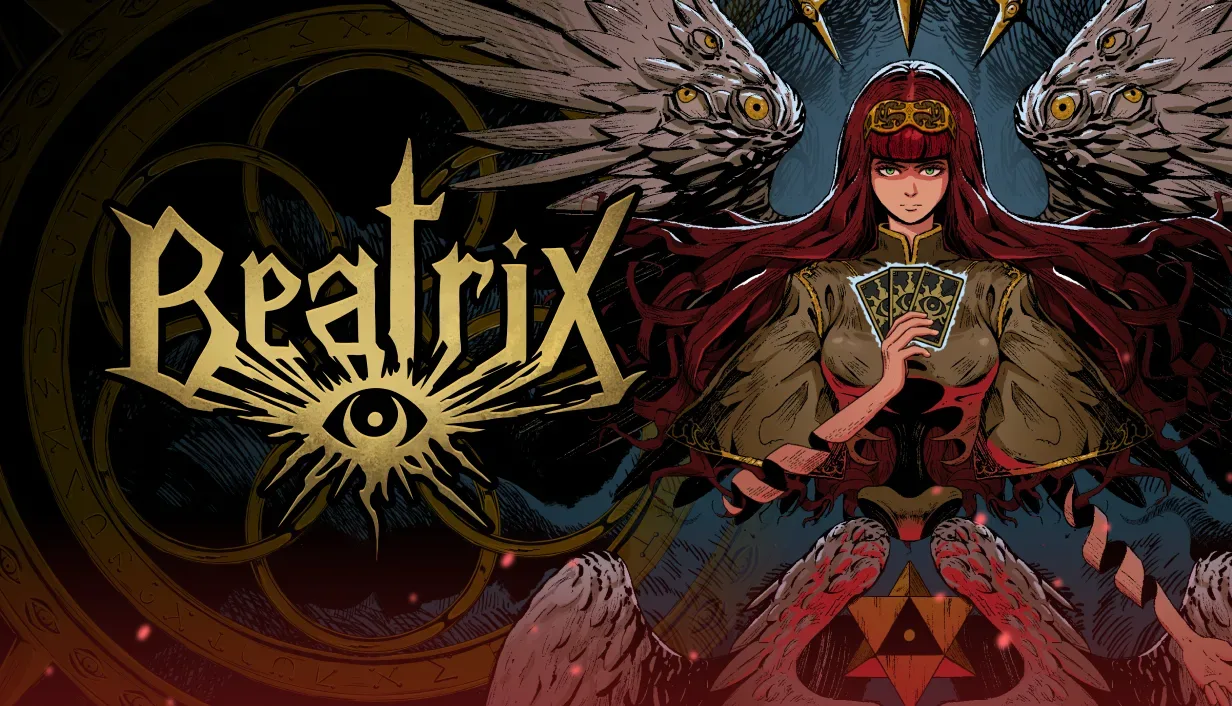
Tambù Digital has released an updated demo for Beatrix, giving Steam players a revised look at its dark fantasy roguelite board-building formula during Steam Next Fest. The event runs from October 19 through October 26, 2026, and the new demo is available now for PC players on Steam.
The update concentrates on the practical parts of a demo experience: helping new players understand the game sooner, making runs flow more smoothly, improving the clarity of the interface, and refining combat. It also includes performance work, audio improvements, and a selection of fixes. For a game built around several interacting systems--cards, a grid-based board, shifting ownership of enemy pieces, and powerful field effects--those changes could be especially important to how quickly players can grasp what makes Beatrix distinct.
Beatrix is described as a dark fantasy roguelite board-builder. Rather than presenting card combat as a separate, fixed battlefield, it asks players to build and manipulate the play space itself. Positioning appears to be central to decision-making, with cards occupying a grid and the state of that grid affecting which plays are possible, desirable, or dangerous.
A card game where the board is part of the deckbuilding puzzle
At the heart of Beatrix is an approach that combines card-based combat with direct control over the battlefield. That premise puts it in a potentially interesting space between traditional deck-driven roguelites and tactical board games. A card is not simply an effect to play and discard; its location and relationship to surrounding pieces can matter just as much as its immediate combat value.
For useful background on this topic, read FLING UP TOGETHER Demo Climbs Into Steam Next Fest With Proximity Voice Chat.
One of the game's defining mechanics lets players convert enemy cards to their side by surrounding them on the grid. This makes the board a contest for territory as well as a place to deploy attacks or defenses. An enemy card may represent a threat in one moment, then become an opportunity if the player can create the right formation around it.
That conversion concept has the potential to change the usual priorities of card combat. Removing an opposing card is often the obvious goal in strategy games, but Beatrix's rules encourage players to consider whether an enemy might be more valuable captured than destroyed. The answer can depend on open spaces, available cards, the layout of the board, and whatever broader rules are active during the encounter.
The game also features effects known as Canons, powerful field effects that alter the rules of play. The stated role of Canons is not merely to add damage or another stat modifier. They can reshape the tactical conditions of a battle, creating new strategic openings and forcing players to reassess familiar decisions. In a game already centered on spatial arrangements, effects that change the rules of the field could make individual encounters feel meaningfully different from one another.
That combination--cards, board construction, encirclement, conversion, and rule-changing effects--is an ambitious pitch for a roguelite. It also explains why onboarding is such a major target of the updated demo. Systems can be deep without being immediately understandable, and a public demo needs to teach its core language efficiently before it can show off the satisfying decisions that language enables.
The updated demo puts accessibility first
The most prominent additions in this version are an improved onboarding experience and a revised tutorial. Tambù Digital has framed the update around accessibility and polish, with the aim of making Beatrix easier to enter without losing the tactical identity at its center.
For players trying the game for the first time during Steam Next Fest, a stronger tutorial could make a substantial difference. Beatrix does not rely on only one familiar genre convention. Players will need to understand how card combat works alongside the grid, how surrounding an opponent changes ownership, and how Canons affect the battlefield. Presenting those ideas in a clear order is likely to be crucial, especially when an early misunderstanding can make a strategic game seem harsher or more opaque than intended.
An improved onboarding process is also useful for returning players. Someone who sampled an earlier build but struggled to find the rhythm of a run may discover that the revised introduction better communicates which decisions matter most. In roguelites, the appeal often comes from seeing how short-term choices connect across a run. If the opening minutes establish that connection more effectively, players have a better chance to engage with the larger systems rather than treating each battle as an isolated puzzle.
The announcement does not detail every tutorial change, nor does it lay out specific new lessons or interface prompts. Still, the emphasis is clear: this demo is intended to be a more approachable representation of Beatrix than prior versions.
Progression and battle refinements target run flow
Beyond the tutorial, the updated demo revises progression in an effort to improve the flow of a run. Roguelite progression has to balance momentum and experimentation. Players need meaningful choices and a sense that their strategy is developing, but they also need to understand why a run is getting stronger, weaker, or more complicated over time.
For Beatrix, progression is particularly tied to the question of how players engage with the board. The ability to take enemy cards by surrounding them suggests that power may not be defined solely by building a stronger collection of cards. It may also come from learning to read positions, create advantageous shapes, and turn hostile elements into resources. Better progression flow could help players recognize those evolving possibilities more naturally.
The demo also includes battle updates and fixes. No full breakdown of individual combat adjustments has been provided, so players should not assume specific balance changes, new encounters, or reworked card effects beyond what has been announced. However, combat refinements are meaningful in a strategy-focused roguelite because small issues can affect the reliability of a turn, the readability of the board, and confidence in the game's rules.
A polished battle system does more than eliminate bugs. It helps players understand the consequences of a choice. When a game asks someone to make spatial decisions under changing conditions, feedback needs to be consistent and comprehensible. The new demo's combined focus on battle work, interface updates, and tutorial improvements suggests an effort to strengthen that foundation.
Interface, performance and audio receive attention
Tambù Digital's update includes numerous user-interface refinements, performance optimizations, and audio improvements. These are often the least flashy parts of a demo update, but they can have an outsized effect on a game such as Beatrix.
Interface clarity matters whenever a screen contains cards, a grid, enemy positions, player-controlled units, and field-wide effects. Players need to be able to parse the board quickly enough to make deliberate plans. If information is difficult to read or actions are awkward to follow, the intended strategy can become obscured. Refinements to the UI should therefore support both accessibility for newcomers and faster decision-making for people beginning to understand the game's systems.
Performance work is equally welcome during a limited-time festival demo. Steam Next Fest is an opportunity for games to make a first impression with a wide audience, and technical stability affects whether players stay long enough to reach the more interesting parts of a run. The announcement does not provide technical benchmarks or system requirements changes, but it confirms that optimization has been part of this demo pass.
Audio improvements round out the update. Sound can be an important part of communicating action and impact in turn-based or card-driven combat, where the player may spend considerable time reading, planning, and watching the board change. Improved audio can make those shifts easier to follow while also helping reinforce Beatrix's dark fantasy atmosphere.
What Steam Next Fest players can try now
The revised Beatrix demo is available on Steam during Steam Next Fest, which runs from October 19 to October 26, 2026. The event window gives interested PC players a chance to try the current build, see how the board-builder concept feels in practice, and assess the new tutorial and run-flow changes for themselves.
Steam Next Fest is especially well suited to a game like Beatrix because its central ideas are easier to understand through play than through a brief genre label. "Roguelite board-builder" communicates the broad direction, but the appeal rests in the interaction between card choices and positioning: deciding when to surround an enemy, when to reshape the board, and how a Canon might transform the rules of an encounter.
Players who are interested but do not have time to play during the event can also add Beatrix to their Steam wishlist to follow development and receive future updates. Tambù Digital has not announced a release date, pricing, or platforms beyond the Steam demo in this update.
For now, the key news is a more refined entry point for a game with an unusual tactical hook. Beatrix is not simply asking players to assemble a powerful hand. It is asking them to treat the battlefield as something they can construct, contest, and ultimately bend to their strategy.
Community
Discussion
Start the conversation.
No comments have been posted yet.