

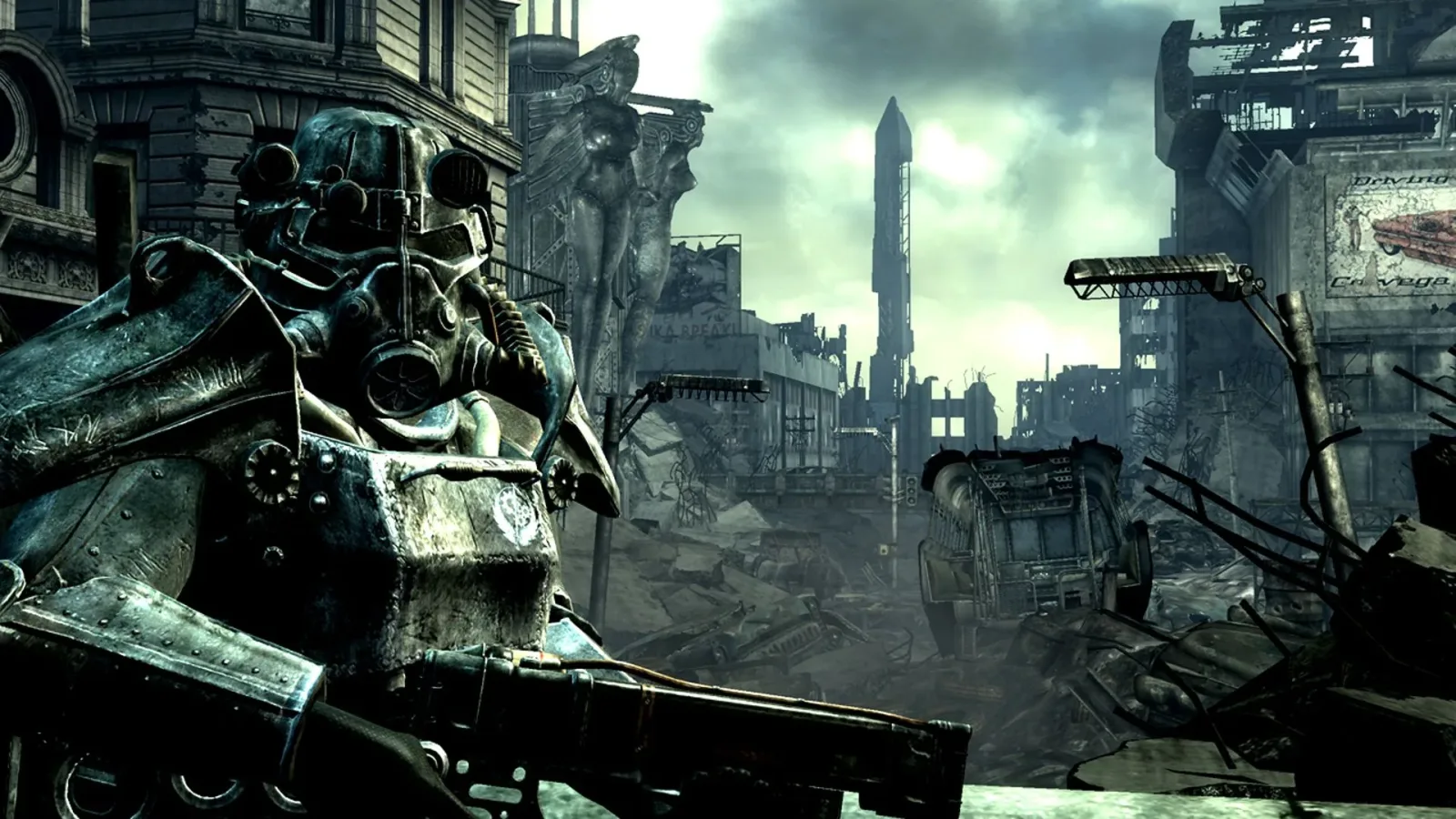
It can be easy to look back at Fallout 3 as the moment the series successfully returned to the spotlight in a radically different form. Bethesda's 2008 role-playing game introduced the post-nuclear setting to a far broader audience, shifted the series into a first-person open-world format, and helped establish Fallout as one of gaming's biggest modern RPG brands.
But before players set foot in the Capital Wasteland, Bethesda had to contend with a substantial amount of skepticism. Long-time Bethesda developer Bruce Nesmith, who worked as a quest designer on Fallout 3 and also contributed to Fallout and The Elder Scrolls projects including Skyrim, has recalled the intensity of the initial response when Bethesda acquired the Fallout license.
Speaking with The Examined Game, Nesmith said a vocal part of the fanbase did not think Bethesda was the right studio to continue the series. Many players instead hoped that Obsidian Entertainment would take on the project, with concerns centering on whether Bethesda's established open-world design sensibilities could preserve what people valued in the earlier Fallout games.
Rather than making the team second-guess the project, Nesmith said the pushback helped create a determination inside Bethesda to demonstrate that its approach could work. The goal, as he described it, was simple: make the strongest game possible and allow the result to answer the criticism.
For useful background on this topic, read Tyrian Returns to the Browser, Bringing a 1995 DOS Shooter Back Into Action.
A Franchise With a Very Different Past
The anxiety around Fallout 3 was understandable in the context of the franchise's history. The original Fallout arrived in 1997 as an isometric, turn-based computer RPG, followed by Fallout 2 in 1998. Those games built their identity around player choice, dark comedy, reactive quests, skill checks, and a harsh retro-futurist world shaped by the aftermath of nuclear war.
The series then spent years in an uncertain position. Fallout Tactics: Brotherhood of Steel and Fallout: Brotherhood of Steel took the property in different directions, while a planned project known as Van Buren never reached release. For fans attached to the first two mainline games, the prospect of a new Fallout was exciting--but it also came with worry that the series could lose its personality.
Bethesda, meanwhile, was already closely associated with enormous first-person fantasy role-playing games. The Elder Scrolls IV: Oblivion, released in 2006, was a major success and had defined expectations around the studio's approach: broad exploration, open-ended discovery, real-time first-person action, environmental storytelling, and a vast number of optional activities.
For some Fallout followers, that was precisely the concern. Nesmith recalled that detractors feared Bethesda would simply apply an Oblivion-like structure to a world that demanded something more faithful to the older games. The criticism was not quiet, either. He described a strong and highly vocal community that believed Bethesda should not have been entrusted with Fallout at all.
Why Obsidian Was the Preferred Choice for Some Fans
Obsidian's reputation made it a natural candidate in the eyes of many RPG fans. The studio had released Star Wars: Knights of the Old Republic II: The Sith Lords in 2004, demonstrating its ability to work with a beloved science-fiction setting and create morally complicated choices, character-driven writing, and layered role-playing systems.
There was also an important connection between Obsidian and Fallout's legacy. Obsidian included developers with roots in Black Isle Studios, the studio behind the first Fallout games. As a result, fans who wanted a continuation that felt especially close to Fallout 2's design philosophy saw Obsidian as a particularly appealing fit.
That preference did not mean Bethesda was unaware of Fallout's foundations. The challenge was how to translate a series built around a top-down presentation and turn-based combat into a fully explorable 3D wasteland without abandoning its thematic core. Fallout 3 would need to retain the setting's distinctive tone while giving players a format that felt at home alongside contemporary open-world RPGs.
Its answer included the Vault-Tec Assisted Targeting System, or V.A.T.S., which slowed combat and allowed players to target individual body parts. The feature was a clear effort to bring some tactical decision-making into a real-time shooter framework. Fallout 3 also used dialogue choices, Karma, skills, perks, factional tensions, branching quest outcomes, and environmental stories scattered across the ruins of Washington, D.C.
The game was not a direct recreation of the first two Fallout titles, and it was never meant to be. Its structure, camera perspective, combat, and scale represented a major evolution. That distinction was at the center of the pre-release debate.
"Make the Best Game You Can Make"
Nesmith said Bethesda's response to the criticism was not to engage endlessly with arguments about which studio should have made Fallout 3. In his view, there was little chance of persuading people who had already decided that Fallout 2 represented the series' untouchable high point.
That position still exists within the Fallout community. For some fans, Fallout 2 remains the defining entry because of its dense role-playing mechanics, extensive reactivity, and particular style of humor. There is no single version of Fallout that satisfies every audience, especially in a franchise that has changed substantially across nearly three decades.
Instead of attempting to win every debate, Bethesda concentrated on development. Nesmith said the internal feeling was that the team had to prove the doubters wrong. He believes Fallout 3 ultimately did just that, gaining acceptance from many players who had approached it with serious reservations.
Fallout 3's eventual reception certainly established that Bethesda's reinvention had found an enormous audience. The game became a landmark release for the studio and helped make the Fallout universe accessible to players who may never have experienced the earlier PC-focused entries. The lonely trips through the Capital Wasteland, the opening hours inside Vault 101, the radio stations, the mutated creatures, and the freedom to wander in almost any direction all became defining elements of its identity.
At the same time, the discussion around what Fallout should be did not disappear. If anything, Fallout 3 expanded it. Fans could now compare not only different stories or settings, but distinct philosophies of RPG design: tightly reactive quest writing, systemic open-world exploration, tactical combat, first-person immersion, authored companions, survival elements, and the balance between player freedom and narrative consequence.
New Vegas Became the Next Chapter in the Debate
The story took an especially interesting turn in 2010, when Obsidian released Fallout: New Vegas. Built using the technological foundation established by Fallout 3, New Vegas brought Obsidian's writing and role-playing approach to Bethesda's first-person Fallout format.
The result gave players a direct example of how different creative teams could interpret the same broad framework. New Vegas emphasized competing factions, reputation systems, consequential dialogue, multiple resolutions, and a Mojave setting shaped by political conflict. It developed a passionate following and remains central to conversations about the series' identity.
Rather than proving that one approach had to replace the other, Fallout 3 and New Vegas showed that the franchise could support contrasting priorities. Bethesda had demonstrated that Fallout could thrive as a vast exploration-driven 3D RPG. Obsidian then showed how that framework could be paired with an especially dense focus on factional choices and narrative reactivity.
Bethesda returned with Fallout 4 in 2015, again evolving its own version of the formula. The future of Fallout 5 remains unannounced, leaving fans to speculate about where the next numbered entry may take the wasteland and which lessons it may draw from the games that came before it.
Fallout's Long-Running Identity Question
There is also continued interest in what Obsidian may do next in the Fallout universe. For now, the wider future of the series remains uncertain, and enthusiasm around any possible new project reflects just how enduring the Fallout 3-versus-New Vegas conversation has become.
Bethesda has separately confirmed that a new cat-themed, Fallout-inspired adventure is in development following leaks connected to the Australian Classifications Board. Beyond that confirmation, players will need to wait for further details.
Nesmith's recollection is a useful reminder that the biggest franchises are rarely built without friction. Fallout 3 arrived under the weight of enormous expectations from people who loved a very different kind of RPG. Bethesda could not make every skeptic prefer its interpretation, but it made a game that earned its own place in the series' history.
That may be the lasting significance of the period. Fallout's community has never been defined by one unanimous vision, and that diversity of opinion has often made discussion heated. Yet the franchise's ability to accommodate radically different games--from Fallout 2 to Fallout 3, New Vegas, and Fallout 4--is also a major reason it continues to inspire such strong feelings.
Community
Discussion
Start the conversation.
No comments have been posted yet.