

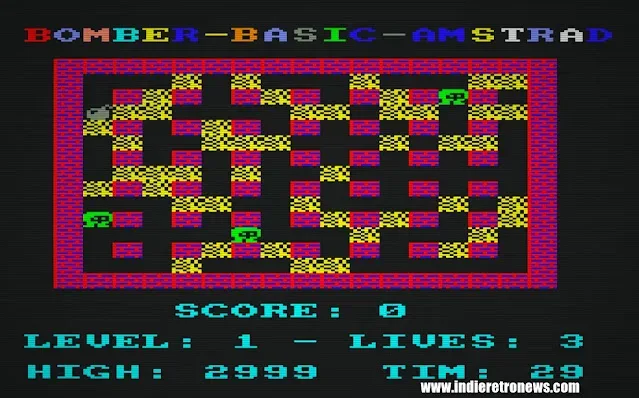
Bomber Basic Amstrad is a remarkably compact new Amstrad CPC game from Altanerus Dog that takes familiar bomb-maze ideas and rebuilds them entirely in Locomotive BASIC. Measuring just 6.3KB, the project is designed as a playful proof of concept, but it is also a complete challenge with nine levels, escalating time pressure, three lives, and a proper ending.
The game draws clear inspiration from Hudson Soft's landmark 1983 maze-bombing game Bomberman, though its tiny footprint and BASIC-based construction give it a character of its own. Rather than attempting to compete with faster, more elaborate versions of the formula, Bomber Basic Amstrad turns its technical restrictions into part of the experience. The action is intentionally measured, positioning, route planning, and memory as the core skills needed to survive.
For Amstrad CPC enthusiasts, the release is as much a demonstration of what can be accomplished under strict constraints as it is a compact retro game. It asks players to escape an underground bomb factory while balancing enemy threats, maze layouts, disappearing explosives, and countdown timers that become less forgiving as progress is made.
A breakout from an underground bomb factory
Bomber Basic Amstrad puts players in control of a self-aware robot attempting a desperate escape from an underground bomb factory. The robot has an unlimited supply of bombs, but that does not make the journey easy. It has only three lives to spend, and every maze requires careful movement through a grid-like arena while factory guards patrol the area.
For useful background on this topic, read Silent Wounds: The Doll Brings a Free Psychological Horror Episode to Steam This October.
The immediate objective is to eliminate those guards and stay alive long enough to advance. As in the genre that inspired it, placing a bomb is never a consequence-free attack. Explosions are dangerous to enemies, but they are equally dangerous to the player. A poorly timed retreat, a blocked corridor, or a bomb placed one square too close can bring a run to an abrupt end.
That basic push and pull gives the game its tension. Players need to get close enough to influence guard movement, find a safe route away from the blast, and avoid leaving themselves boxed into a corner. The mazes create the conditions for ambushes, but they also make every escape path important. Clearing a guard is not simply a matter of dropping an explosive; it is about understanding where the enemy can go and where the player can go after committing to the blast.
The disappearing-bomb twist changes every decision
The project's most notable mechanical wrinkle is what happens immediately after a bomb is placed. A dropped explosive acts as a physical obstacle, allowing it to block routes and potentially trap a pursuing guard. However, the bomb then disappears from view. It remains active, but players must remember exactly where it was placed until it detonates three seconds later.
For another perspective on this story, read Bomber Basic Amstrad Turns a 6.3KB Locomotive BASIC Experiment Into a Nine-Level Escape.
This transforms a familiar action mechanic into a small memory test. In a conventional bomb maze, the visual presence of an explosive continually communicates its location and the danger it represents. Here, that information is removed almost at once. The player has to track the invisible bomb mentally while still watching guards, reading the maze, and planning their own movement.
The result is a tactical tool that can be especially useful in narrow passages. A bomb can close off a route behind an enemy, help guide a guard into a worse position, or prevent the player from accidentally taking a particular turn. But using it effectively means recalling the bomb's position and accounting for the coming detonation. Forgetting where it sits can be fatal, especially once the timer is running down and there is pressure to move quickly.
That idea also gives Bomber Basic Amstrad an unusual rhythm. The pace may be slower than later action-heavy games built around the same broad concept, but the slower movement leaves room for uncertainty. A player may know that a bomb is somewhere nearby while losing track of its exact tile, creating a brief moment of panic before its three-second fuse runs out.
Built entirely in Locomotive BASIC
One of the most striking details about Bomber Basic Amstrad is that it was created in 100% Locomotive BASIC, the programming language closely associated with the Amstrad CPC. The entire game fits into 6.3KB, an extraordinarily lean size for a multi-level maze game with enemy encounters and an ending.
The use of traditional two-dimensional arrays and numerous code loops is central to the game's design. Those choices contribute to the deliberately slow-paced action, rather than the rapid movement often associated with more technically advanced bomb-dropping games. Yet the release does not present that speed as a flaw to be hidden. It embraces the pace as part of an old-school design exercise, where the player has time to think but cannot afford to become careless.
For anyone interested in programming on vintage machines, the game offers a tangible reminder that limitations can produce distinctive mechanics. Low memory budgets force economy. BASIC loops can shape the tempo. A restricted display and simple grid can make spatial clarity more important than spectacle. Bomber Basic Amstrad is small enough to underline all of those points while still providing a playable structure with progression.
There is a long tradition of retro development projects that revisit famous game concepts on original hardware, often using period-appropriate tools. What makes this one stand out is its emphasis on compactness and simplicity. It is not presented as a sprawling reinterpretation. Instead, it focuses on one recognizable loop--move, place bombs, evade blasts, eliminate threats--and sees how much personality can emerge from that loop within a very small BASIC program.
Nine levels and a tightening countdown
Despite its modest size, Bomber Basic Amstrad includes nine distinct levels and an ending. That gives the game more structure than a single-screen experiment or a technical demo. The factory escape has a destination, and its challenge changes as players push further into the level sequence.
An increasingly strict countdown timer is one of the main ways the pressure rises. Early on, a more relaxed pace may allow players to learn the interaction between maze walls, guards, invisible bombs, and blast timing. Later, the timer demands more decisive play. Spending too long attempting to set up the perfect trap may be as dangerous as rushing into an explosion.
This gradual tightening is well suited to the game's underlying systems. Since bombs can become temporary barriers, players are encouraged to think ahead instead of treating each encounter as a reflex test. The timer complicates that approach by making over-planning risky. Success requires a balance between caution and commitment: enough preparation to avoid being caught in a blast, but enough urgency to finish the job before time runs out.
The three-life limit reinforces the stakes. Infinite bombs might suggest unlimited freedom, but lives remain scarce. Every mistake matters, and every later level places greater value on knowing the maze, judging the fuse, and preserving a safe line of retreat. The ending provides an additional reason to keep learning those systems rather than treating each stage as an isolated score-chasing round.
A retro project that makes limitations part of the fun
Bomber Basic Amstrad will likely appeal to different audiences for different reasons. Players who enjoy Amstrad CPC software can appreciate a new game made specifically around the machine's historical environment. Fans of grid-based bomb games may find the invisible-explosive mechanic an interesting variation on a well-established formula. Meanwhile, hobbyist coders can view the 6.3KB program as an example of disciplined design under extreme constraints.
Its appeal is not based on speed, visual excess, or a large list of features. The draw is the way a minimal set of systems interacts. The player moves through a maze. Guards need to be removed. Bombs explode after a short delay. Those bombs can alter movement before they explode, then vanish from view and become hazards that must be remembered. Add a timer, limited lives, nine levels, and an escape narrative, and the result is a surprisingly complete game loop.
That is the kind of design lesson vintage platforms continue to offer. Technical limitations can force creators to identify the one or two ideas that deserve the most attention. In Bomber Basic Amstrad, the central idea is not merely dropping bombs. It is handling information that the game deliberately takes away from the player. The bomb is placed, its location is no longer displayed, and the player must live with the decision.
Altanerus Dog's release therefore lands as both a nostalgic tribute and a compact experiment in tension. It honors the broad language of classic bomb-maze action while finding a new hook in its implementation. With nine levels to clear and an ending waiting beyond the factory, Bomber Basic Amstrad demonstrates that a few kilobytes of Locomotive BASIC can still create a meaningful challenge on the Amstrad CPC.
Community
Discussion
Start the conversation.
No comments have been posted yet.