

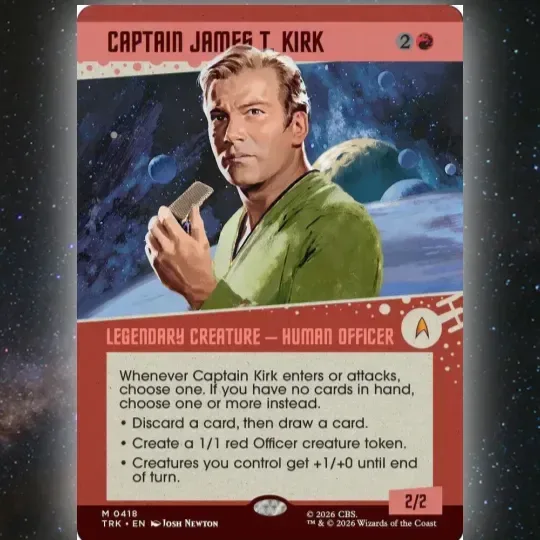
Magic: The Gathering's upcoming Star Trek crossover is giving fans of both franchises plenty to examine before the cards arrive later in November, and author Brandon Sanderson has already found one design that he believes captures its character exceptionally well. During a recent episode of his podcast with co-host Dan Wells, Sanderson singled out a mono-red Captain James T. Kirk card based on William Shatner's portrayal in the original Star Trek television series.
Sanderson and Wells agreed that the card is, in Sanderson's words, "a perfect Kirk." The praise was not simply about the character art or the novelty of seeing the Enterprise captain in a Magic set. Sanderson focused on the way the card's abilities translate Kirk's defining traits into tabletop mechanics: improvisation under pressure, inspiring a crew, and somehow finding an answer when a situation looks impossible.
That is exactly the kind of character-to-rules translation that can determine whether a Universes Beyond card feels like a clever crossover collectible or an authentic adaptation of its subject. In Kirk's case, Sanderson sees a card that understands why the character has endured for decades.
A Captain Who Creates Options
Sanderson described the Kirk design as especially smart because it supports players who are out of resources. As he explained, the card can draw a card and can also let its controller discard a card before drawing again. The result is a commander who can provide something to work with when a player has nothing in hand, while also helping improve an existing hand when the available cards are not useful.
For useful background on this topic, read GameStop Begins Reopening Previously Closed Stores With Ohio Location.
For Sanderson, that flexibility is the heart of the character. Kirk is remembered as a captain who confronts no-win scenarios, impossible choices, hostile alien civilizations, malfunctioning technology, and threats that often appear far beyond the Enterprise crew's ability to handle. The card's ability to offer options in a depleted position turns that narrative identity into a familiar Magic gameplay moment: the player is behind, resources are scarce, and one draw or one new line of play might change everything.
"If you have no options, he gives you them," Sanderson said, describing the card's draw and discard effects. He added that Kirk "solves the unsolvable problems, he makes a red shirt, and he buffs your team with a rousing speech."
Those additional elements are important to the overall flavor. The reference to making a red shirt reflects one of the longest-running jokes associated with the original series, in which security personnel wearing red uniforms were often put in danger during away missions. Meanwhile, the team-wide boost evokes Kirk's role as an inspirational leader. Magic regularly represents leadership through effects that improve a player's creatures, and it is easy to see why a boost driven by a rousing speech would fit the captain of the Enterprise.
In short, the card reportedly combines card advantage, hand filtering, token creation, and support for a wider board. That may sound like a lot for one legendary character, but Sanderson's reaction suggests that the design is unified by a clear idea rather than being a random pile of references. Kirk is not just depicted as a famous face with generic red abilities. The mechanics appear designed around his specific approach to command.
Why Mono-Red Fits James T. Kirk
Magic's five colors are often used as shorthand for values, tactics, and personality traits. Mono-red characters tend to be impulsive, emotional, daring, energetic, and willing to act immediately rather than wait for a perfect plan. That does not mean every red character is reckless, but it does mean the color has a natural connection to risk-taking and decisive action.
Kirk has frequently been interpreted through that lens. He is a captain who can be bold to the point of seeming foolhardy, particularly when the people under his command are in danger. But his daring is usually paired with confidence, charisma, and a refusal to accept that the rules of a crisis have already been written. The reported Kirk card's ability to generate choices when a player is empty-handed is therefore a strong thematic match for red's desire to act, adapt, and press forward.
It also helps differentiate this version of Kirk from the broader Federation setting. Star Trek as a whole has obvious thematic ties to white and blue mana: cooperation, diplomacy, organization, science, long-term planning, and intellectual curiosity are central to the franchise. A mono-red Kirk can emphasize the individual captain's more forceful and instinctive qualities without claiming that those qualities define every part of Starfleet.
That distinction may be one reason the card made such an impression. Crossovers are at their best when they can narrow in on what makes an individual character distinct, rather than relying only on broad franchise associations. A set may contain the Federation, Klingons, starships, iconic planets, and alien species, but Kirk needs to feel different from Spock, Uhura, McCoy, Picard, or any other captain who could eventually appear in the game.
A Base Set Version of the Original-Series Captain
The James T. Kirk card discussed by Sanderson is one of several versions of Shatner's original-series interpretation of the character. Importantly, it is described as a card that can be opened from the main set rather than an exclusive card tied to one of the preconstructed Commander decks available for preorder.
That distinction matters for collectors and players. Commander decks are frequently built around specific legendary characters and strategies, making them a direct route to particular cards. A base-set card, however, enters the normal booster ecosystem. Players may open it in packs, encounter it in drafts or sealed events depending on the set's formats, or seek it through the secondary market once the set is available.
Its exact rarity and eventual availability were not established in the discussion. Since the Star Trek Magic sets are not due until later in November, there is still uncertainty around how commonly this particular Kirk will appear. That means anyone interested in building around the card will need to wait for fuller set information and the final product breakdown before knowing the easiest way to acquire it.
Still, placing a prominent original-series Kirk in the base release makes sense. The character is among the most recognizable figures in the entire franchise, and a mechanically resonant version has the potential to appeal beyond dedicated Star Trek collectors. Red players, Commander brewers, and fans of legendary creatures that turn low-resource situations into opportunities could all find reasons to pay attention.
Sanderson's Interest Adds to Cosmere Crossover Talk
Sanderson's enthusiasm for the card naturally stands out because he has long spoken publicly about both Magic: The Gathering and Star Trek. The author's interest in games and adaptations has also led fans to wonder whether one of his own fictional settings could someday receive a Magic crossover.
No Cosmere or Stormlight Archive Universes Beyond release has been announced here, and the possibility remains speculation. However, there are reasons the idea continues to circulate among fans. Sanderson has an established relationship with Wizards of the Coast and previously exclusively previewed a card from Tarkir: Dragonstorm in March 2025. That does not confirm an adaptation of his fiction, but it demonstrates a degree of connection between the author and Magic's publisher.
There has also been fan discussion about a custom Stormlight Archive Magic set Sanderson created. His wider body of work is rich with material that lends itself to card-game adaptation, including distinct worlds, recognizable protagonists and antagonists, unusual magic systems, powerful artifacts, factions, creatures, and major conflicts. The Cosmere's scale would offer abundant material for legendary creatures, planes, enchantments, equipment, and mechanics built around its many forms of supernatural power.
Timing has made the question more interesting as well. An Apple TV adaptation is in development, while a large new Stormlight board game is expected to head to Kickstarter later this year. Those projects show continued expansion of Sanderson's work into other media and game formats. They do not establish that a Magic collaboration is coming, but they make the concept easier to imagine than it might have been years ago.
Universes Beyond Continues to Put Character Design Under the Microscope
Every Universes Beyond release invites scrutiny over how faithfully Magic can represent a licensed universe while still functioning as Magic. The strongest cards often do not need a paragraph of explanation to justify themselves. Their color identity, abilities, and play patterns immediately suggest something essential about the character or setting they depict.
The Kirk card described by Sanderson appears to aim for that clarity. A player who has no cards receives a chance to find a way out. A player with an unhelpful hand can exchange a card for a new possibility. The captain can produce a disposable crew member and rally the rest of the team. Those ideas connect directly to a pop-culture image of Kirk as an audacious problem-solver who leads from the front and refuses to concede defeat.
Of course, the full verdict on the design will depend on the finished card, its mana cost, its complete rules text, the environment around it, and how it actually performs in games. An ability can be flavorful on paper but awkward in practice, or it can become far stronger or weaker than early impressions suggest once players begin building decks. For now, though, Sanderson's response offers an encouraging early read on one of the set's signature characters.
With the Magic: The Gathering Star Trek release still ahead later in November, more reveals should provide a better picture of how the crossover handles its many eras, crews, and conflicts. For Sanderson, at least, Captain James T. Kirk has already set a high bar. The key to the card's appeal is not merely that it lets players put an iconic captain on the battlefield. It is that, when the game appears to leave its controller without an answer, Kirk gives them one.
Community
Discussion
Start the conversation.
No comments have been posted yet.