

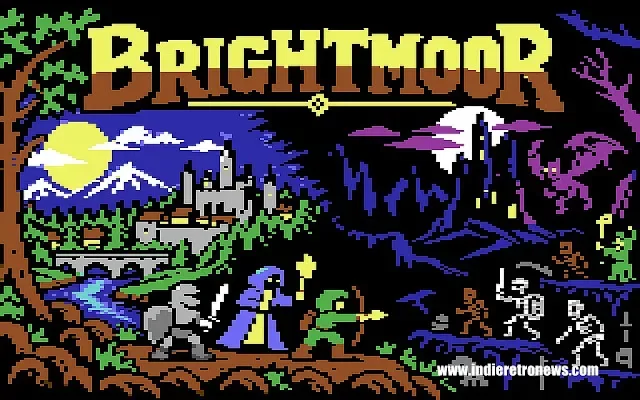
BRIGHTMOOR is a newly announced dark fantasy role-playing game for the Commodore 64, described as an Ultima-style adventure built in 6502 assembly. Created primarily by J5, the developer behind GloomKeep II, the game places players in a kingdom consumed by endless twilight and asks them to reclaim the daylight by confronting six sinister underground strongholds.
The project is built on the established GloomKeep II engine, but its premise reaches beyond a simple follow-up. BRIGHTMOOR centers on a once-protected realm whose fate changes when its ruler makes a disastrous agreement with an ancient presence buried beneath the land. King Mordran, frightened by his mortality, seeks escape through a bargain that instead destroys the order he was meant to preserve.
That decision silences the kingdom's dawn bell, an artifact or ritual tied to the arrival of morning. With the bell no longer sounding, the realm falls into permanent twilight. Mordran himself becomes the Hollow King, and the player takes on the role of the solitary hero willing to cross the blighted country and reverse the catastrophe.
A Classic Computer RPG Foundation
BRIGHTMOOR's Ultima-style description immediately suggests a game built around exploration, discovery, character-driven progression, and a world that needs to be navigated rather than simply conquered in a straight line. The Commodore 64 remains a particularly fitting home for that kind of design. Early computer role-playing games helped establish the pleasures of traveling through tile-based landscapes, speaking with inhabitants, uncovering dangerous locations, and gradually turning an overwhelming map into familiar territory.
For useful background on this topic, read Stupid Never Dies review: Punk-Rock Style Can't Save Its Sluggish Monster Mash.
The game's world is said to span 64 by 64 tiles. That provides a sizeable grid for a C64-era RPG and gives the central journey a useful sense of scale. A map of that size can accommodate settlements, hostile wilderness, landmarks, secrets, and meaningful routes between major objectives. It also makes the premise of restoring the light feel more substantial: this is not merely a hero clearing a few rooms near a castle, but a figure traveling across an entire afflicted kingdom.
What stands out most about BRIGHTMOOR's main destinations is their inversion of a familiar fantasy image. Rather than climbing towers that loom over the landscape, players must conquer six black towers called Gloomholds that descend into the earth. These are not sky-reaching monuments of power. They are inverted structures that burrow downward, turning each major objective into a descent toward the ancient darkness connected to Mordran's bargain.
That concept gives the game a strong visual and thematic identity. Towers traditionally offer visibility, distance, and elevation; BRIGHTMOOR's Gloomholds instead imply confinement, burial, and corruption hidden beneath the surface. The goal is still grand and heroic--overcome six major bastions--but the direction of travel reinforces the game's bleak atmosphere. Progress toward the restoration of dawn begins by moving deeper into the world's shadow.
The Hollow King and a World Without Dawn
BRIGHTMOOR's story begins with King Mordran's fear of death. His attempt to escape mortality leads him to an ancient force sleeping under the earth, and the agreement he reaches with it has consequences for everyone in the kingdom. The protective dawn bell falls quiet, twilight becomes permanent, and the king transforms into the Hollow King.
It is a classic dark-fantasy setup with a personal flaw at its center. The disaster is not presented as an accident of nature or an invasion without a face. It begins with a ruler's desperation and a choice made in pursuit of eternal life. That gives the hero's quest a political and emotional dimension alongside its monster-filled adventure structure. The kingdom's darkness is tied directly to the person who should have protected it.
The silent bell is also an effective focal point for the setting. Bells can represent warning, ritual, community, or the passage of time. In BRIGHTMOOR, the dawn bell is specifically associated with the kingdom's protection and the return of daylight. Its silence marks a break in the natural rhythm of the world. Morning is no longer something the people can expect, and the player's mission becomes an effort to restore not only a throne or a settlement, but the basic certainty that the sun will rise.
The six Gloomholds give that mission a clear long-term structure. Each conquered stronghold should represent a tangible step toward dismantling the darkness, while the larger 64-by-64 world offers the space between those milestones. For retro RPG players, that combination of broad travel and focused dungeon objectives is a familiar and appealing framework. It creates room for expedition planning while keeping the campaign's ultimate purpose visible.
Built in 6502 Assembly
J5 has developed BRIGHTMOOR from the ground up in 6502 assembly, using the robust engine previously created for GloomKeep II. The 6502 processor was central to many influential home computers and consoles, including the Commodore 64. Developing a new game at that level means working close to the machine's hardware and its constraints, a process that remains highly valued in the modern retro-development community.
Using an existing engine does not make BRIGHTMOOR a minor undertaking. An engine offers a technical foundation, but a role-playing game still needs its own world, progression, encounter design, art direction, music, and narrative context. BRIGHTMOOR is presented as a new game constructed on that foundation, with its own map, villain, core objective, and dark fantasy identity.
The project's credits identify J5 as responsible for most of the design, code, art, and music, with assistance from other developers and Claude. The stated use of AI assistance is part of the game's development background, while the creative project remains attributed primarily to J5. In an era when AI involvement can mean many different things, the available description is specific in presenting it as assistance within a wider development effort rather than replacing the credited creator's role.
For fans of new C64 software, the technical angle is inseparable from the appeal. Modern releases for the machine often balance nostalgia with the advantage of decades of accumulated coding knowledge, tools, and community experience. BRIGHTMOOR's assembly-built approach and reuse of the GloomKeep II technology suggest a project designed with the platform's particular strengths and limits in mind rather than a game merely styled to resemble the period from afar.
Tools, Music, and Art Contributions
Several additional tools and resources are acknowledged in the project's development. BRIGHTMOOR uses Krill's loader, while its music production credits include GoatTracker 2 by Cadaver. GoatTracker 2 is a well-known tool in Commodore 64 music creation, associated with the SID sound chip and the distinctive audio character that continues to define the platform for many players.
The project also credits Exomizer by Magnus Lind. Compression and loading tools can be vital on classic hardware, where every byte matters and developers must carefully manage what can fit into memory or onto a release medium. These technical acknowledgements reveal some of the practical craft supporting BRIGHTMOOR's larger fantasy ambitions.
Monster artwork is credited as being after assets by Kenney and Hexany, released under CC0, as well as Kcaze's 1-Bit Fantasy Creatures 2, released under CC BY 4.0. The credits are notable both for recognizing those contributions and for showing how contemporary retro projects can combine original work with appropriately credited community resources. BRIGHTMOOR's visual direction is therefore rooted in J5's overall authorship while openly identifying artistic inspirations and source material used for creatures.
That transparency matters in a scene where independent developers frequently rely on specialized tools, open resources, and shared knowledge to make ambitious games possible on vintage systems. BRIGHTMOOR's listed credits outline a production that combines solo-led creative work, support from other developers, AI assistance, established C64 utilities, and licensed art references.
A Promising New Journey for C64 Players
BRIGHTMOOR has the ingredients of a compelling modern Commodore 64 release: a large tile-based world, a clearly defined central mystery, an exploration-led RPG structure, and a setting tailored to the strengths of dark fantasy. The image of a lone hero crossing a twilight kingdom to descend into six inverted towers is especially memorable, offering a hook that separates it from more familiar castle-and-dungeon adventures.
Its relationship to GloomKeep II should also interest players who have followed J5's prior work. Building on a proven engine can allow a developer to devote more energy to a new game's content and atmosphere, and BRIGHTMOOR's premise appears designed to make the most of that opportunity. The old-school technical method is not being used only as a novelty; it supports a full-scale quest about a kingdom, a fallen king, and the return of the dawn.
Further specifics about BRIGHTMOOR's release plans, distribution, gameplay systems, and timing have not been detailed in the available announcement. For now, the confirmed picture is of an ambitious C64 RPG made in 6502 assembly: one that challenges players to explore a 64-by-64 world, defeat six subterranean Gloomholds, and end the endless twilight brought about by the Hollow King.
Community
Discussion
Start the conversation.
No comments have been posted yet.